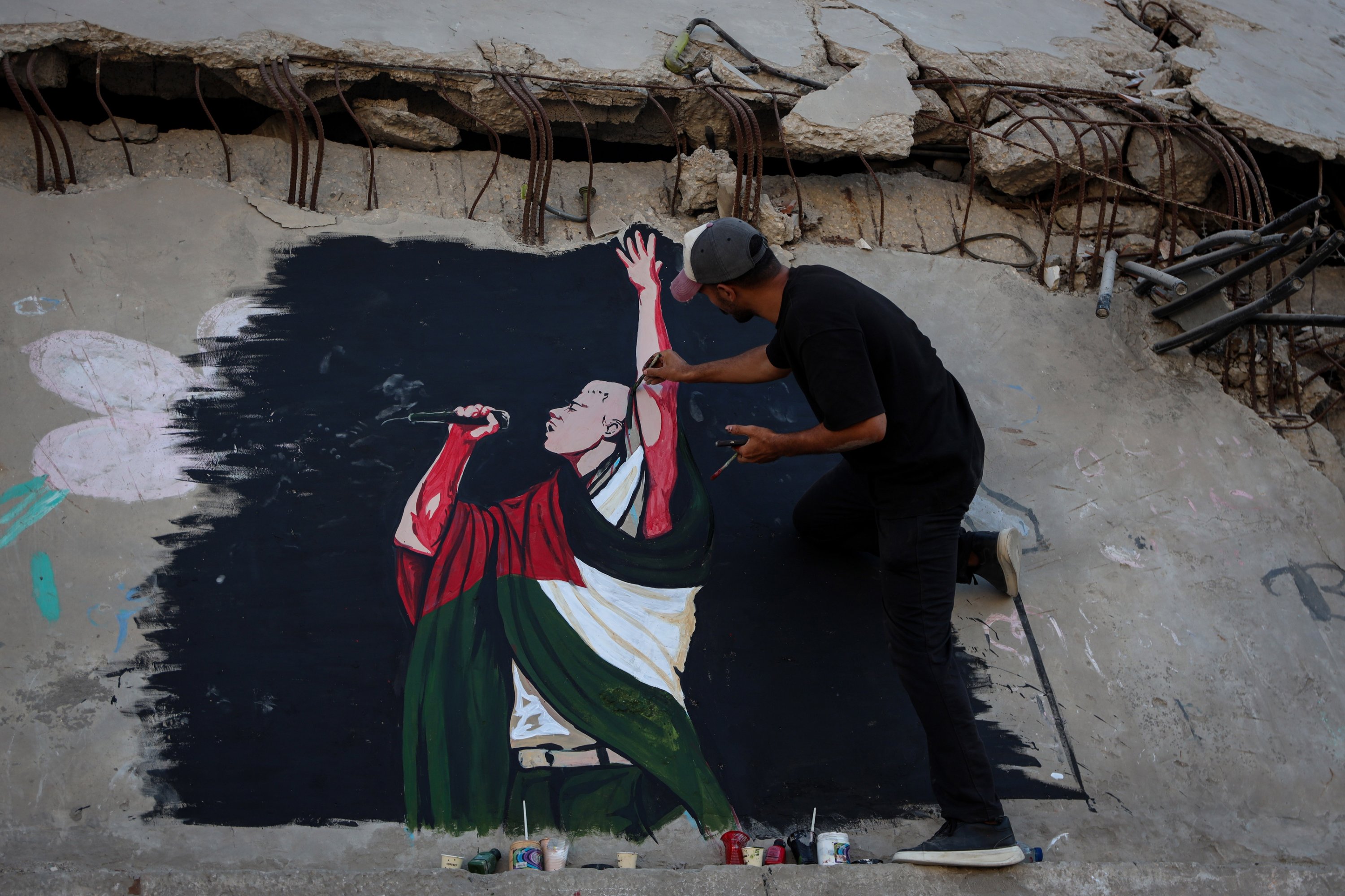
Even though popular culture is conventionally, if not banally, criticized as a sphere of pacification and consumerism, it is a battleground for culture wars under the surveillance of the guardians of cultural and political economy. Macklemore’s cry of “free Palestine” on Ed Sheeran’s tour reveals as much, and also how it is governed through the techniques and instruments of control and discipline. So-called escapist popular culture is inescapable: the cultural field is subject to punishment, execution and excommunication under the guise of a comfortable and easily consumable “apoliticism.”
Macklemore’s decision to speak out at the risk of excommunication, like those of Susan Sarandon, Melissa Barrera, Kneecap and many others before him, opened a breach in the wall: in the words of Roger Waters, who has himself been punished for the same cause, they were told, not in state education but in the culture industry, “If you don't eat your meat, you can't have any pudding!” But they did not comply.
Predictably, with the paternal intervention of Robert Kraft, the billionaire owner of Gillette Stadium, Macklemore was removed from the remaining eight concerts on Ed Sheeran’s tour. While Finneas, Lukas Graham, Aaron Rowe and members of Beoga withdrew in solidarity with Macklemore and refused the meat, Sheeran said the removal was the promoter’s decision and that he wanted concerts centered on unity rather than politics.
In Sheeran’s account, in line with the ordinary narrative about popular culture, a concert must be a temporary zone of nonpolitical leisure and escape, where the category “political” is defined discretionarily. Damaging the spirit of unity in the arena, Macklemore’s statement was political and therefore a disturbing, dissonant voice against conformity and the desired consensus.
Sheeran’s reason is more revealing still: “There is a reason I do not use my professional platform for politics," he said, adding, "my audience includes young people, often children, of all backgrounds.”
Children are the guardians’ word. For him, a singer who suspends the entertainment to address the audience as people capable of moral and political judgment is being irresponsible.
Demanding Macklemore’s removal, the Israeli-American Council, Pink and other critics also raised their voices, arguing that his words could make Jewish or pro-Israel people feel unsafe.
It is hard to understand why the demand for the safety of children in Gaza should weigh so much less than the health and security of Jewish and pro-Israel audiences. Their version of the responsible act, like Sheeran’s civic concern, also implies a neutral and impartial stance on the dispute. It is this civility that has granted them the privilege of ruling on “safety,” “hate,” or “professionalism.” In any case, musicians like Macklemore possess less of a right to political speech than the Israeli-American Council (IAC) or stadium-owning Zionist billionaires.
However, the more effective form of depoliticization is the replacement of its object by asking questions such as “Did Ed Sheeran have a choice?” “Is Macklemore anti-Semitic?” or “Does a venue owner not have the right to decide who takes his stage?” All these questions assume a superior position above the “political” concern for Gaza; they flatter the liberal intellectual’s pose as jurist and release him from conscious moral and political subjectivity. Sheeran’s aspiration to offer unity, joy and love instead of “free Palestine,” too, invites us to an invaluable public discussion, where what is sayable at a public event in a professional manner is decided and applied.
This is why Macklemore could not be left unpunished in the machinery of cultural silence. This machinery is older than discipline; its prehistory, for French philosopher Michel Foucault, is the pastorate. The shepherd governs each and all without the sword, and his sanction is not the censor’s ban but exclusion from the flock. The culture industry as a pastorate excommunicates Macklemore for two words, “Free Palestine,” which refuse the shepherd’s guidance, what Foucault called counter-conduct. The heresy therefore required exclusion from the material means of cultural circulation.
As excommunication is a sanction that restricts participation in sacramental and institutional life, deplatforming imposes a kind of public exile on Macklemore. Even though he retains the formal right to sing and speak, he loses access to the public sphere, where speech could become communication. As a secular heresy, dissent becomes a breach of belonging, and the punishment warns everyone who remains within the fold. A ministry of censorship is not required if agents, venues, advertisers and platforms correctly anticipate which speech will subvert the calm and peace of the flock.
The dispersed economy of sanction, however, can extend even to the carceral edge. If the cost is money and brand deals for Macklemore, a citizen, for the non-citizen and the colonized, the instrument may become the terrorism charge. Wealth and citizenship can leave an artist with losses he can survive, but someone without those protections may confront a detention cell. From a reposted Instagram story to the immigration detention cell, the variable determining which instrument applies is the speaker's proximity to whiteness, wealth and citizenship, and his distance from Gaza.
In "Perfect Victims: And the Politics of Appeal," Mohammed El-Kurd points out how Western intermediaries and anti-Zionist Jewish or Israeli validators are required for the recognition of the suffering in Gaza, within an epistemic hierarchy in which Palestinians’ capacity to produce their own knowledge and speak their own language is denied. Macklemore is such a validator, audible because of the hierarchy El-Kurd indicts, and his excommunication closes even that mediated channel. At the bottom of that hierarchy stood the poet and scholar Refaat Alareer, who was murdered on Dec. 6, 2023, in Gaza. He was the co-founder of "We Are Not Numbers," a nonprofit organization committed to fostering “a new generation of Palestinian writers and thinkers” and opposing the reduction of the stories of Palestinian individuals to mere statistics.
Macklemore is an illuminating limit case precisely because the sanction against him stopped at money and the stage, while structurally identical speech cost Palestinian writers and journalists their lives. Grateful to Macklemore and praying for Alareer and all the martyrs and those who still suffer in Gaza.
We should recall Omar El Akkad’s words: “one day, when it’s safe, when there’s no personal downside to calling a thing what it is... everyone will have always been against this.” Excommunication helps prepare that future. Those who speak while opposition still carries a cost are pushed out; their convictions can be welcomed back once they cease to inconvenience anyone. There is no such readmission for the dead. Solidarity cannot be discharged by tomorrow’s declarations of innocence. Macklemore’s excommunication leaves a question: what kind of communion makes silence about Palestine the price of belonging?