“If I had influence at the United States Treasury, I would not lend a penny to a single one of the present governments of Europe.” If it were U.S. President Donald Trump who had directed these words at European countries that are members of the Minsk Group, and have failed to bring peace to the Caucasus in 30 years, it would hardly be surprising in today’s world. Yet this statement is, in fact, a quote from British Economist John Maynard Keynes’ 1920 book “The Economic Consequences of the Peace,” and it remains strikingly relevant to the Caucasus’ present reality. The region, long a stage for conflict and geopolitical rivalry for over a quarter of a century, now stands at a historic turning point.
The U.S.’ role in the Caucasus conflict dates back almost as far as the conflict’s own history. The U.S. served as one of the co-chairs of the Organization for Security and Co-operation in Europe (OSCE) Minsk Group, established in 1992 during the First Karabakh War. However, American efforts to bring Azerbaijan and Armenia to the negotiating table for peace are largely a product of the new century. In this context, on April 3-6, 2001, the U.S. organized talks under the OSCE Minsk Group framework at the Presidential Palace on Key West Island, Florida. Although these negotiations did not yield significant results at the time, the choice of Key West carried symbolic significance. This venue was selected at the initiative of the U.S. Special Negotiator for Nagorno-Karabakh, Ambassador Carey Cavanaugh.
The primary reason for the failure of this initiative was the U.S.’ position at the time. It was influenced in part by the Armenian lobby within the country, which favored Armenian nationalism rather than pursuing a balanced resolution. As in many other parts of the world, the U.S. was in clear competition with Russia in the Caucasus; however, its stance at that time was far removed from rational self-interest. How, then, can one explain the U.S.’ demonstration of a will toward resolution after nearly a quarter of a century?
Washington’s sudden emergence as a key player in resolving the Caucasus issue, after having long remained distant from the region’s problems, is directly linked to both its domestic and foreign policy dynamics. A hegemon’s interest in regional conflicts is not always as benign or peace-oriented as it is often portrayed. As Foreign Minister Hakan Fidan aptly remarked, “If you wait for the hegemon, the hegemon comes, lays down the law, gives you none of the results you wanted, takes what it came for, leaves you with more problems than you had before, and walks away.” In this regard, it is necessary to approach the issue from the perspective of the U.S.’ own strategic agenda.
The first reason behind the sudden presentation of the U.S. as a peacemaker in the Caucasus lies in Trump’s desire to consolidate the image of a “president who will end wars,” a key element of his election campaign. Although Trump has failed to end two major conflicts he claimed he would end, namely the Russia-Ukraine war and the Israeli-Palestinian conflict, he views the Caucasus peace as another opportunity to serve his political agenda.
The second reason for Washington’s transoceanic engagement with the issue is the shifting geopolitical balance. Trump seeks to position the U.S. within a framework that would contribute to the erosion of Russia’s century-old influence in the region. At the same time, the matter is also significant in the context of competition with its traditional rival, China. Beijing perceives the prospective Zangezur Corridor, a likely outcome of a Caucasus peace settlement, as a strategic threat to its Belt and Road Initiative. The U.S., by contrast, envisions benefiting from the corridor’s economic potential. From this perspective, U.S. involvement in the Azerbaijan-Armenia peace process serves its own geopolitical and economic agenda far more than it serves the stability of the region.
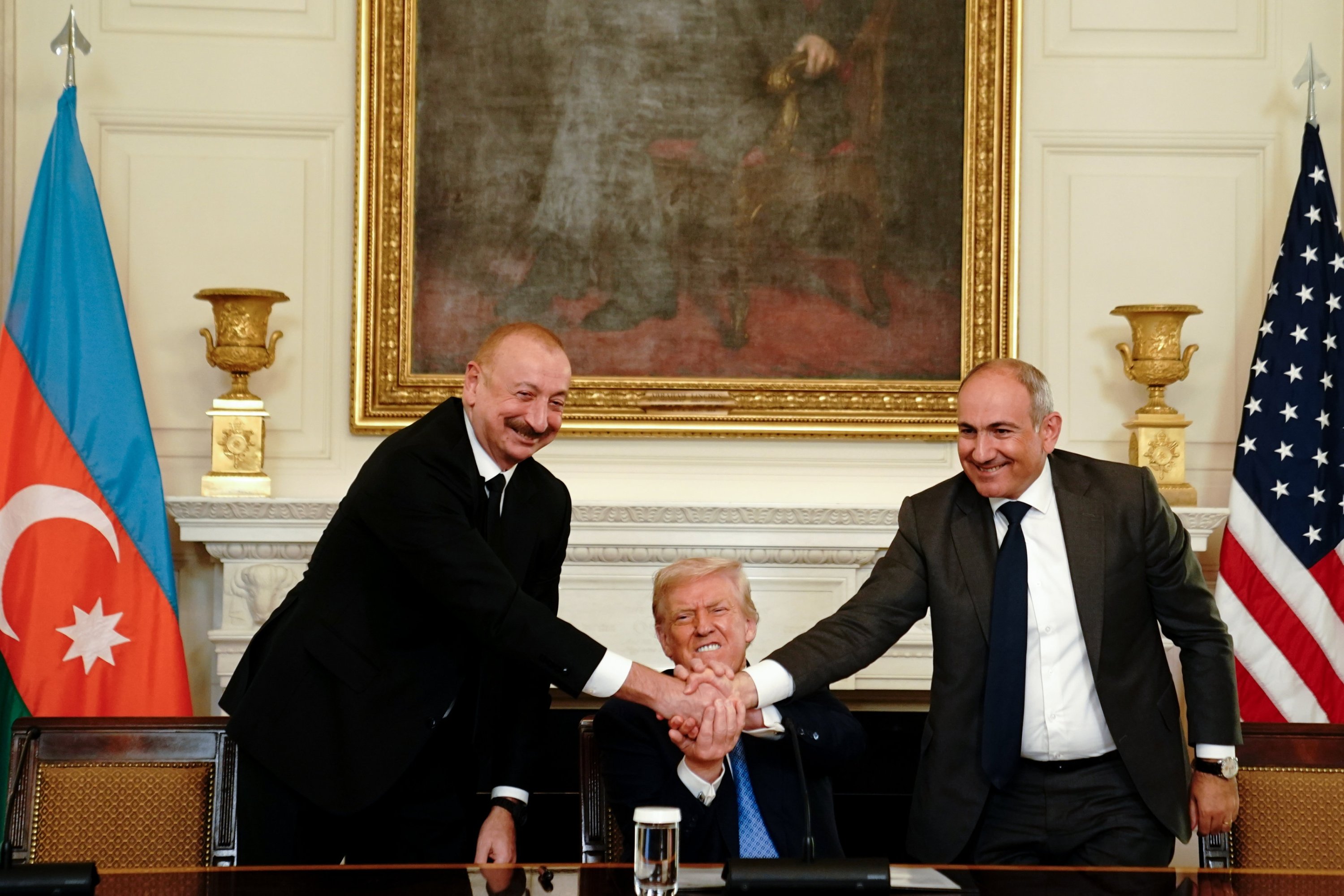
On Aug. 8, 2025, in Washington, D.C., the landmark agreement was signed by U.S. President Donald Trump, Azerbaijani President Ilham Aliyev and Armenian Prime Minister Nikol Pashinyan. The agreement contains striking provisions, including the establishment of diplomatic relations between Baku and Yerevan, the dissolution of the OSCE Minsk Group, and the construction of the “Trump International Peace and Prosperity Route” (TRIPP) through the Armenian segment of the Zangezur Corridor. Under the agreement, the U.S. will work jointly with mutually agreed third parties to develop a framework for this connectivity project. In this context, it is entirely natural that one of these third parties will be Türkiye.
The international community widely recognizes that Türkiye has been the key actor in paving the way toward resolving the Caucasus conflict. Azerbaijan’s restoration of its internationally recognized borders after the Second Karabakh War was made possible through Ankara’s military and diplomatic support. Therefore, it is unrealistic to suggest that the Aug. 8 agreement took place without Türkiye’s knowledge or consent. The fact that, only 20 days earlier, President Recep Tayyip Erdoğan had received both Aliyev and Pashinyan separately underscores the coordination behind the outcome.
For Türkiye, the signing of the agreement in the U.S. poses no problem; on the contrary, it is considered a diplomatic success, as it prevents Ankara from coming into direct confrontation with Russia and China. The Ministry of Foreign Affairs’ immediate statement of satisfaction and the phone call between Erdoğan and Aliyev the following day further demonstrate this support. Nevertheless, for both Azerbaijan and Türkiye, the foundation of lasting peace remains power — the only enduring currency in international relations.