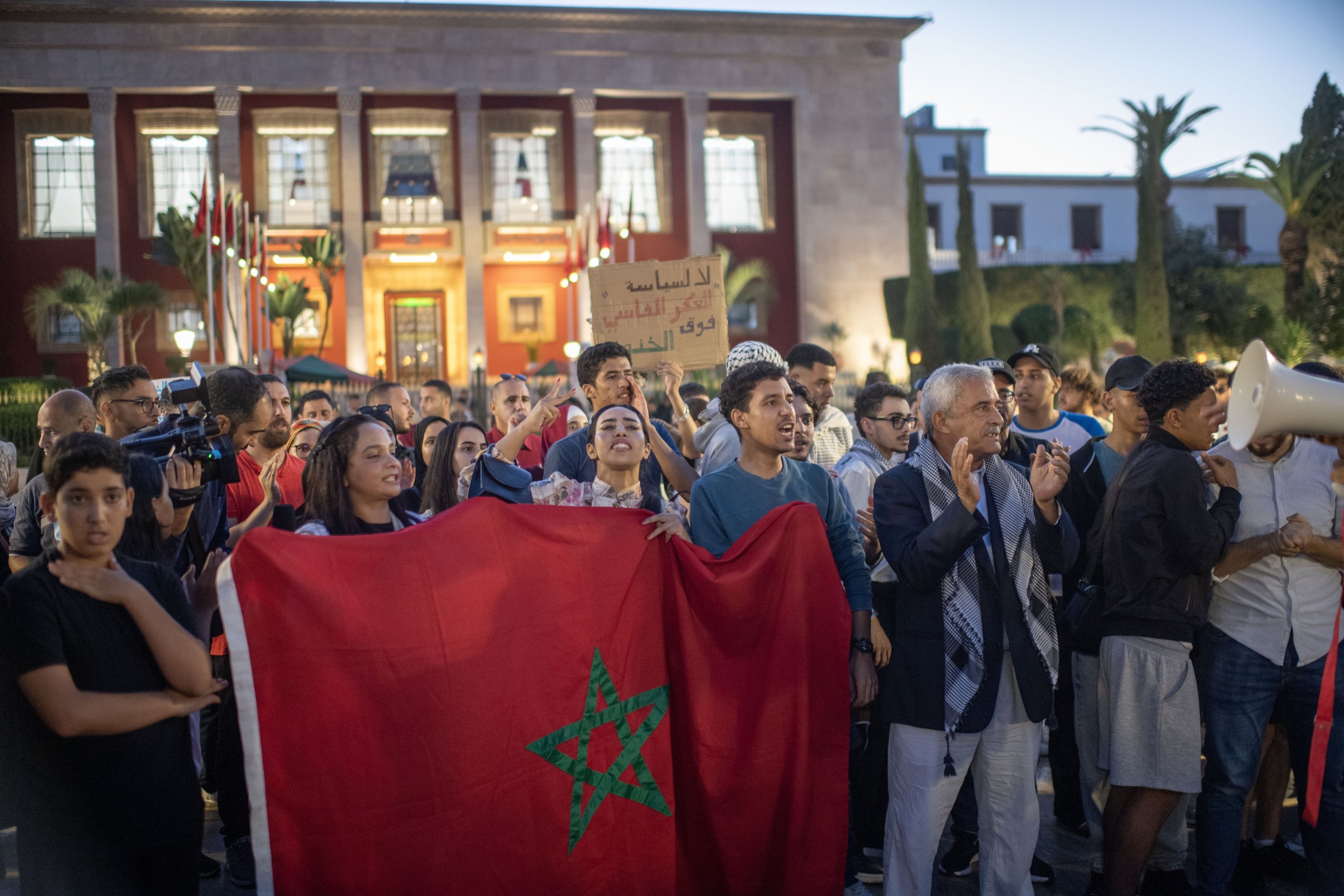
Youth has a voice, and no matter what the elders or the governments may do, whether they try to silence it in good or bad faith, whether they build barriers and walls against its ambitions, it always finds a way to be heard.
In 2019, the supporters of Moroccan football club IR Tanger made the stadiums tremble with a song that, in a few lines, encapsulated the pain of Moroccan youth in particular and of Arab youth in general: "This Is the Land of Injustice" ("Hadi Blad el Hogra").
A song born spontaneously from the hearts of the young, written and sung with passion and anguish. It shook the stands, but, alas, failed to stir the authorities. And so the youth continued to wander, seeking life beyond the Mediterranean, only to find death in its waters.
Today, youth protests in Morocco have reignited. Many are unaware of the actual cause of this anger. No, it was not sparked by Morocco’s joint hosting of the 2030 FIFA World Cup alongside Spain and Portugal. What reignited the flame of protest was a tragedy: The death of eight pregnant women in a public hospital in Agadir. Eight pregnant women, an unspeakable horror.
From that moment, young people took to the streets to demand reform of the health and education systems.
Certainly, the announcement of the World Cup added fuel to the fire, and the youth are right to ask: Are we not more deserving of these funds than the stadiums and the turf?
No one doubts that the World Cup will bring economic and tourist benefits to the country, investment gains, as well as promised improvements in health care, security, transportation, housing and lasting infrastructure for future generations.
On Dec. 4, 2024, the president of the Royal Moroccan Football Federation, Fouzi Lekjaa, declared that a rehabilitation program would be launched to include cities not hosting World Cup matches; that it would aim to modernize hotel and commercial infrastructures, strengthen and upgrade health services, develop communication networks and deploy a large-scale training plan for young talents.
But it seems these promises have remained mere ink on paper. Once again, ministerial statements have focused on developing the tourism sector, yet an economy cannot stand on tourism alone. Reality is stark: one in four young Moroccans aged 15 to 34 is unemployed. Do we need more evidence to acknowledge the failure of public policies?
The same minister also announced that Morocco would build the largest stadium in the world, with a capacity of 115,000 spectators, in preparation for the 2030 World Cup. History, however, offers its warnings.
In 1987, the Syrian Arab Republic, then led by former President Hafez Assad, hosted the Mediterranean Games. It was an era of dictatorship and, for those who might have forgotten, the stench of blood from Palmyra (1980) and Hama (1982) still lingered over the country crushed under one of the most brutal and sectarian regimes in the world.
Assad built stadiums and deployed propaganda extolling the “great benefits” these games would bring to the nation. What remains today of those infrastructures? Nothing, nothing but empty concrete shells, symbols of a political mirage.
Of course, the comparison between 1980s Syria and today’s Morocco would be exaggerated. Yet, the recent demonstrations in several Moroccan cities are not isolated incidents; they are the natural outcome of deep social and political accumulations left unresolved.
Moroccan youth, particularly Generation Z, have raised slogans demanding that responsibility be inseparable from accountability. They call for officials to be held accountable for the chronic dysfunctions that plague public projects and programs. In their view, local authorities bear direct responsibility for the decline in living conditions. Promised projects remain mere words on paper, while the embezzlement of public funds continues with almost mafia-like regularity.
An attentive observer will notice that protesters address the government in general terms. In reality, citizens, especially the youth, make little distinction between government, Parliament, local councils, public institutions, or political parties. To them, all these entities merge into a single concept: the state. Thus, the current protests do not target the government alone, but all those who manage public affairs, particularly at the local level.
In short, what is happening today in Morocco is the uprising of a youth demanding reform, social justice and the revitalization of key sectors: Education, health and employment.
It is worth recalling that protests in Morocco have never truly ceased since the Arab Spring of 2011, which gave rise to the Feb. 20 movement, which compelled the king to amend the constitution and call early elections. Since then, sectoral and professional demonstrations have continued.
But the Generation Z protests seem to revive the spirit of Feb. 20, through the youthfulness of their participants and their national momentum.
The Moroccan monarchy, for its part, faces no immediate threat. It enjoys historical legitimacy and deeply rooted popularity. Its place in the heart of the people is not unlike that of the British or Japanese monarchies: An ancient institution, guarantor of national unity, and pillar of state continuity.
Even in their most radical form, popular demands do not go beyond the aspiration to a genuine constitutional monarchy, one in which the king reigns but does not govern, serving as a symbol of the state rather than an active political authority. In other words, it is a call for the further democratization of the monarchy and a rationalization of its political conduct.
Traditionally, the Moroccan monarchy has preferred to concede, sometimes symbolically, certain reforms, rather than resorting to excessive repression, unlike authoritarian military regimes incapable of any genuine concession. Perhaps because it possesses a reservoir of legitimacy, it wishes not to squander by bequeathing grudges and resentments that could one day threaten the dynasty itself. In this, its behavior is reminiscent of Oman’s monarchy during the 2011 uprisings.
Let us not forget that the first spark of the Arab Spring was ignited by a street vendor, an ordinary man seeking nothing more than the right to earn his daily bread, denied to him by the arbitrariness of a police officer.
The demands of Moroccan youth are clear: Dignity and a fight against corruption. The protests, despite some isolated acts of vandalism or looting, remain overwhelmingly peaceful and civic-minded.
In education, for example, the National Teachers’ Union has recently warned of mounting social tension in public schools, the result of government policies that deepen inequalities and undermine public education. It has called for a deep and structural reform of the public education system; the restitution of rights for employees penalized by promotion delays; the improvement of teaching conditions and the end of pedagogical neglect; respect for trade union rights and an end to restrictions on union activists.
In short, it calls for the protection of public education, the defense of teachers’ rights, and the rejection of policies of progressive dismantlement.
An open, sincere national dialogue with youth about employment, education and the future of political participation is urgently needed. Ignoring their voice or attempting to silence it will only widen the gap between the state and society.
The question today is not whether the protests will continue or when they will end, but rather, when those in power will grasp the message and act. To act, not merely to talk. The time for dialogue has passed. The problems and solutions are both known. What remains is action: To implement reforms and turn the countless official promises into a tangible reality.
Shortly after I wrote these lines, the king of Morocco, in his Friday speech, urged the government to accelerate development programs, particularly in education and health. Yet, he made no explicit mention of Generation Z or their protests, remaining silent on their calls for the resignation of the prime minister.