In ancient Greek mythology, the Titan Atlas was condemned to bear the weight of the heavens forever, unable to set it down without catastrophe. Modern France resembles this figure: burdened by its self-image as a beacon of civilization, yet too fragile to sustain the illusion. Unlike Atlas, however, France’s trembling is self-inflicted, born of decades of political delusion and fiscal decay.
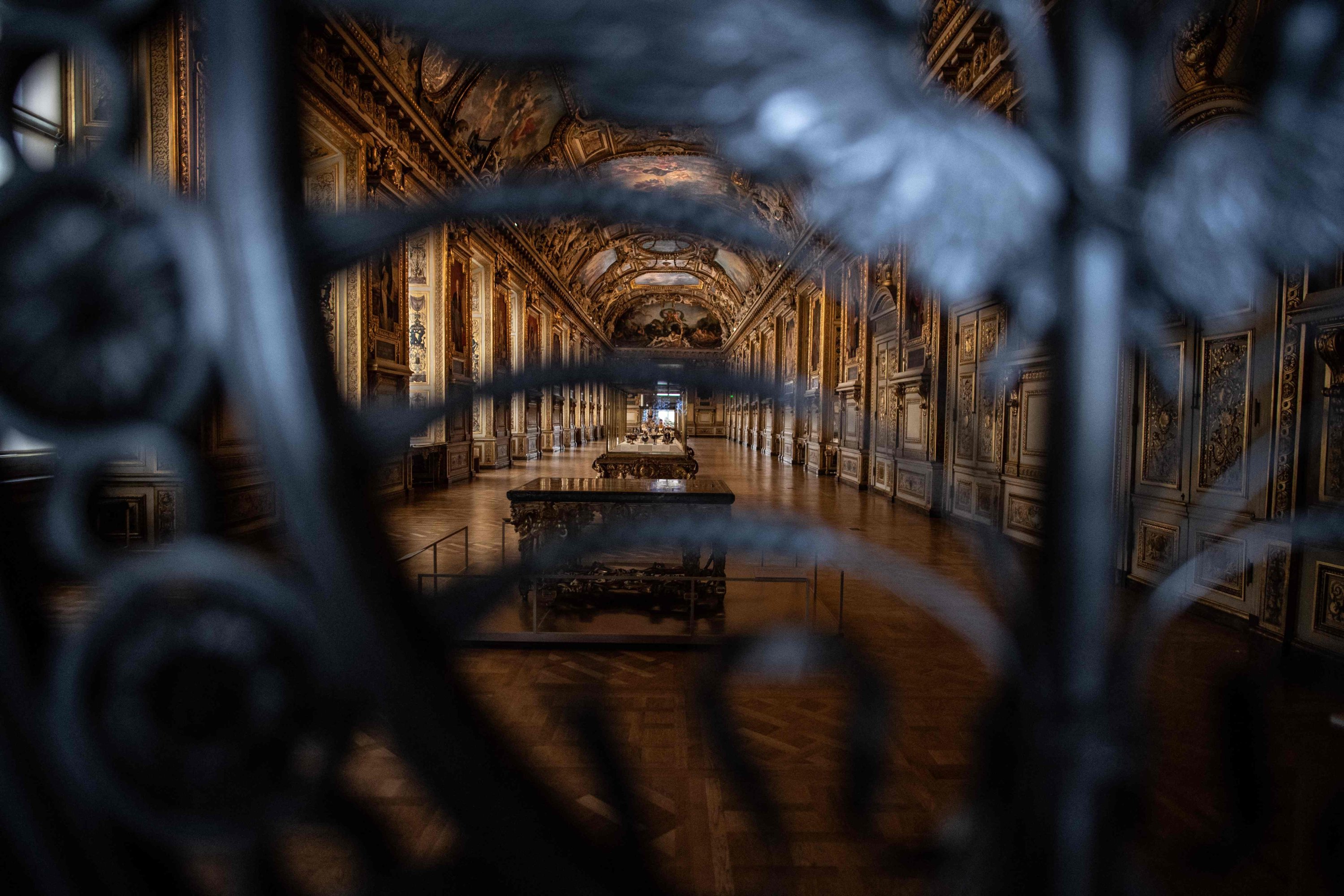
The recent security breach at the Louvre, where thieves raided the Galerie d’Apollon and stole jewels once belonging to France’s imperial dynasties, is more than a museum scandal. It is a metaphor for a nation unable to protect what it claims to hold sacred.
Among the missing treasures were the emerald necklace and earrings of Empress Marie-Louise, brooches of Empress Eugenie, and the sapphire sets of Queens Marie-Amelie and Hortense, those objects that once adorned Europe’s royal courts and embodied France’s imperial grandeur. The crown of Empress Eugenie, glittering with more than 1,300 diamonds and 56 emeralds, was later found discarded and damaged near the Seine, a poignant image of a civilization clinging to the fragments of its past glory.
The Apollo Gallery itself was designed in the 17th century for Louis XIV as a shrine to royal power, later becoming the display hall for the nation’s crown jewels. That this gallery, the symbolic heart of French heritage, could be violated in broad daylight underscores the fragility of the institutions built upon it. Just as the Louvre’s defenses proved outdated against modern thieves, France’s political architecture, designed for an earlier era of stability, now crumbles under contemporary pressures.
The heist is therefore not merely about missing diamonds, but about a republic stripped of its illusions, unable to safeguard either its treasures or the myth of exceptionalism that once defined it.
For decades, the French model, where six-week holidays and a 35-hour workweek were treated almost as birthrights, rested on increasingly unstable economic foundations. Behind the façade of prosperity, fiscal indiscipline and stagnant productivity have hollowed out the state’s capacity to deliver. The Louvre’s violation thus becomes an emblem of a deeper malaise. France’s institutions, once models of republican discipline, now buckle under their own contradictions. Public debt interest payments have quadrupled since 2018, surpassing 100 billion euros annually – four prime ministers in 20 months; a National Assembly paralyzed by ideological deadlock. What remains is not governance, but managed decline draped in republican rhetoric.
At the center of this crisis stands Emmanuel Macron, the self-styled centrist reformer who promised to transcend ideology but instead presided over political fragmentation. His Renaissance party, lacking social roots or ideological coherence, has become an empty vessel drifting with public sentiment. Macron’s presidency, once framed as pragmatic and modernizing, now looks like opportunism masquerading as balance. His attempts to reform pensions and labor markets have provoked widespread unrest, while his appeal to “stability” rings hollow in a country that has experienced five governments in three years. France’s political center, once its pride, has collapsed into a vacuum of authority.
Into this vacuum steps France's far-right politician Marine Le Pen. While Macron plays chess with phantom pieces, Le Pen’s Rassemblement National has positioned itself as the voice of the disillusioned. Her message to defend public services, strengthen borders and restore dignity resonates with a society weary of elite detachment. That her fiscal promises are implausible matters little. In the emotional politics of contemporary France, resonance outweighs realism. Le Pen is no longer a protest candidate; she is becoming the permanent alternative, a prospect that exposes how far France’s republican mainstream has eroded.
The immediate trigger of the current crisis captures France’s descent into farce. On Oct. 6, Macron appointed his ally Sebastien Lecornu as prime minister. Within hours, Lecornu resigned after his first cabinet announcement collapsed. A week later, he returned with a second line-up, France’s fifth government in three years.
This cabinet of 34 includes not only Macron loyalists and center-right figures but also eight technocrats from civil society. Among them: Paris prefect Laurent Nunez as Interior Minister, SNCF director Jean-Pierre Farandou as Labor Minister and former WWF France director Monique Barbut as Environment Minister. Competent administrators, perhaps, but unelected and unaccountable.
This technocratic turn underscores France’s deep democratic deficit. When political leaders cannot govern, power shifts to bureaucrats, governance by executive decree disguised as pragmatism. Even before a vote of confidence, Lecornu’s cabinet faced motions of censure from both the far right and the far left, with Socialist deputies also hinting at rebellion. New legislative elections appear increasingly inevitable, threatening to plunge France into deeper paralysis.
Unable to stabilize the homefront, Macron increasingly turns outward. His recent efforts to support Palestine, though framed as moral leadership, may serve more as a distraction than a conviction. Foreign policy has become his stage for legacy, a way to deflect from domestic impotence. But diplomatic theatrics cannot conceal France’s institutional exhaustion.
The parallel with the Louvre deepens. Just as the museum’s outdated security failed to confront modern threats, France’s Fifth Republic, which was designed for stable party systems, is buckling under today’s fragmented politics. The result is chronic instability: governments too weak to govern, parties too divided to cooperate, and citizens too disillusioned to care.
The Louvre will recover from its breach; security systems will be upgraded, investigations will be concluded, and tourists will return. France’s political crisis, however, offers no such easy fix. The actual theft has not been of art but of trust, the social contract that once bound citizens to their institutions.
When a country that defined modern democracy cannot maintain a government for six months, when the state that built Europe’s welfare model teeters on the brink of insolvency, and when its cultural sanctuaries are violated with ease, the symbolism is impossible to ignore. France is no longer the confident republic it imagines itself to be. It is a weary power confronting the limits of its exceptionalism. What emerges from this reckoning may be less glamorous but more honest: a France stripped of illusions, forced to reconcile grandeur with reality.
Whether this becomes a wake-up call for renewal or an epitaph for the Fifth Republic remains to be seen. But one thing is clear: the old model of cultural prestige masking economic and political fragility is over. The Louvre has fallen, and with it, the myth of French invincibility.