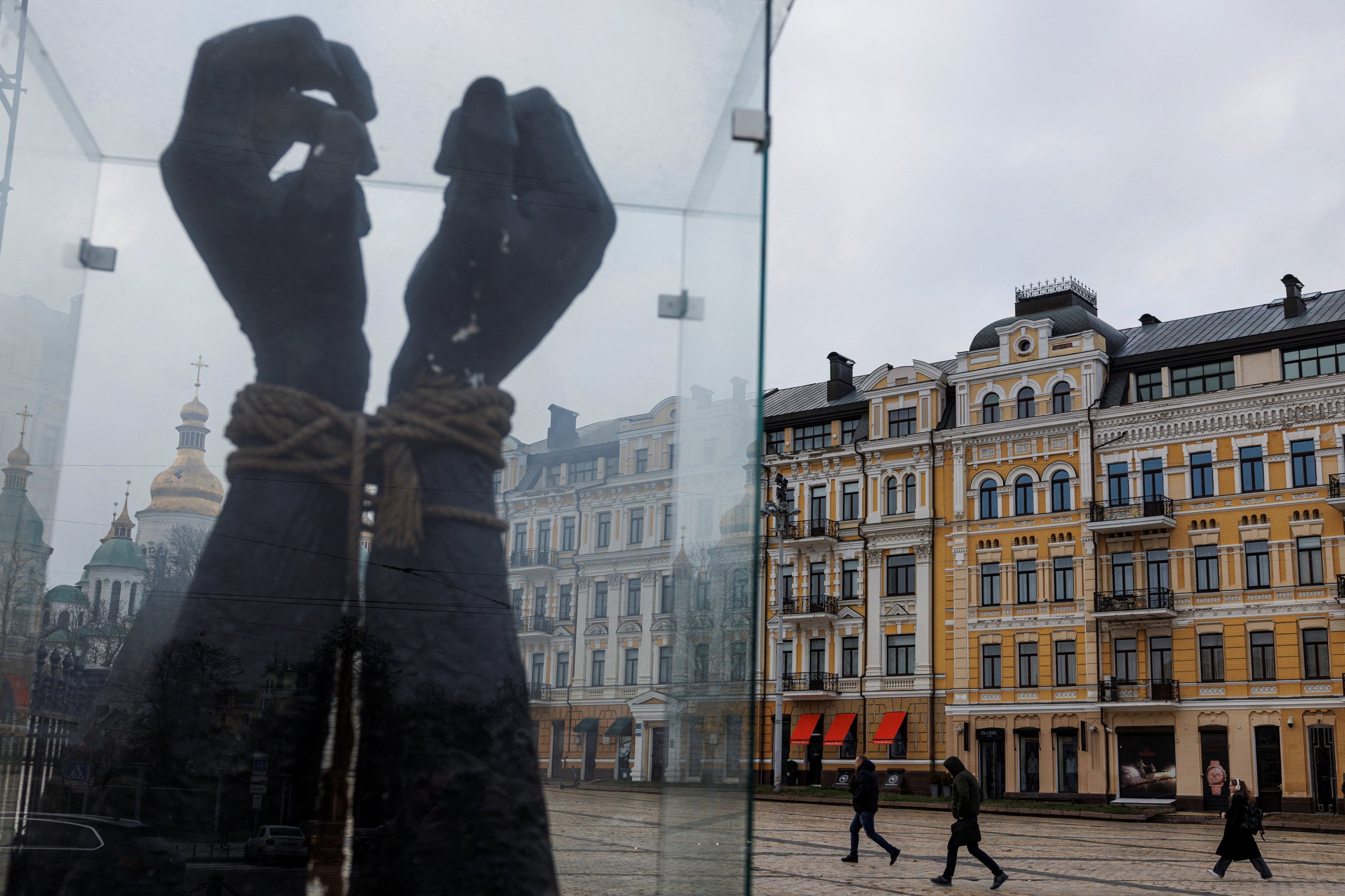
As the Greek dramatist Aeschylus famously suggested, “The first casualty of war is the truth.” When reality collapses, justice collapses alongside it, and any fracture in justice inevitably reshapes the future. U.S. President Donald Trump’s 28-point peace proposal is built precisely on this erosion of reality. The war’s inherent distortions, shifting power balances, weakened norms and suspended legality underlie the plan’s geopolitical architecture.
Geography does not start wars; yet the nature of war and the structure of peace are almost always determined by the power embedded in geography itself. The Russia-Ukraine conflict is a clear example. The geopolitical weight of Donbas, the strategic finality of Crimea, the centrality of the Black Sea in energy and connectivity, and Europe’s structural vulnerabilities have collectively defined both the war’s trajectory and the posture of the actors at the negotiating table.
Although Trump’s plan has not been fully disclosed, U.S. Special Envoy to the Middle East Steve Witkoff’s Moscow-Istanbul diplomacy, strategic leaks from the Trump team, and Russia’s openly articulated demands provide a coherent framework for understanding the intended architecture of the 28-point proposal. This interpretation is hardly misguided. It is based on Russia’s cold strategic calculus, and Trump’s power-centric approach confirms it. This issue brings us to the essential question: “What happens next? How will the battlefield shape the political architecture at the table? Moreover, how realistic is the implementation of such a plan?”
When Trump assumed office, it would not be inaccurate to argue that Russian President Vladimir Putin quickly recognized the widening trans-Atlantic rift and sought to turn it into an operational advantage. From 2017 onward, Trump’s core foreign policy narrative consistently emphasized that the U.S. would “no longer shoulder Europe’s security burden.” His repeated characterization of NATO as “a free-riding structure dependent on U.S. power” signalled a profound shift in Washington’s traditional commitments toward Europe.
Although today U.S.-Russia relations are predominantly interpreted through the lens of the Ukraine-centered confrontation, a significant segment of the American strategic community increasingly holds that “the real long-term threat is China, while Russia remains a secondary actor.” This perception has encouraged a geopolitical logic in which selective rapprochement with Russia, while positioning Ukraine as a negotiable variable at the bargaining table, is seen as strategically acceptable.
After 2025, this tendency became even more pronounced. The Trump team has reframed the deepening crisis within trans-Atlantic relations as a geopolitical asset. Simultaneously, the global competition for rare earth elements and the ongoing semiconductor crisis have reshaped the U.S.' strategic priorities. By creating a framework conducive to “great-power bargaining with Russia,” the Trump team has ensured that the 28-point proposal is not merely a peace negotiation document. Instead, it represents a broader attempt to redefine the global balance of power, recalibrate the positions of major actors, and reshape the parameters of geoeconomic competition.
Trump’s 28-point outline is neither merely a peace proposal nor merely a geopolitical project. It is the byproduct of an asymmetric battlefield, divergent security perceptions, and great-power bargaining. There are three structural realities: First, the more Russia advances on the ground, the more assertive its demands become at the table. This validates the pro-Russia tilt embedded in Trump’s framework. Second, Ukraine is losing its manoeuvrability due to war fatigue and economic exhaustion. The collapse of “reality” is most visible here. Last, the widening trans-Atlantic divide weakens Europe’s influence. This issue may increase the plan’s feasibility but undermines the durability of any peace settlement. So we can say that this is not a blueprint for a just peace but a framework for the only peace the current power structure can realistically produce.
Today, Ukraine has increasingly become a strategic bargaining variable rather than an autonomous actor. The primary reason for this assessment lies in the explicit focus areas of Trump's 28-point framework, which collectively reduce Ukraine's geopolitical agency and relegate its security concerns to the background.
The first component of the plan is the permanent limitation of Ukraine's military status. In this context, NATO membership is definitively closed to Ukraine, its military size and armament capacity are restricted, and Western security guarantees are rendered ambiguous and conditional.
The second component is the territorial negotiations, implicitly framed in Russia's favor. This includes the de facto recognition of Crimea as Russian territory, the redefinition of the Donetsk-Luhansk line to consolidate Russian control, and the deliberate designation of Odessa as a "open for future negotiation" grey zone. These provisions erode Ukraine's territorial integrity not only legally but also strategically.
The third component is the exclusion of Europe from the post-war political architecture. Neither the EU nor major European capitals are included in the negotiation framework. As a result, the future of the conflict is being reconfigured along a U.S.-Russia axis, effectively sidelining the key stakeholders of the European security architecture. The ongoing discourse surrounding the 28-point proposal necessitates a careful and nuanced analysis of its potential ramifications. This proposal appears to facilitate the consolidation of Russia’s strategic advantage, concurrently undermining Ukraine's security landscape. Furthermore, it may significantly diminish the influence of European nations in establishing the post-conflict order.
In principle, it is often said that “even the worst peace is better than war.” However, not every peace constitutes a just or equitable peace. The central question here is whether the 28-point framework can truly produce a fair, sustainable, and future-oriented political order. Such a model of peace would merely freeze the current conflict while generating new zones of confrontation, deeper vulnerabilities and long-term security dilemmas.