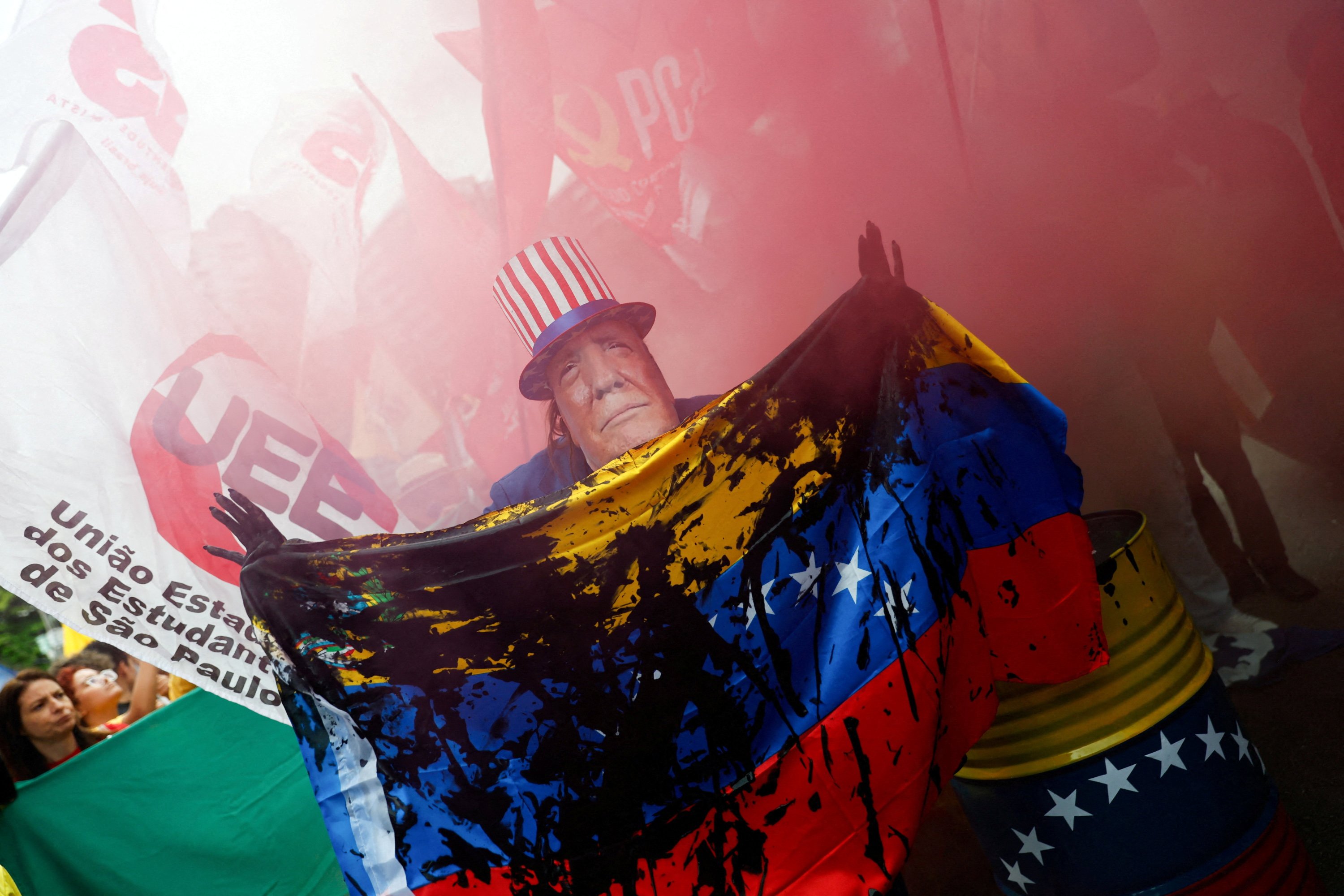
U.S. President Donald Trump described on Fox News his conquest of Venezuela and the abduction of President Nicolas Maduro as an “incredible thing of letting somebody else take over” – in other words, a regime change operation. He was audibly enthusiastic about it, openly saying, “If we have to do it again, we can do it again, nobody can stop us.” Many of his followers, as well as a large number of his supposed opponents, similarly indulged in hubris, the former group frequently invoking the imperial Monroe Doctrine as justification, as if it were divine law, or had any moral basis, however loose. A close associate of Trump’s, incidentally the wealthiest individual in the world, Elon Musk was so ecstatic that immediately after the event, he embarked on a crusader’s mission to personally write on his platform to each and every head of state that he would love to see overthrown like Maduro. For example, to Colombian President Gustavo Petro, who had condemned the U.S. action, Musk responded in Spanish, basically asking him whether he would take the “bribe” and flee, or rather stay and get killed.
Indeed, as shocking as it may be, killing has been a recurrent theme in the discourse. For instance, in his characteristically brazen and fairly explicit threat to Maduro’s Vice President Delcy Rodriguez, Trump warned that, “if she doesn’t do what’s right” (meaning, if she doesn’t accept Trump’s terms), “she is going to pay a very big price, probably bigger than Maduro.” Self-styled “American nationalists” and “chauvinists” applauded Trump for this boldness, entirely dismissing its moral implications, as predicted. Legality was really never worth thinking about for them.
Yet, in Europe, even someone like Reform U.K. leader Nigel Farage, who is customarily associated with the “far-right” in Britain, had to identify the illegality of the action at least, though, to be sure, he was not bothered by it even a little bit. He called it “unorthodox and contrary to international law,” insisting, however, that, still, “it may be a good thing.” With this tacit endorsement, was Farage questioning in the abstract the relation between legality and morality? What was his moral evaluation of the matter, then? In any case, he certainly showed greater respect for international law than British Prime Minister Keir Starmer did. At least Farage recognized the illegality of the action, whereas Starmer has been ridiculously evasive in his comments so far, despite his much-celebrated credentials as a “world-renowned human rights lawyer.”
Starmer’s duplicate in France, or really the original, President Emmanuel Macron, did not feel even slightly uncomfortable about the “unorthodox” ousting of Maduro, however. He wholeheartedly welcomed the news and wasted no time discussing its legal or moral basis. The symbol of the European liberal center, Macron, aligned himself with Trump not out of love, but out of fear and, to some degree, for the sake of their mutual interests. In contrast, the most popular “far-right” figure in France and indeed across continental Europe broadly, Marine Le Pen, not only acknowledged the illegality of the invasion, but also condemned it, putting her liberal haters in their place.
Although appeals to international law in this context transcended ideological boundaries, as clearly seen in these examples, they have been utterly futile and meaningless nonetheless. And how could they not be? To begin with, Maduro was charged under U.S. domestic law. Specifically, he was charged with the crime of possessing machine guns, among other things. (It would be a shame if Maduro did not cite the Second Amendment of the U.S. Constitution in his defense.) In these circumstances, how can Maduro be expected to take the rule of law seriously? This episode leaves behind a simpler residue, namely, a public record in which threats are celebrated, killings are joked about, and senior decision-makers sound like spoiled children who got their hands on the toys they have always wanted badly. That record will outlive both Trump and Maduro, however, and it will be read closely elsewhere.