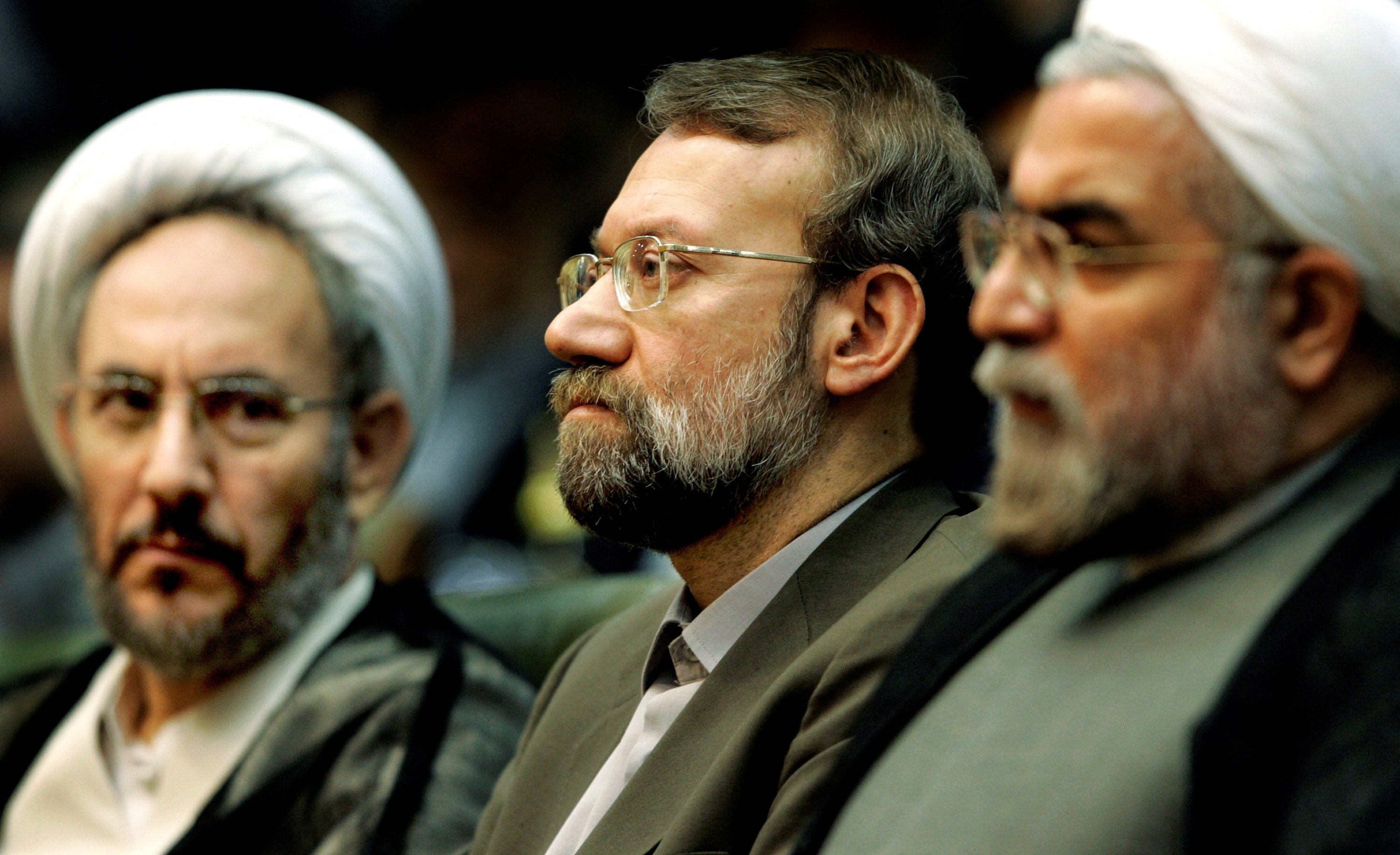
The media accounts of the assassination of Ali Larijani, a top commander within the Islamic Revolutionary Guard Corps (IRGC), conceal a profound intellectual paradox in his life. Reading even a brief biography of Larijani would shatter the one-dimensional portrait shaped by stereotypical narratives. Larijani was not a misguided fanatic nor an extremist as he was systematically depicted in Western media outlets. He was a philosopher who held a Ph.D. degree with a dissertation titled "Kant's Philosophy of Mathematics." At the same time, after 30 years, by 2025, he had become the secretary of the Supreme National Security Council – and following the assassination of Supreme Leader Ayatollah Ali Khamenei, the mind that once worked on the arguments of Immanuel Kant emerged as Iran's de facto wartime leader.
Larijani knew that Immanuel Kant was not just a name on the reading list on a philosophy syllabus but a foundational figure of the Enlightenment, the philosophical pride of Western civilization. He dedicated years to Kant's philosophy and used his conceptions against the enemy. In his view, the fight was against the architects of the world system whose slogans of liberal democratic order were built upon precisely Kantian ideas: perpetual peace, cosmopolitanism and universal ethics.
This is why the story of Larijani's intellectual paradox goes beyond a radical career change, a personality disorder, or a mere ideological transformation. Larijani published three treatises on Kant while he was on duty in one of Iran's security apparatuses. However, what was striking was not his publication record but his use of Kant under unexpected conditions.
As Iran's chief nuclear negotiator, he referred to Kant's phenomenon-noumenon distinction to reframe the debate: Western “universal values” such as human rights norms, non-proliferation regimes and international law functioned as phenomena produced by a globally dominant perspective. But, from his perspective, Iran's enrichment rights were a noumenal claim, prior to and independent of what Western institutions recognize. The United Nations Security Council, for him, had no authority over that claim than a perceiving subject has over the thing-in-itself. Here, he not only borrowed Kant's vocabulary but also his logic.
In any case, his degree of academic achievement cannot legitimize the violence he contributed to Iran or elsewhere. In most of the cases, he was not a victim of philosophy education but a philosopher who researched the abstract ideas of Kant, but still chose the path of the guardianship of the revolution of his country.
This parallax view must have stemmed from a profound mistrust, not of Kantian philosophy itself, but of its function within the imperial, colonial mindset, representation and polity. His reading of Kant does not seem to be a failure of comprehension but a tragic conclusion: that in a world system dominated by Western aggression against what is nowadays called the Global South, Kant's "perpetual peace" just functions as a hollow decoration of the claim of Western civilizational superiority.
Kant's logic could be and is valuable, but its validity in the face of imperial power politics was null for Larijani. For Larijani, Kant could not determine Western political decisions; he merely provided the intellectual wallpaper for their colonial ambitions. So, he chose to be a part of his homeland's reality, proving that he can master the language of the enemy to use it as a post-mortem report for a failing world order.
And he is not alone in the region. Philosophers and intellectuals from different backgrounds have long faced the same realization that the Enlightenment's promises were never applied. Some of us ignored this paradox, carried on speculating on abstract ideals, and some others, like Larijani, conclude that if the “universal” code is a lie, then power is the only remaining language. Preferring the command of the IRGC to university lecture halls, he did not just abandon philosophy; he announced the failure of Western perception of Kantian philosophy.
If Larijani is the radical outlier for turning Kant against the liberal order, the question is what the liberal order has done with Kant in the meantime. The strike that killed him was carried out by the states that had already stopped pretending. They have already left the logic and vocabulary of universal rights and international law, which they once claimed. Larijani spent 30 years arguing that the universalist claim was a cover, and was killed at the precise moment that cover was no longer considered necessary. This leaves a question that does not have a clean answer: Who, in the end, was the more faithful reader of Kant? Larijani, or his enemies?