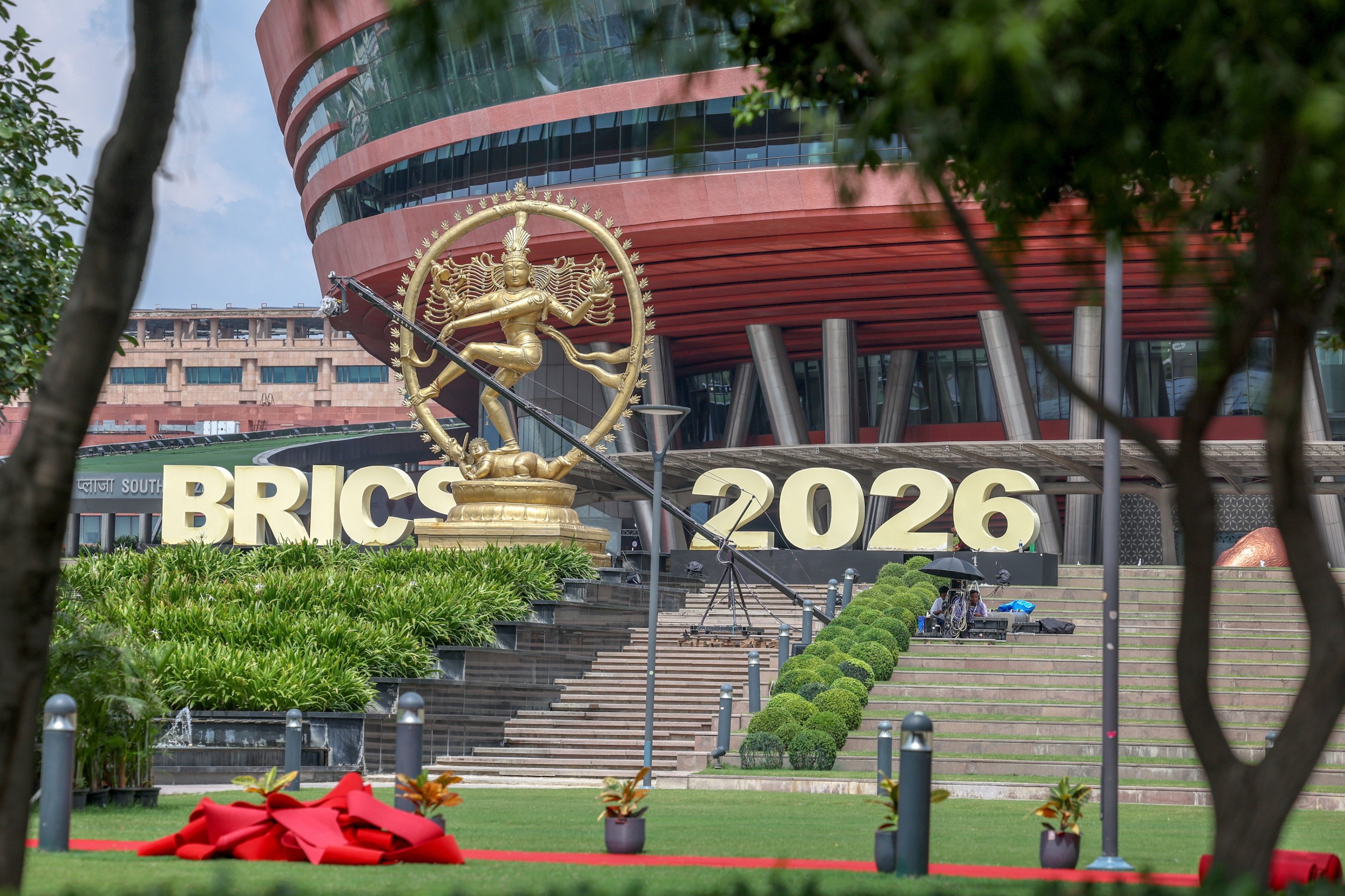
When leaders and representatives of the expanded BRICS nations gathered in New Delhi for their 18th summit on Sept. 12-13, the event drew heightened international scrutiny. The key question dominating the corridors was simple yet consequential: what unified stance, if any, could this increasingly complex bloc project?
This intense focus stemmed from a few major structural factors.
First, the bloc had stumbled significantly just months earlier in May, when BRICS foreign ministers failed to reach a consensus on a joint declaration. With the U.S.-Israel war against Iran raging, persistent reports suggested that several BRICS members pushed for a formal condemnation of American and Israeli actions as unprovoked aggression. However, others, most notably India, resolutely resisted taking such an explicitly adversarial stance.
Furthermore, the broader Iran-Gulf confrontation laid bare deep internal fault lines. When BRICS expanded in 2024, the core premise had been positive economic connectivity, fostering trade, energy flows, and cross-border investment, coupled with ambitious visions of de-dollarization. Consequently, all eyes turned to the new entrants, particularly the United Arab Emirates (UAE) and Saudi Arabia. While a degree of strategic hedging from Gulf capitals was fully anticipated, and Saudi Arabia's formal status had already turned into a prolonged saga, few foresaw the degree to which the Arab Gulf states would find themselves targeted under Tehran’s retaliation strategy. Until recently, analysts openly questioned whether the expanded BRICS could ever recover its cohesion.
Second, Washington’s strategy against Tehran hinges on the comprehensive economic isolation of the Iranian regime. The U.S. has freely deployed primary and secondary sanctions against Tehran and its commercial partners. BRICS nations have long shared a deep aversion to the weaponization of economic sanctions, frequently advocating for de-dollarized intra-group trade as a financial defense shield. Observer interest was therefore focused on whether the summit would take concrete steps toward de-dollarization, a move that carries the distinct risk of direct economic confrontation with Washington and accusations of fuelling an anti-Western agenda.
Third, observers watched closely to see if China would assume a proactive mediating role in the crisis. Beijing had previously orchestrated the landmark Saudi-Iranian normalization agreement. Yet, as that deal failed to fundamentally alter regional security dynamics and the U.S. became bogged down in Middle Eastern conflicts, China chose to maintain a cautious distance. Nevertheless, recent regional turmoil has directly threatened maritime security and vital trade lanes, jeopardizing Chinese mega-projects, including the Belt and Road Initiative. While some experts urged Beijing to adopt a more assertive posture, others pondered whether India’s preferred doctrine of strategic balance and restrained language would ultimately define the summit’s tone.
The summit provided clear answers. Indian foreign policy, anchored in strategic balance, pragmatic diplomacy, and a constructive Global South discourse, firmly shaped the proceedings. While New Delhi placed the theme "The Global South as a Re-shaper of the World Order" at the heart of the agenda, Indian diplomats worked meticulously to ensure this framework was not framed in opposition to the West. Instead, delegations emphasized redistributional equity, multipolarity, robust multilateralism, a stronger voice for developing nations, and reform of international institutions, including the United Nations. Despite New Delhi’s delicate diplomatic balancing act, U.S. President Donald Trump responded with hostility to the outcome, dismissing the BRICS nations as inherently anti-American and threatening them with punitive tariffs.
Although the summit did not conceal the deep divisions within the expanded grouping, member states successfully negotiated a joint declaration. While the document stopped short of officially condemning the ongoing war, it explicitly rejected the weaponization of economic coercion and military strikes against peaceful civilian nuclear infrastructure, statements clearly aimed at Washington and Tel Aviv, though neither was explicitly named. Similarly, while Israeli aggression against Iran was not formally denounced, the declaration offered unambiguous support for a two-state solution based on recognition of the State of Palestine's 1967 borders with East Jerusalem as the Palestinian capital, while condemning the forced displacement of Palestinians.
Crucially, the declaration omitted any mention of Iranian actions in the Gulf. However, on the sidelines, Iranian and Emirati leaders held their first high-level meeting since the crisis erupted. Tehran avoided direct condemnation within BRICS for its naval blockades in the Strait of Hormuz, showing that Iran retains a valuable seat at the table, positioning itself as a diplomatic bridge between the Global South and the wider international community. Meanwhile, although Saudi Arabia signed the joint declaration, its exact membership status, whether fully ratified or merely invited, remained unclarified. On financial integration, New Delhi vetoed the creation of a global BRICS currency to rival the U.S. dollar, but members agreed to embrace a local BRICS currency mechanism for intra-group trade settlement.