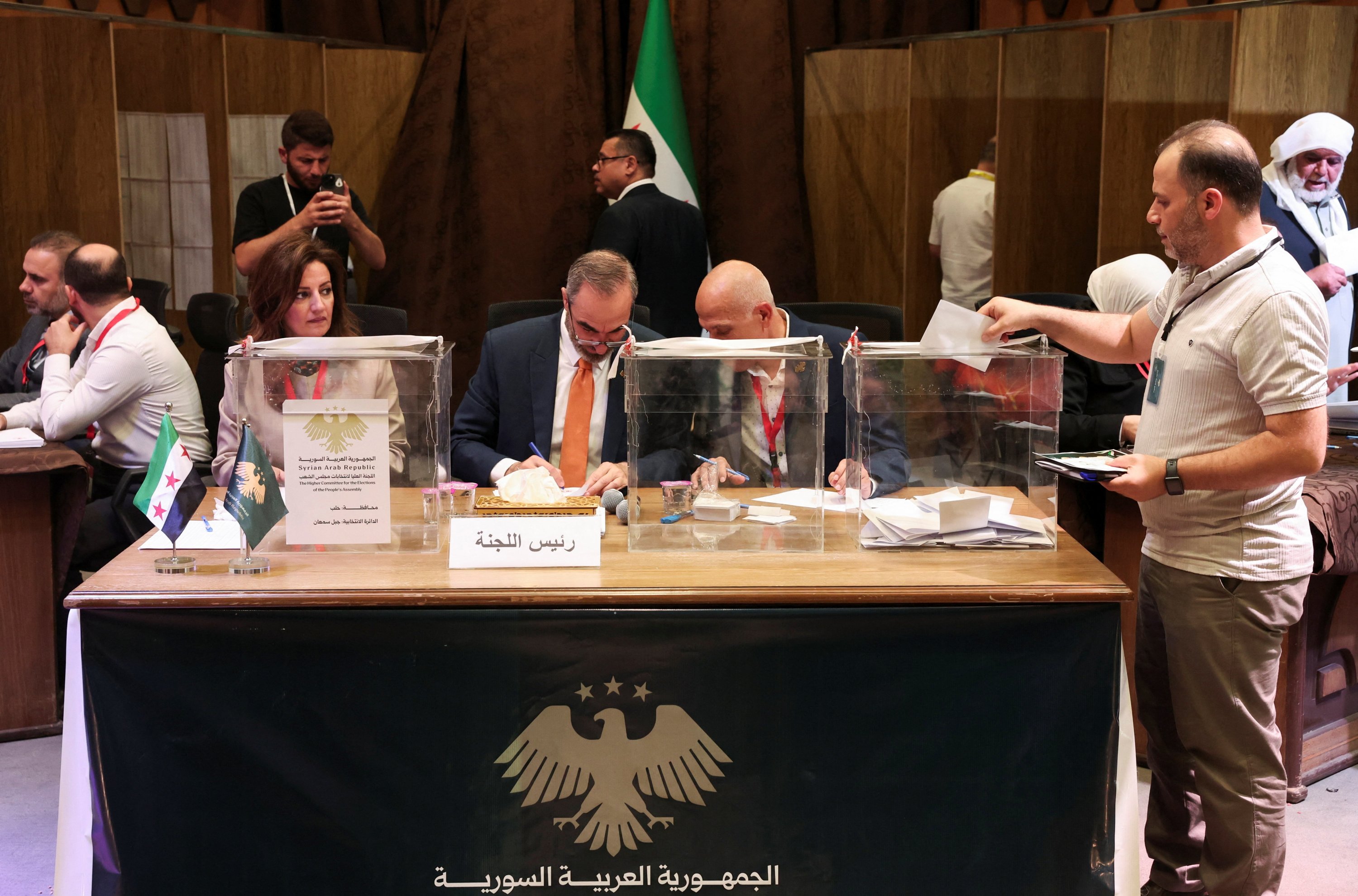
With the fall of the Assad regime in Syria, the new leadership under Ahmed al-Sharaa outlined a transparent roadmap for building a democratic society. One of the central responsibilities of the al-Shara-led transitional government was to prepare the country for parliamentary elections and restore an active parliamentary life. Despite immense challenges, authorities insisted on holding elections, originally planned for Sept. 15-20, 2025. However, the process was delayed as some groups expressed unwillingness to engage with the vote, coupled with precautionary measures introduced by the electoral commission.
Despite all the hardships and opposition, elections were held on Oct. 5, with committees established to oversee the process, ensure proper monitoring, and coordinate with local actors. According to the Higher Committee for People’s Assembly Elections, these committees operated in all provinces except Suwayda, Hasakah and Raqqa.
From its inception, the transitional government under Ahmed al-Sharaa prioritized preparing Syria for democratic elections. However, the country’s extraordinary circumstances have pushed security concerns to the forefront. Several developments have complicated the process: pro-Assad Alawite groups in Latakia and Tartus resisting the new order; the YPG, the Syrian wing of the PKK, refusing to fully integrate with the central government despite a signed agreement; Druze separatists under Hikmat al-Hijri launching an uprising in Suwayda; and Israel’s ongoing strikes against Syria. Under these conditions, security considerations have overshadowed the democratic agenda.
Nevertheless, the new leadership pressed ahead with its pledge to hold elections, forming electoral commissions in nearly all provinces. What has provoked the most debate is not the nationwide postponement, but rather the indefinite suspension of elections in Suwayda, Raqqa and Hasakah. This decision triggered objections from both the YPG and Druze factions. Yet, the rationale behind the move is clear. As commission spokesperson Nawar Najmeh explained: “The elections are a sovereign matter that can only be conducted in areas fully under government control.”
In reality, government authority in YPG-held eastern Syria and in Suwayda remains limited. The YPG continues to resist disarmament and full integration, while Druze insurgents openly call for Israeli intervention and press independence claims. Given these conditions, postponing elections in these areas was not a retreat from democracy but a safeguard for it. The government has left parliamentary seats for these districts vacant for now, with the understanding that once the YPG dismantles its armed structures and accepts integration, the people of these regions will be represented directly in Damascus.
The absence of polling stations in the three provinces has sparked debates over whether Syria’s ethnic, religious and cultural diversity will be adequately represented in the new Parliament. These debates have been amplified by separatist Druze groups and the YPG, but their narrative does not reflect the country’s broader reality. Hikmat al-Hijri’s faction does not represent all Syrian Druze, just as the YPG does not represent all Syrian Kurds. Framing the suspension of elections in these regions as a move against specific ethnic groups is misleading.
Both Druze and Kurds remain integral to Syria’s social fabric, just as much as Arabs or Sunnis, and their participation in the new parliament is guaranteed through other constituencies. Across the 50 electoral districts where elections are being held, the principle of national belonging, rather than sectarian or ethnic identity, has guided the process.
Another group voicing concerns has been the Shiite community, which makes up roughly 2% of Syria’s population. While some Shiites have expressed frustration, this is less about underrepresentation and more about the loss of privileges once extended during the years of Iranian dominance. President Ahmed al-Sharaa and Interior Minister Enes Hattab have both engaged in dialogue with Shiite leaders, stressing that no community will face discrimination and that all citizens will enjoy equal rights.
The government’s approach toward Christians has also been markedly inclusive. The Higher Committee for People’s Assembly Elections has held meetings with leading clerics such as Patriarch John X Yazigi and Patriarch Mar Ignatius Ephrem II, as well as with Christian civil society organizations. This demonstrates the transitional government’s commitment to ensuring that every minority community is heard and included in shaping Syria’s future.
The decision to postpone Syria’s elections to Oct. 5, and to delay voting indefinitely in Suwayda, Hasakah and Raqqa has been driven not by political maneuvering but by unavoidable security realities. With separatist movements active and foreign interventions – particularly Israel’s – ongoing, the determination of the Damascus government to press ahead with elections reflects a genuine commitment to democratization under difficult circumstances. Despite the turmoil, the insistence on holding elections marks an important step forward for Syrian democracy.
In this context, the election also carries symbolic weight beyond Syria’s borders. It signals to regional and international actors that the transitional government is intent on legitimizing its authority through ballots rather than arms. While challenges remain immense, the pursuit of elections under such conditions underscored a determination to redefine state-society relations on the basis of representation and political accountability.