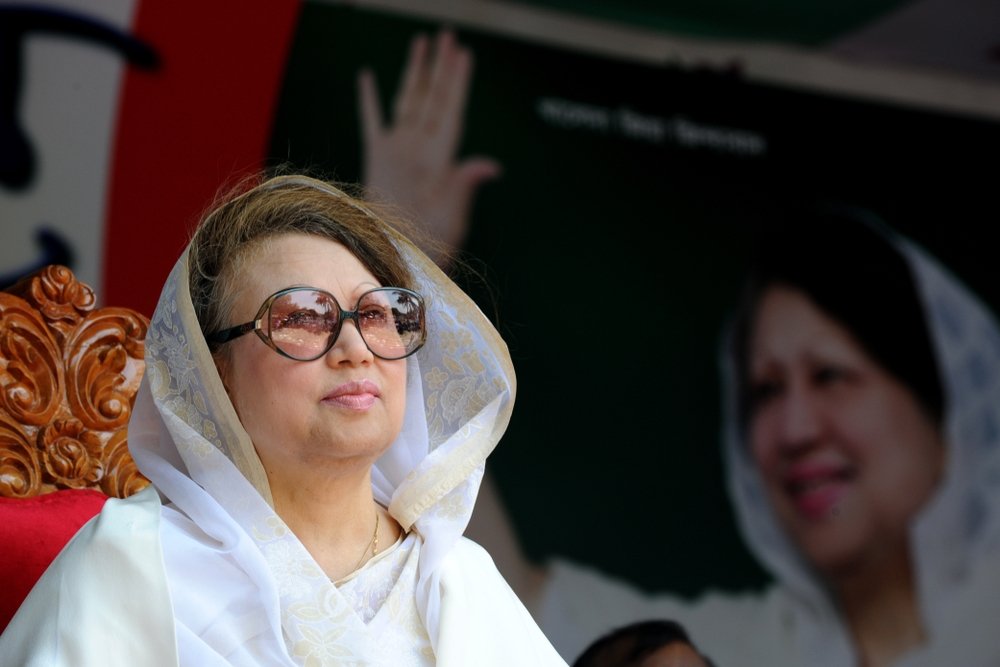
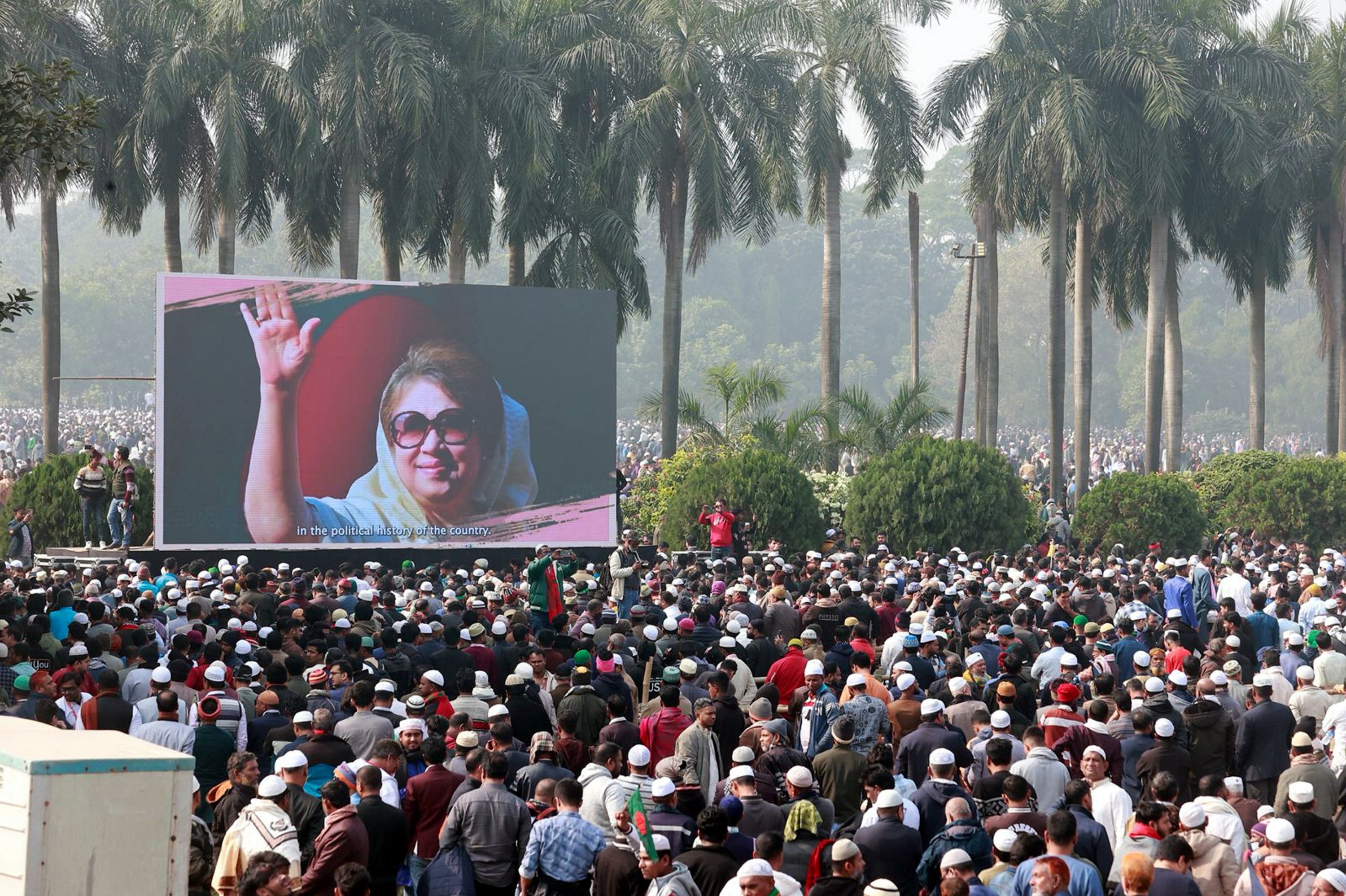
Khaleda Zia, Bangladesh’s first female prime minister and a two-time head of government, passed away on Dec. 30, 2025. The widow of President Ziaur Rahman and among the earliest Muslim women to lead a modern state, she was never merely a party figure in Bangladesh’s political imagination. Her funeral, attended by several million people, was likely the largest public gathering the country has witnessed in recent decades.
The scale of the crowd has unsettled many easy explanations. Millions gathered without party mobilization, without slogans and without the familiar choreography of Bangladeshi street politics. This was not a demonstration of organizational strength by the Bangladesh Nationalist Party (BNP), nor a sudden revival of electoral enthusiasm. It was something quieter and politically more revealing.
The turnout forces a harder question: Why did a leader who had been out of power since 2006, politically neutralized for years by imprisonment and illness, still command such wide public recognition? And more importantly, what does her absence now change in Bangladesh’s political landscape?
The first thing to understand is that mass mourning does not always signal political agreement. It often signals political recognition. Khaleda Zia’s appeal at the end of her life was not rooted primarily in policy achievements or party loyalty. It was rooted in what she came to represent after she stopped governing.
For more than a decade, repression in Bangladesh was personalized. While opposition institutions were hollowed out, Zia became the most visible site on which the costs of dissent were inscribed. Evicted from her home, isolated in prison, denied normal political activity, and slowly removed from public life, she absorbed the weight of a system that no longer allowed meaningful contestation. In doing so, she ceased to function primarily as a party leader and became something else: a symbolic anchor for opposition legitimacy.
This matters because authoritarian or semi-authoritarian systems do not eliminate opposition feelings. They redirect them. When parties cannot operate freely, and elections lose credibility, public frustration does not disappear. It searches for a form that feels safe, legible and morally coherent. Khaleda Zia provided that form. Supporting her did not require confrontation, militancy or ideological alignment. It required only recognition of endurance.
That is why the crowd at her funeral cut across partisan lines. Many of those present were not endorsing the BNP’s past governments, its alliances or its mistakes. They were acknowledging a figure who had stayed put when leaving would have been easier; who refused negotiated exile when compromise might have offered comfort; and who bore repression without converting it into uncontrolled street violence. In a political culture saturated with transactional loyalty, that posture mattered.
Paradoxically, Khaleda Zia’s political significance grew as her formal power diminished. After 2010, she no longer shaped policy or strategy in any meaningful sense. But she performed a different function: She contained political emotion. Anger, fear, resentment and memory were channelled toward her person rather than spilling into fragmented, unpredictable forms. As long as she lived, opposition politics had a human reference point, someone onto whom loyalty could be projected without mobilization.
This containment had stabilizing effects. While she was alive, the regime could repress without triggering the total collapse of political meaning. Opposition supporters could wait rather than radicalize. Even silence had a face. Her presence acted as a buffer between accumulated grievance and political explosion.
This is why her absence now matters more than her life in its final years.
With Khaleda Zia gone, Bangladesh enters a post-charismatic phase of opposition politics. The BNP remains organizationally intact, but organizational continuity is not the same as moral authority. Tarique Rahman inherits command, but inheritance is not the same as legitimacy. He may consolidate party control, but he cannot replicate what his mother embodied: a lived bridge between the democratic rupture of 1990-91, the caretaker era, and the long authoritarian consolidation that followed.
Funerals reveal what institutions conceal. The crowd at Khaleda Zia’s janaza was not a rehearsal for electoral victory. It was a release of accumulated recognition that had nowhere else to go. For years, public respect for her was politically inert – felt but unexpressed. Death created a moment where that recognition could surface without risk.
The danger now is not that opposition disappears, but that it loses mediation. When symbolic authority vanishes while grievances persist, politics becomes more volatile, not less. Leaderless resentment is harder to predict than disciplined opposition. It can fragment, radicalize or drift into forms that no party controls.
Khaleda Zia mattered most after she stopped governing because she prevented that drift. She offered a stabilizing illusion of continuity: that someone still stood, still endured, still anchored memory to a recognisable figure. Her final public messages – urging restraint, rejecting revenge, privileging country over party – were not merely moral gestures. They were political acts aimed at containing the aftermath of her own disappearance.
Bangladesh now confronts a new reality. Opposition politics must operate without its last personalised anchor. Whether this leads to renewal, fragmentation or prolonged uncertainty remains open. But one thing is already clear: the millions who came to her funeral were not mourning a party leader alone. They were mourning the end of a political grammar in which suffering could still be personalised, and legitimacy could still be symbolically held.
What replaces that grammar will define Bangladesh’s next political chapter.