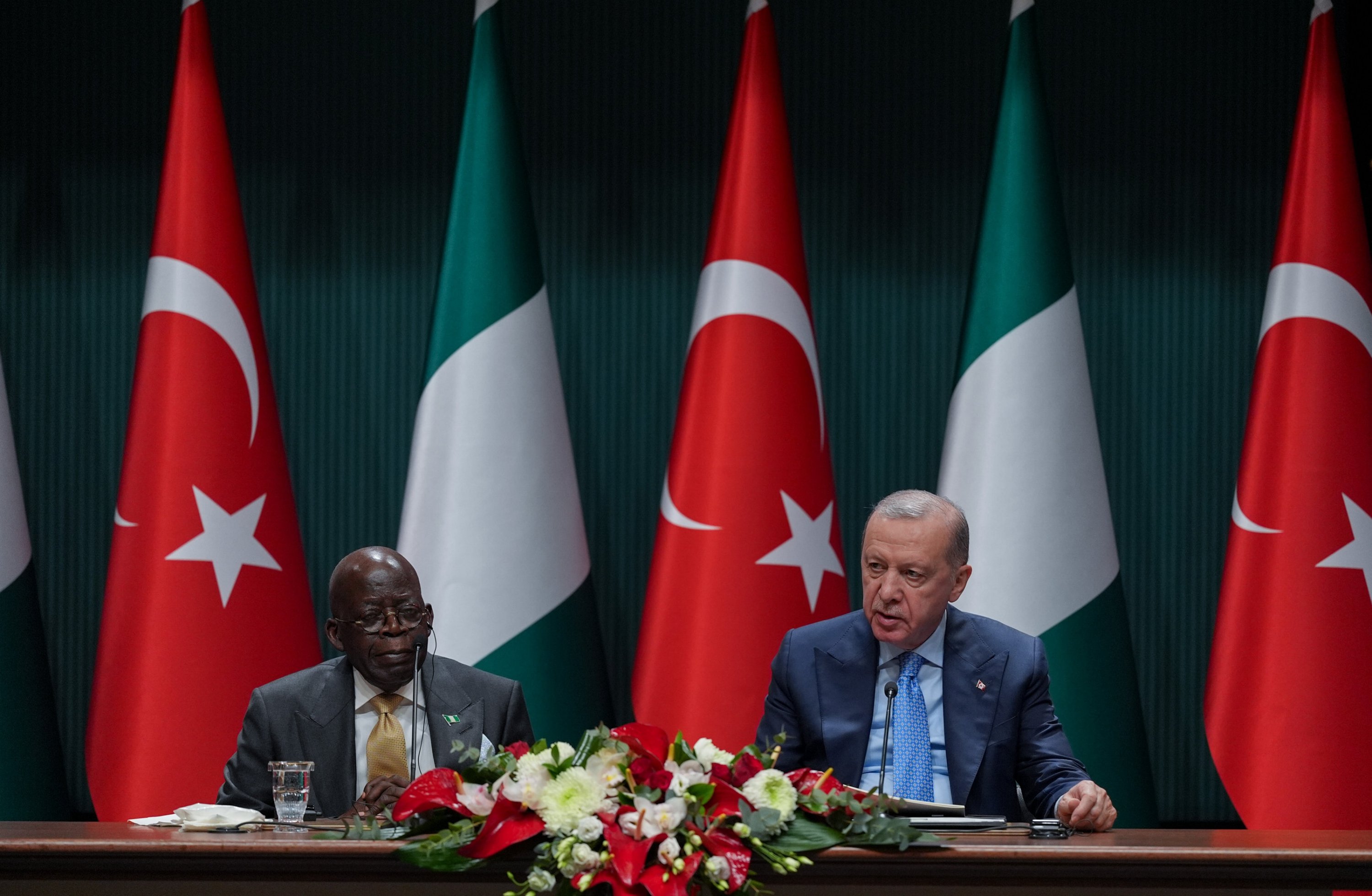
Nigerian President Bola Ahmed Tinubu’s state visit to Türkiye on Jan. 27 should be read as more than another entry in the diplomatic calendar. It was a signal carefully crafted and institutionally anchored that Türkiye and Nigeria are repositioning their relationship for a more contested, transactional and fragmented global order. The visit culminated in the signing of nine agreements and memoranda of understanding, spanning not only defense and trade, but also diaspora policy, media and strategic communication, higher education, women and social policy, diplomatic training and halal quality infrastructure, plus a joint declaration establishing a new economic coordination mechanism, the Joint Economic and Trade Committee (JETCO)
This breadth matters. It suggests that both capitals have moved beyond the project-by-project logic that often limits partnerships in Africa-Eurasia relations. Instead, they are experimenting with a whole-of-government and increasingly whole-of-society approach. Agreements that connect ministries, regulators, universities, diaspora institutions and communication authorities into a single strategic frame. Put simply, the message is clear. Nigeria and Türkiye want a partnership resilient enough to survive shocks, whether those shocks are security threats, supply chain disruptions or information warfare.
For years, observers have described Nigeria-Türkiye relations as promising but under-institutionalized. The creation of the JETCO aims to correct precisely this weakness. In official statements around the visit, both sides emphasized not only expanding trade, but also removing structural barriers that prevent investments from scaling and diversifying.
That institutional push is especially important because the current economic relationship, while growing, is still far below potential. Official data cited during the visit notes that bilateral trade reached $688.4 million (TL 29.95 billion) in the first 11 months of 2025, and that when energy trade is included, Nigeria became Türkiye’s largest trading partner in sub-Saharan Africa in 2025. Leaders also restated an ambition to reach a $5 billion trade volume, underscoring that the political leadership now expects faster and more measurable progress.
The baseline is not empty. More than 50 Turkish-owned companies reportedly operate in Nigeria, with investments valued at around $400 million, while Turkish contractors’ project volume has approached $3 billion. The strategic question, therefore, is not whether the relationship exists; it does. But whether it can be upgraded into a high-trust, high-volume economic corridor. JETCO is designed to be the mechanism that turns political will into bankable, implementable outcomes.
Energy did not appear as a standalone memorandum of understanding on the signature list, but it clearly sits near the top of the agenda. In remarks published by Nigeria’s State House, President Recep Tayyip Erdoğan stated that Türkiye targets the $5 billion trade goal and that discussions have already begun, while also highlighting that energy was among the sectors comprehensively reviewed by both delegations.
Beyond rhetoric, the economic logic is compelling. Nigeria exports crude oil and agricultural products to Türkiye, while Türkiye exports machinery, iron and steel, and chemical products, among others, an exchange profile that can evolve toward higher value-added cooperation if institutional bottlenecks are reduced. Erdoğan’s comments also pointed to expectations around cooperation between the Turkish Petroleum Corporation and Nigerian counterparts, which, if pursued through JETC,O could open pathways in upstream coordination, services, and longer-term supply arrangements. In an era where energy security is increasingly linked to geopolitics, a Nigeria-Türkiye energy track would not only be commercial. As well, it would be a strategic hedge for both.
The visit also reaffirmed that defense cooperation is no longer peripheral. It is becoming one of the partnership’s most dynamic and consequential pillars. Among the nine instruments signed was a protocol on military cooperation, and leaders publicly discussed closer cooperation in military training and intelligence. This is not happening in a vacuum. Nigeria’s security environment remains pressured by terrorism and armed violence, while instability in the wider Sahel continues to produce spillover effects.
Crucially, defense cooperation is already layered. Reporting around the visit notes that the Nigerian Air Force has purchased Turkish drones and six T129 ATAK attack helicopters, a marker of both growing confidence and a desire to diversify procurement partnerships. The strategic implication is that Abuja is not only seeking platforms. It is seeking capabilities training, operational know-how, sustainment, and the kind of adaptable doctrine that can reduce dependency over time. Türkiye’s comparative advantage, in this regard, has often been its emphasis on local capacity strengthening, pairing technology with training and institutional support. Whether Nigeria can translate this into measurable battlefield effectiveness will depend on implementing clear road maps, interoperability planning and sustained political oversight.
One of the most forward-looking components of the package was the memorandum of understanding on media and communication. This reflects a shared understanding that modern security challenges extend beyond borders and battlefields. They also live in the information domain. Disinformation can undermine national cohesion, distort international perceptions and weaken public trust, especially during counterterrorism campaigns or politically sensitive reforms. By formalizing cooperation in strategic communication, Türkiye and Nigeria are signaling that they want more agency over how their realities are narrated and a greater ability to coordinate against digital manipulation. For Nigeria, the prize is not only external messaging but also internal resilience. For Türkiye, the media track complements its broader Africa engagement by contesting one-dimensional portrayals of African politics and security in global discourse.
A partnership built only on presidents and protocols is fragile. A partnership rooted in people and institutions can endure. That is why the agreements on diaspora policy, higher education, education cooperation and social policy are strategically meaningful. They widen the relationship’s social foundation and create channels that survive political cycles.
Even modest data points reveal the direction of travel. Reporting around the visit notes that Nigeria-Türkiye educational links continue through scholarship and training channels, with Nigerian students studying in Türkiye under formal programs. The point is not the number. It is the strategic function. Education produces elites, networks and long-term familiarity assets that translate into diplomatic, commercial, and cultural influence over time.
So what is the main message of Tinubu’s Ankara visit? It is that Nigeria and Türkiye want to upgrade their ties from friendly relations to a structured, strategic partnership that is multi-sectoral, institutionalized and resilient. The nine signed instruments show that both sides now see value in coordinating across the full spectrum: trade, defense, diplomacy, regulation, human capital and narrative power.
But the real test begins after the photographs. Success will hinge on implementation speed, the operational performance of JETCO, and the ability to convert agreements into deliverables that businesses, security institutions and citizens can feel. If sides get this right, the Nigeria-Türkiye corridor can become a model for pragmatic, respect-based partnership in a multipolar era, one that is not defined by dependency, but by shared capacity building and mutual strategic depth.