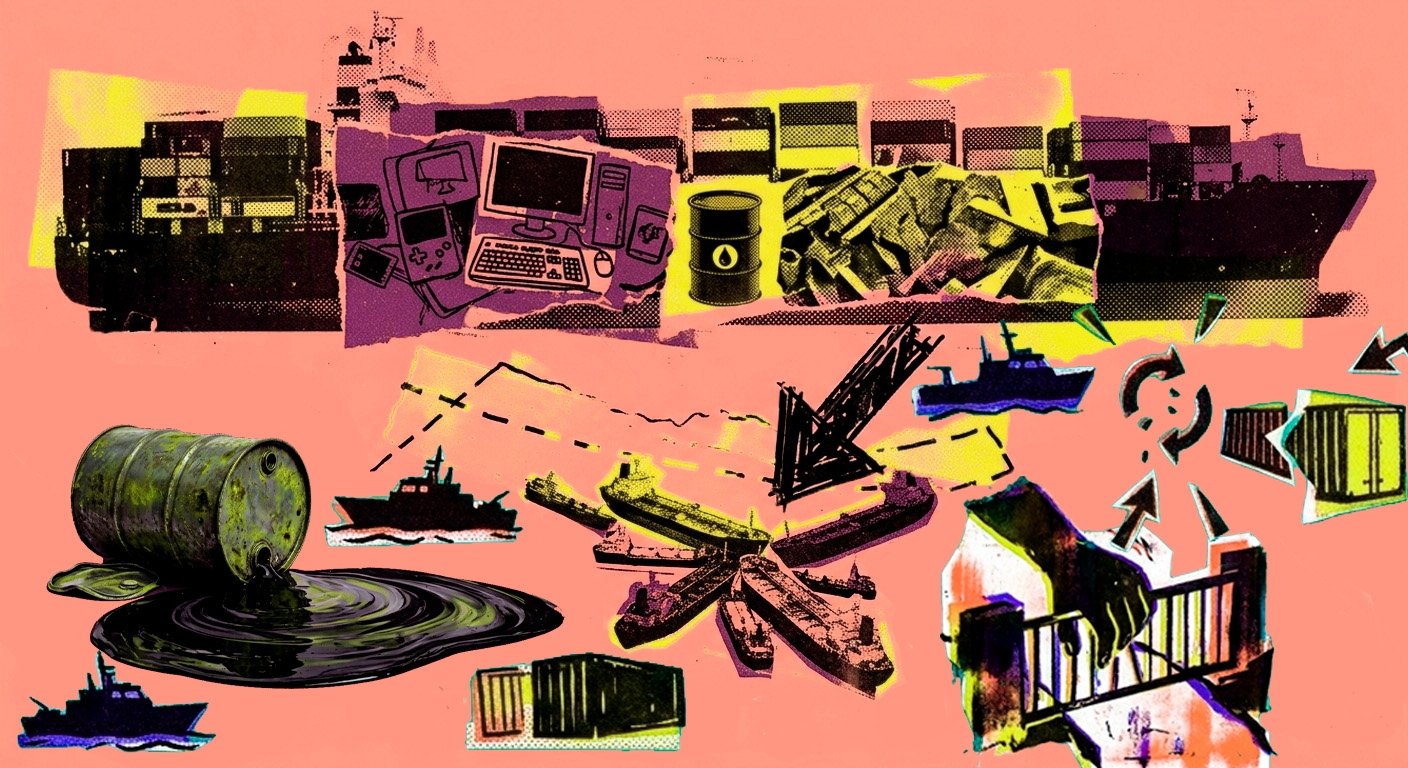
Every day, nearly 500 ships pass through a stretch of water so narrow that, at its tightest point, it is just 2.8 kilometers (1.2 miles) wide. Oil tankers from the Middle East, electronics bound for Europe and raw materials fuelling Asia’s factories all converge in this single corridor. Most people will never see it, but they rely on it every day. By the end of the year, more than 100,000 vessels will have crossed it, carrying roughly 22% of global maritime trade. This is the Strait of Malacca. It is not just a route. It is the beating heart of the global economy.
I came across a headline in Jakarta Globe that read: “Indonesia Floats Ship Tax in Malacca Strait as Singapore Defends Free Passage.”
At first glance, it seemed like another regional policy disagreement. But the more I looked into it, the clearer it became that this was not just about a proposed toll. It was about something much bigger.
To me, the controversy was never really about tolls. I see it as exposing a deeper flaw in the global system: The world depends on strategic chokepoints while assuming someone else will pay to maintain them.
For most people, this narrow passage exists only as a distant name on a map. Yet it quietly shapes daily life. The phone in a pocket, the fuel in a vehicle and the goods on store shelves are all connected, in one way or another, to ships that pass through these waters.
And yet, one question has been avoided for far too long. Who pays to keep it open?
For decades, the answer has quietly been: not the ones who benefit most.
The principle of free passage has allowed ships from around the world to transit this strategic chokepoint without charge. It is a system so deeply embedded in global trade that it is rarely questioned. It works efficiently, predictably and at a massive scale.
But it also rests on an uncomfortable truth.
Maintaining one of the busiest shipping lanes on Earth is neither simple nor free. Indonesia, Malaysia and Singapore, the littoral states bordering the strait, carry the burden of keeping it safe. They patrol its waters, respond to accidents and manage environmental risks in a corridor under constant strain.
The risks are not theoretical. Despite improvements since the 1990s, small-scale sea robberies still occur. The sheer density of traffic increases the likelihood of collisions and oil spills. At its narrowest point, a single disruption could send shock waves through regional and global economies.
In an interview for this article, Pizaro Gozali Idrus, a researcher at the Asia Middle East Centre for Research and Dialogue and an international relations lecturer at the Islamic Institute of Pemalang, Indonesia, noted that, “The Strait of Malacca is not just a waterway, it is the lifeline of modern global trade.” But what stood out to me in that conversation was not just its importance, but the imbalance it reflects. As he emphasized, “The costs are borne by littoral states, while the primary beneficiaries are the global shipping community.”
That imbalance is no longer defensible, but what I find striking is how long this imbalance has been treated as normal.
Indonesia’s recent, albeit short-lived, proposal to introduce a transit toll brought this issue into sharp focus. The idea was quickly withdrawn, underscoring both its political sensitivity and legal complexity. Under the United Nations Convention on the Law of the Sea, the Strait of Malacca is classified as an international strait governed by the regime of transit passage, which guarantees freedom of navigation without undue interference.
As Pizaro noted in the interview, “there is no international agreement that allows the imposition of tolls in international straits.”
Legally, the case is straightforward. But to me, that is precisely the problem. The law settles what states can do, but not whether the system itself is fair.
The system works until someone asks who is paying for it.
Global trade depends on infrastructure that it does not pay for and has learned to take for granted. With more than 102,000 vessels annually, even a modest transit fee would translate into billions of dollars across the global logistics system.
What happens in these waters does not stay there. And yet, the legal framework leaves little room for unilateral change.
Imposing transit fees would not only challenge the principles of the United Nations Convention on the Law of the Sea (UNCLOS) but could also trigger a chain reaction. As he warned in the interview, “Precedent is one of the most dangerous ‘weapons’ in international law.” If one chokepoint shifts, others may follow, from the Bosporus to already sensitive routes like the Strait of Hormuz.
This is why comparisons with the Suez Canal and Panama Canal miss the point. Those are engineered, state-controlled infrastructures. The Strait of Malacca is not. It is a natural artery of global trade, governed by a different set of rules and expectations.
Treating it like a toll road would not just be controversial. It would be a rupture.
“Seas and straits are no longer neutral trade routes; they have become geopolitical leverage points,” Pizaro observed. As global competition intensifies, control over geography is becoming a form of power.
In my view, Indonesia’s proposal should not be read as a serious attempt to impose a toll, but as a signal. It reflects growing pressure on states that sit at the center of global trade routes yet receive little in return beyond responsibility and risk.
In this context, Indonesia’s position is becoming increasingly difficult to sustain. It is expected to guarantee the smooth functioning of a global system while absorbing its costs. For Indonesia, this is not an abstract debate. It is a question of sovereignty, cost and how long it can afford to carry a global system on its own shoulders.
A unilateral toll is neither legally viable nor strategically wise. But the alternative, maintaining a system where a handful of states carry the burden for the benefit of all, is equally untenable.
The solution will not come from disruption. It must come from recognition. If global trade depends on these chokepoints, then responsibility for maintaining them must also be shared.
For decades, the idea of free seas has been treated as permanent. But as Pizaro cautioned, “Freedom of the seas is not a natural law; it is a political construct that requires continuous commitment.”
Indonesia may have stepped back from the idea, but I suspect this will not be the last time a littoral state questions the logic of maintaining a global artery at national expense.
The debate, in my view, is not really about whether ships should pay to pass through the Strait of Malacca. It is about whether the architecture of global trade can continue to rely on assumptions built for a different era. The question is no longer who owns the world’s chokepoints, but how long the world expects others to carry them for free.