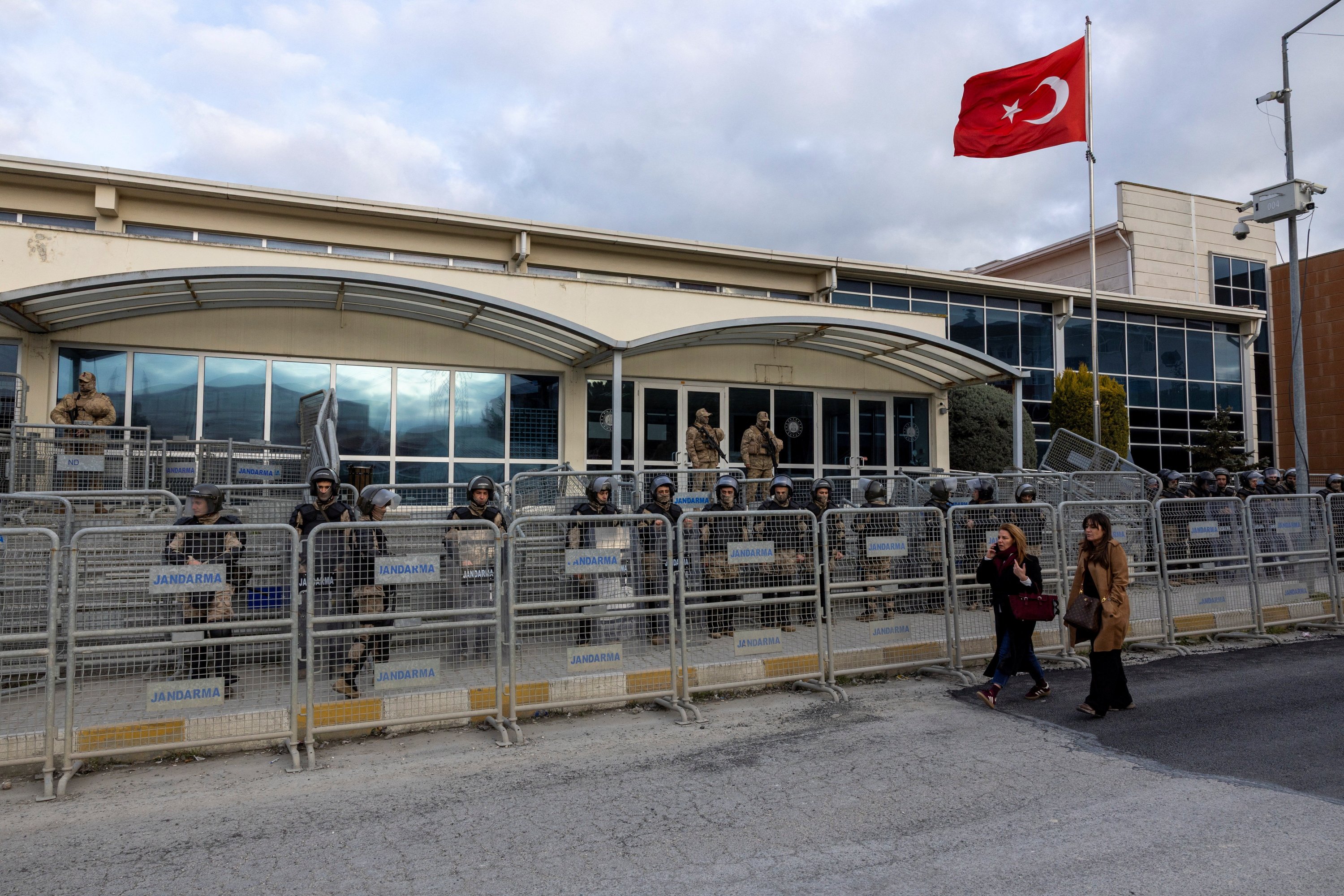
Ekrem Imamoğlu, former mayor of Istanbul for the main opposition Republican People’s Party (CHP), and dozens of other defendants were on trial on Monday in Istanbul, in the eighth hearing in a case over allegations of corruption at the municipality. The third week of the hearings kicked off with statements of Ali Sukas, head of a municipal subsidiary, who was arrested along with Imamoğlu in March 2025. Resul Emrah Şahan and Mehmet Murat Çalık, former mayors of Istanbul’s Şişli and Beylikdüzü districts, respectively, are expected to present their defense in the hearings later this week.
The trial is being held in a massive courtroom-prison complex where Imamoğlu and others are also in custody. A total of 407 defendants, including 107 who are held in pre-trial custody, are on trial. The hearings will continue well into the night, a judicial practice for trials with a high number of defendants.
The first hearing of the trial was held amid turmoil as Imamoğlu attempted to disrupt the proceedings and wanted to testify first, although the defendants will be heard by the order defined by the court. Imamoğlu argued with the judges, leading to the court members to adjourn the hearing briefly. Imamoğlu and his party claim the charges against the defendants are politically motivated.
At Monday’s hearing, Sukas, who served as director of Ağaç A.Ş., a municipal subsidiary for sapling production and urban landscaping, denied corruption allegations and claimed witnesses testifying against him was part of a defamation campaign. A co-defendant in the case has claimed that the municipal subsidiary owed him cash for the work he has done through a contract but was forced to pay Sukas separately to collect his debt. Another defendant has claimed that Sukas asked him to lease him a bus to be used for election campaign tour of Sukas’ wife who was a candidate in recent elections for CHP, in exchange of collecting the cash Ağaç A.Ş. owed to him.
Dubbed “corruption of the century” by some Turkish media outlets, Imamoğlu and his associates at the Istanbul Metropolitan Municipality (IBB) are accused of involvement in 143 acts of bribery and corruption. Their actions cost the public TL 161 billion ($3.65 billion), according to the prosecutors.
The businessman-turned-mayor faces prison terms up to 2,352 years for multiple instances of corruption that mainly revolve around bribery accusations from businesspeople in exchange for operating, construction permits and accusations of widespread rigging in lucrative tenders of the municipality.
The trial is expected to take about two months before the court reaches a verdict or decides to postpone it to another date.
In their indictment of 3,806 pages, prosecutors named Imamoğlu as the leader of a criminal ring thriving on corruption. The court will question the mayor, the municipal bureaucrats and people doing business with the municipality on accusations of taking luxury residences as bribes and stacks of cash stored in a currency exchange office, which were reportedly illicit gains of the “Imamoğlu gang” and alleged secret transfer of bribe money from lucrative excavation businesses to abroad.
Along with corruption accusations, Imamoğlu faces charges of illegally obtaining personal data, money laundering and deliberate pollution of the environment, related to other crimes he is accused of, such as the alleged sale of personal information of Istanbul’s residents through a municipality app.
The indictment says Imamoğlu’s criminal organization was similar to the Gülenist Terror Group (FETÖ), which is notorious for its infiltration into public institutions. Prosecutors say a network similar to FETÖ’s cells was established by Imamoğlu and others at the Istanbul municipality and district municipalities (also run by the CHP) of Türkiye’s most populated city. The suspects used counterintelligence tactics to avoid detection, the prosecutors say.
The mayor both sought personal enrichment and bought his way toward the full control of the CHP, the indictment says. Imamoğlu was picked as a future presidential candidate of the CHP after his arrest. Prior to an intraparty election in the CHP in 2023, Imamoğlu was caught red-handed as he lobbied for the ouster of the party’s chair, Kemal Kılıçdaroğlu. He is named in another trial on alleged vote-buying in the intraparty election, where he and others are accused of offering cash to delegates in exchange for votes for the Kılıçdaroğlu rival Özgür Özel. The “personal enrichment” cited by prosecutors includes three villas in Istanbul’s upscale Emirgan neighborhood worth TL 1.5 billion, which were not included in the declaration of assets by mayoral candidates at the elections. The indictment also includes witness statements on a private jet, which made multiple flights abroad to carry cash accumulated by Imamoğlu’s criminal ring to London. The flights between 2022 and 2025 were arranged by Murat Gülibrahimoğlu, a fugitive defendant in the case.
The indictment reveals that Taç Döviz, a firm named in a separate money laundering investigation, acted as a "custodian" for the criminal proceeds of the ring led by Imamoğlu.
Although the mayor is facing a slew of legal cases, Monday's trial is by far the biggest. In a separate case, Imamoğlu is facing an even more significant legal obstacle: a lawsuit challenging the validity of his university degree, a constitutional requirement for presidential candidates.
Imamoğlu maintained his innocence in remarks made to public before the trial began, though he did not offer an elaborate defense, apparently saving it for the trial. His party also claims that the trial is politically motivated, pointing to the arrests of other CHP mayors before and after Imamoğlu’s arrest. In all cases, mayors were arrested on charges of corruption and some cases were directly linked to Imamoğlu himself. The main opposition staged rallies every evening in a different city after Imamoğlu’s arrest, to protest it and other cases.
Some suspects who collaborated with authorities as part of a plea deal claimed Imamoğlu sought to fund his campaign for the presidency through bribes.
Ertan Yıldız, the former head of Istanbul Metropolitan Municipality’s department overseeing the subsidiaries, was among those collaborating with authorities. Speaking to the Yeni Şafak newspaper in an interview earlier this month, Yıldız detailed the “system” of corruption. “Imamoğlu always wanted to be president. It is not an evil goal but it matters how you try to achieve it. If Imamoğlu did not get himself into (this corruption), he would be a strong presidential contender. He did not have to do this, he did not have to be greedy,” he said.
Yıldız said Imamoğlu and his associates earned “resources” through lucrative tenders, especially on road maintenance and excavation. He said Gülibrahimoğlu was behind the usage of the vast Cebeci mining field for dumping construction leftovers. “This place was supposed to be run by a municipal subsidiary but was leased to another company and was unregulated. They launched tenders but the dumping was uncontrolled. They had a partnership of corruption, between Gülibrahimoğlu, Fatih Keleş and Ibrahim Bülbüllü,” he said, referring to other municipal figures.
“Overall, they had a lucrative system bringing in $150 million to 200 million yearly. They used to earn cash from minor tenders in the past but over time, they reaped more elsewhere,” he said, pointing out to reconstruction or construction permits at scenic Bosporus route of Istanbul. “They took bribes of $1 million for permits. All were delivered in bags,” he said.
He said Gülibrahimoğlu earned $10 million-20 million from the Cebeci mining field and when he objected to his schemes to funnel cash to his company, he complained. “But Imamoğlu supported him,” he claimed.
Digging deeper into an alleged criminal network run by Imamoğlu and expanding another investigation linked to a businessperson whom the district municipalities had awarded lucrative contracts, investigators launched further operations, rounding up municipal bureaucrats and other mayors throughout 2025.