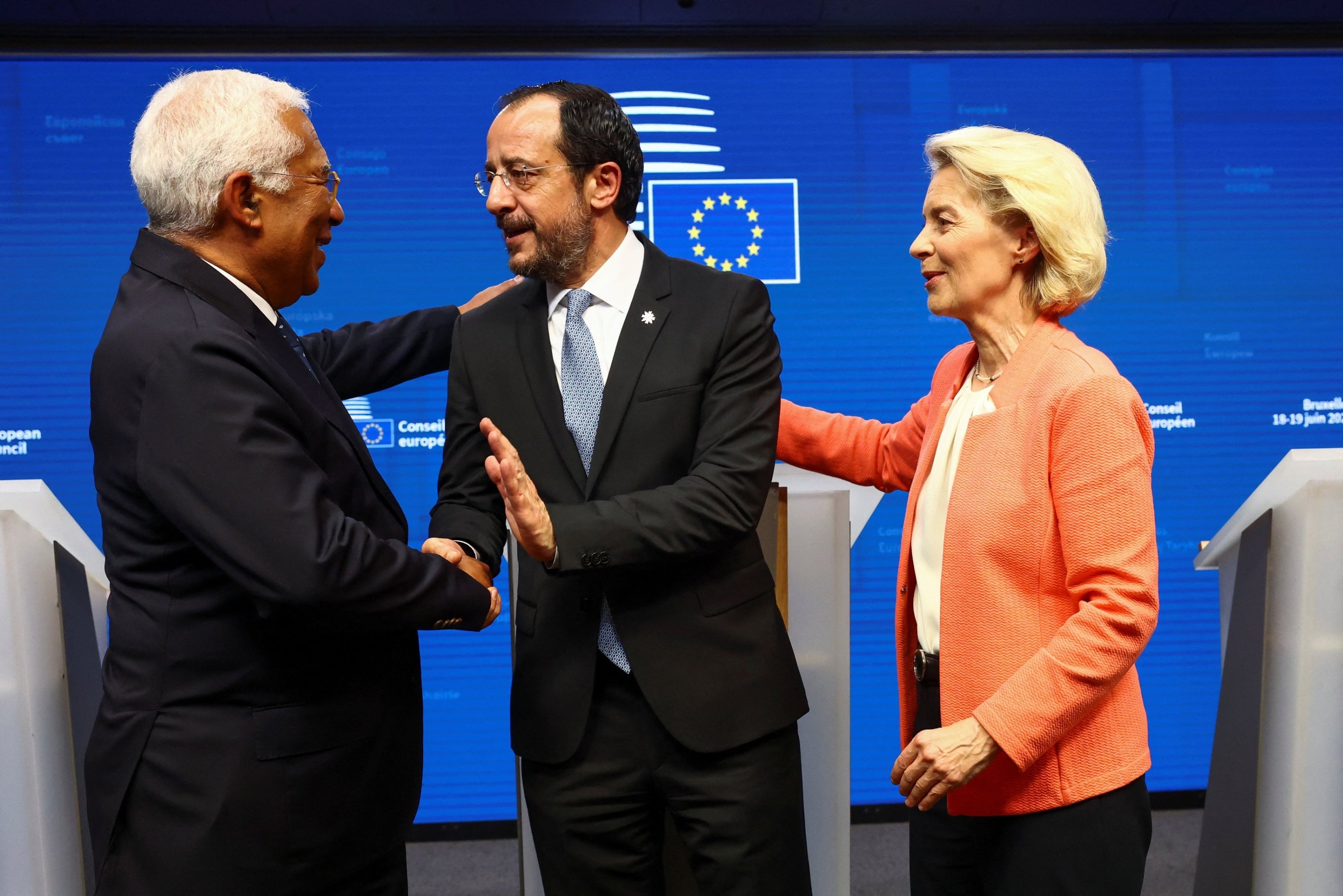
Türkiye’s ambition to join the European Union is often disrupted by disagreements on several issues, and major powers of the bloc usually seek to look past them. But Greece and the Greek Cypriot administration have remained steady hurdles in Ankara’s rapprochement with the EU. This was evident again when the European Parliament approved a resolution squarely targeting Türkiye over what it called crimes carried out by Türkiye’s Peace Operation in 1974.
The Greek Cypriot administration concluded its term at the rotating presidency of the Council of the European Union earlier this month. However, the repercussion of the presidency was felt once again this week after a report, prepared by a member of the European Parliament from Greece’s ruling party, was overwhelmingly adopted by the EU body. The report focuses on what it calls sexual violence targeting Greek Cypriot women during the 1974 Turkish operation on divided Cyprus. It calls for recognition of those crimes, but more importantly, it urges the withdrawal of Turkish troops from the island and implies that it was an obstacle to “reunification” of the island.
The six-month term, which wrapped up on June 30, 2026, was marked by intense diplomatic broadsides, regional energy maneuvers and a complete freeze on high-level political integration. While the presidency has now transitioned to Ireland, the fallout underscores how central the divided island remains to any potential EU-Türkiye strategic reset.
Türkiye was quick to condemn the resolution and branded it as “null and void.” The Turkish Foreign Ministry said in a statement that the resolution contained "baseless and preposterous allegations” against the Turkish army. The ministry also highlighted that the EU "adopted a one-sided stance on Cyprus,” which departed from “historical realities and impartiality.”
Ankara often complains that the EU is held hostage by the narrative of Greek Cypriots and Greece, which is among the guarantor states in Cyprus. The staunch opposition of Greece and Greek Cypriots to Türkiye’s efforts to integrate itself with the European Union often overlaps with their aim to damage Türkiye’s geopolitical interests. Before and after it took over the rotating presidency, the Greek Cypriot administration made it known that it would remain combative against Türkiye’s rights in the Eastern Mediterranean, for instance. It pushed regional energy and defense projects despite concerns of Ankara that its maritime rights and national security are being put at risk.
One such move was a framework agreement signed between the Greek Cypriot administration and Egypt earlier this year for transporting natural gas from offshore fields to Egypt. The Turkish Republic of Northern Cyprus (TRNC) and Türkiye view it as a violation of the equal rights of Turkish Cypriots in the region where the fields are located.
On the security front, Greek Cypriots and Greece reinforced their partnership with Israel, an arch-foe of Türkiye, while signing a Status of Forces Agreement with France for the potential deployment of French troops on the island in the future.
Although Turkish-EU relations were lukewarm at best during the Greek Cypriot presidency, the diplomacy remained at work. The recent NATO summit in Ankara was also an opportunity for Ankara to review its relations with the EU. Erdoğan met European Council President Antonio Costa and European Commission President Ursula von der Leyen on the margins of the summit. Erdoğan’s statements following the meeting that highlighted cooperation with the bloc demonstrate that Türkiye is still committed to alignment with the EU. Cyprus, however, loomed large at the same meeting, with Costa urging Türkiye to seize “renewed momentum” on talks about the divided island.