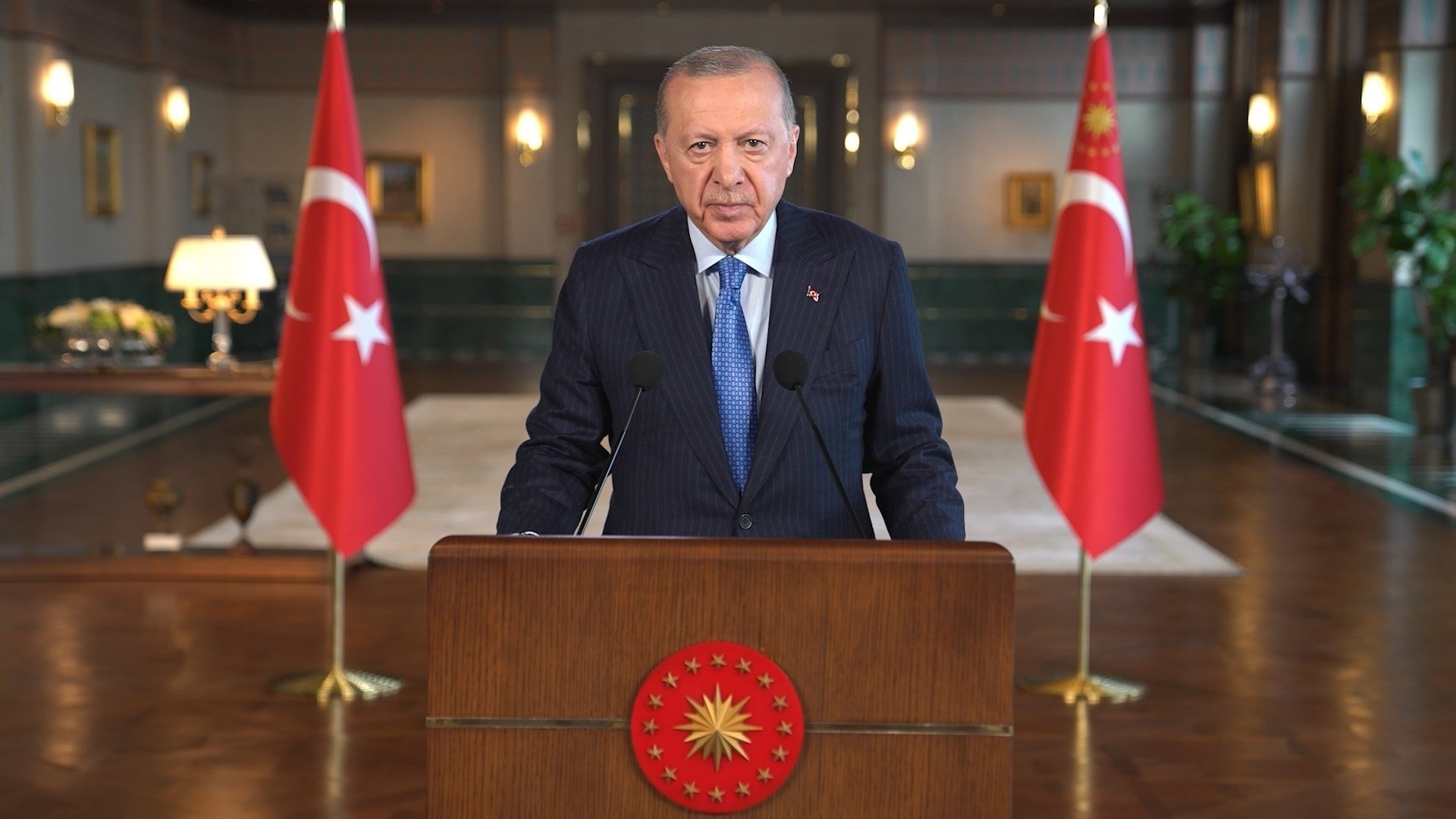
President Recep Tayyip Erdoğan reaffirmed Türkiye's commitment to mediation and diplomatic engagement Friday, citing its role in the Russia-Ukraine prisoner exchanges and peace initiatives across Africa, as global conflicts intensify and confidence in international institutions weakens.
In a video message to the 9th Istanbul Mediation Conference, hosted by Foreign Minister Hakan Fidan under the theme "Partnerships and New Perspectives for Peace: Mediation in a Changing World," Erdoğan said Ankara would continue working to create opportunities for dialogue even when prospects for peace appear limited.
"We are striving to pave the way for peace through the achievements we have made across a wide geography, from prisoner exchanges between Russia and Ukraine to our mediation efforts on the African continent," Erdoğan emphasized.
The president warned that the international community was facing a period of escalating conflicts, mounting tensions and declining trust in international law and institutions.
"Even when parties refuse to speak to one another and hopes are fading, we have made it our principle never to abandon diplomacy," he noted.
The president also criticized the structure of the United Nations Security Council, arguing that its decision-making system undermines confidence in international governance.
"Millions of people in Palestine, Lebanon, Sudan and other crisis regions who have placed their hopes in the United Nations are deeply disappointed."
"A structure in which the will of more than 190 countries depends on the discretion of five countries is neither fair nor capable of fully establishing trust," Erdoğan added, referring to the Security Council's five permanent members.
He emphasized that Türkiye rejects an international political order built on mistrust and believes diplomatic channels must remain open even during the most difficult disputes.
"We will continue bringing parties together for peace, mediating for just solutions and assuming responsibility," he stated.
Addressing the conference, Foreign Minister Hakan Fidan warned that armed conflicts, repeated cease-fire violations and disruptions to critical trade and maritime routes were placing increasing pressure on the international system.
Citing United Nations estimates, Fidan said approximately one-quarter of the world's population lives in conflict-affected areas, while more than 100 million people have been forcibly displaced, including a significant proportion of children.
He pointed to the humanitarian situation in Gaza and the West Bank, criticizing Israel's military actions and cease-fire violations for further undermining confidence in international institutions.
The minister stressed that protecting civilians, particularly children, and ensuring humanitarian assistance must remain priorities, while reiterating Türkiye's support for a just political settlement to the Palestinian issue.
Against this backdrop, he outlined three principles that should guide international mediation efforts: sincere dialogue, sustained mediation and regional ownership.
"Rebuilding trust is absolutely essential for mediation to work," Fidan said, emphasizing that effective mediation depends on the consent of the parties, mutual confidence and inclusivity.
He argued that the growing number and complexity of conflicts were testing the international system's ability to respond, making peaceful dispute resolution more urgent than ever.
Highlighting Ankara's diplomatic engagement in several regional crises, Fidan cited Türkiye's involvement in Russia-Ukraine negotiations, the Black Sea Grain Initiative and the Ankara Process between Somalia and Ethiopia as examples of sustained mediation.
According to the Ethiopia-Somalia Ankara Declaration, the two parties decided to launch technical negotiations facilitated by Türkiye by the end of February 2025 and conclude them within four months. They also agreed to abandon differences of opinion and contentious issues and to move decisively toward shared prosperity.
Türkiye’s engagement with the continent gained unprecedented momentum after it declared 2005 the “Year of Africa.”
Ankara has repeatedly presented itself as a fairer player than the continent’s former colonial powers, touting cooperation based on “equal partnership and a win-win principle.”
Fidan further emphasized that resolving disputes requires patience, flexibility and a willingness to maintain communication with all relevant parties.
"You cannot resolve a dispute if you cannot engage with the parties concerned."
He remarked that negotiations must continue even when comprehensive peace agreements remain out of reach, arguing that incremental progress can create the foundation for broader settlements.
"There is no single formula," the minister noted, noting that every conflict has its own historical background, actors and circumstances.
Turning to Libya, Fidan said Türkiye was maintaining dialogue with stakeholders in both the country's east and west, as well as international partners, to support a lasting political settlement.
He described a Libyan-led and inclusive dialogue process as the only viable path toward sustainable stability, expressing hope that progress toward a comprehensive solution could be achieved.
Fidan also emphasized the importance of regional ownership in resolving conflicts, arguing that locally driven initiatives are more likely to produce sustainable outcomes than externally imposed arrangements.
"Stability cannot be imported, and lasting solutions cannot be imposed from outside," he said.
He explained that regional actors possess a deeper understanding of local dynamics and are better positioned to sustain peace efforts after international attention shifts elsewhere.
Fidan cited regional cooperation initiatives, including the Balkan Peace Platform and the Mecca Joint Defense Agreement, as examples of efforts to strengthen dialogue and encourage practical solutions among neighboring countries.
The Mecca agreement, signed on Aug. 7 by Erdoğan, Saudi Crown Prince Mohammed bin Salman and Pakistani Prime Minister Shahbaz Sharif in Mecca, establishes a collective defense framework among the three countries. Under the pact, an armed attack against any one of the three countries is considered an attack against all of them. The agreement also calls for broader defense cooperation and collective deterrence.
He also called for closer cooperation among governments, international organizations, civil society, universities and the private sector to improve mediation capabilities.
Fidan said Türkiye was working to transform mediation from a conventional diplomatic instrument into a strategic and institutionalized component of its foreign policy.
"Mediation is not about who wins, who loses or who makes concessions. It is about finding common ground and achieving a win-win solution for all parties," he said.
He expressed hope that the Istanbul conference would provide an opportunity to exchange experiences, strengthen collective mediation capabilities and develop new approaches to resolving international disputes.