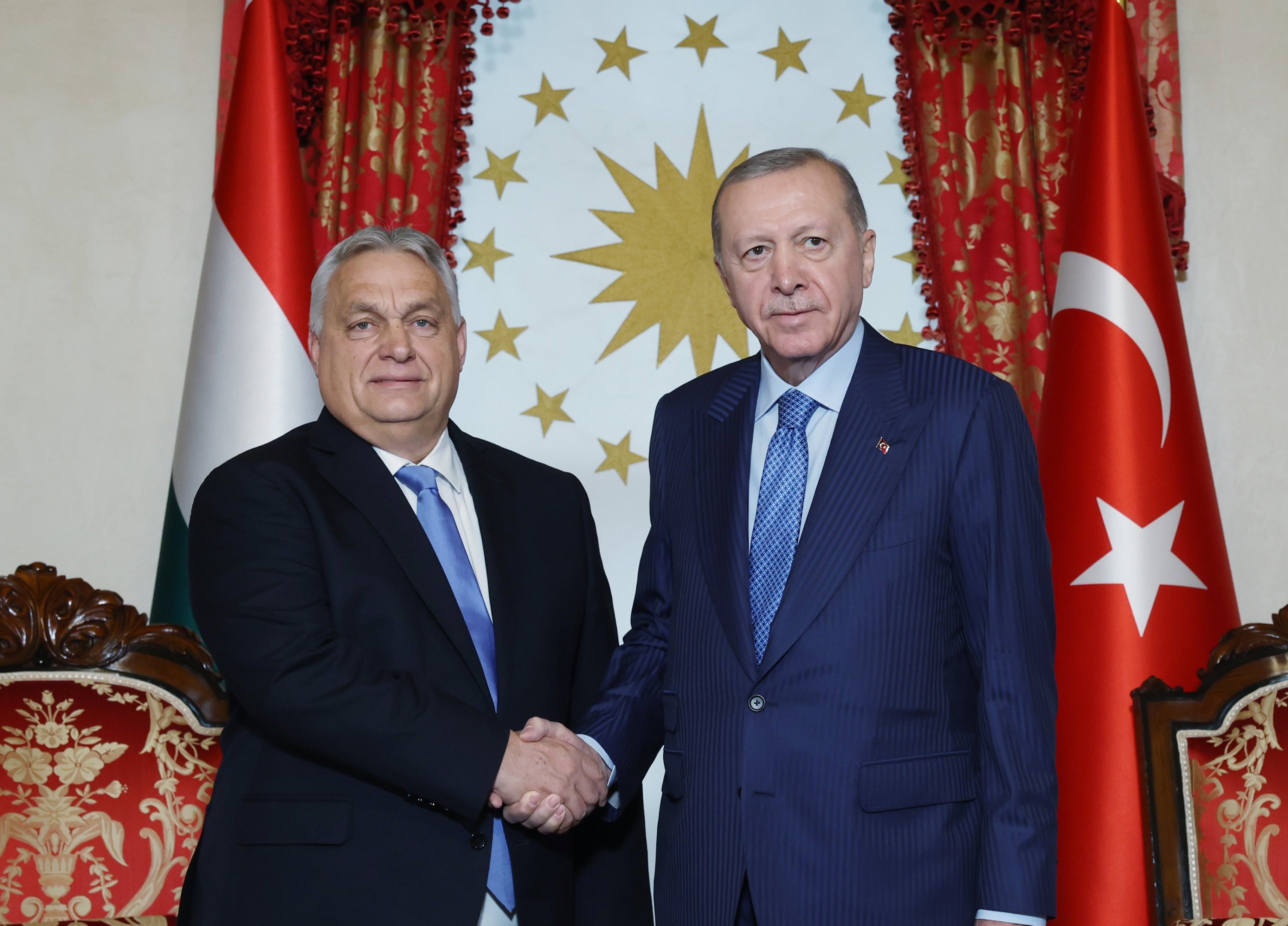
President Recep Tayyip Erdoğan on Monday welcomed Hungarian Prime Minister Viktor Orban with an official ceremony at the Dolmabahçe Palace in Istanbul.
Erdoğan and Orban held bilateral and delegation-level meetings before attending a signing ceremony for a series of agreements. Erdoğan and Orban will later address a joint press conference and take part in an official dinner.
The two leaders, both successful in domestic politics with consecutive election victories, have developed a good personal rapport that has also reflected on bilateral ties.
The pair reviews key issues between their countries annually, with this year’s agenda centered on the economy, migration, the war in Ukraine and energy, according to Orban.
Speaking to reporters aboard his flight to Istanbul, Orban praised Türkiye’s roles in efforts to end the war in Ukraine, saying Ankara and Budapest share the view that “war has only losers” and therefore work together to support peace.
Noting the growth in bilateral trade, Orban said the two sides had set a goal of doubling the previous trade volume of 2-2.5 billion euros ($2.3-2.9 billion) when the meetings began. “We have now reached 4.5-5 billion euros,” he said, adding that Turkish investment in Hungary has expanded, while Hungarian presence in the Turkish economy has also increased.
Orban highlighted the strategic importance of the TurkStream pipeline, saying cheaper Russian gas reaches Hungary exclusively through that route. The war in Ukraine, he added, has made the pipeline even more vital for Hungarian energy security.
The closeness in ties was evident as Turkish and Hungarian ministers launched the first meeting of the Joint Consultation Mechanism in Istanbul ahead of the leaders’ meeting.
Foreign Minister Hakan Fidan stressed the new mechanism is designed to deepen cooperation between the two countries across foreign policy, security and defense industry fields.
He also called for accelerating joint efforts to boost economic relations and mutual investments while reaffirming both sides’ intent to advance ongoing defense industry collaboration through new projects. He emphasized the importance of Hungary as a partner in security cooperation and highlighted continued coordination in counterterrorism based on shared interests.
The Joint Consultation Mechanism, bringing together foreign and defense ministers, intelligence chiefs and senior defense industry officials, was created to bolster cooperation in military, security, defense industry and counterterrorism fields. It is planned to convene at least once a year, alternating between Türkiye and Hungary.
The two countries’ relations trace back to the Ottoman era, as a military victory by the Ottomans in the 16th century reshaped Hungary, effectively dividing the country for decades before it was reunited in the 17th century. Under the leadership of President Erdoğan, the two countries have inched closer to each other, drawing from their cultural proximity. The close ties ultimately led Hungary to become an observer member of the Organization of Turkic States (OTS), which was co-founded by Türkiye.
Flourishing economic ties aside, the two countries also became closer in the context of the European Union. Türkiye has long struggled to gain membership in the EU, and Hungary has been one of the few steadfast supporters of this goal.
Orban is also the only voice in the EU that opposes an all-out conflict with Russia and, like Erdoğan, supports a just, fair peace between Russia and Ukraine.