Pakistan's ambassador to Türkiye said Wednesday that Islamabad remained in close contact with Ankara throughout diplomatic efforts that led to a ceasefire agreement between the United States and Iran, underscoring the two countries' longstanding strategic partnership and shared approach to regional peace.
Speaking to Anadolu Agency (AA), Ambassador Yusuf Junaid said negotiations held in Islamabad helped pave the way for the agreement and that a final signing ceremony is expected to take place on Friday, as previously announced by Pakistani Prime Minister Shehbaz Sharif.
"We remained in continuous contact with the brotherly leadership of Türkiye throughout this process and maintained a common position on all these issues," Junaid said.
The ambassador described peace and stability as key priorities of Pakistan's foreign policy, which he said is guided by the vision of the country's founder, Muhammad Ali Jinnah, emphasizing friendship with all nations, particularly neighboring states.
Junaid said wars and conflicts benefit no one and often result in severe humanitarian and economic consequences. He stressed that Pakistan seeks to play a constructive role in resolving regional and international crises through diplomacy and dialogue.
The ambassador also praised President Recep Tayyip Erdoğan's role in international mediation efforts, describing him as one of the most influential leaders of the modern era.
"President Erdoğan is one of the most effective and influential leaders in modern history," Junaid said. Referring to Türkiye's mediation initiatives in conflicts including the war between Russia and Ukraine, he added that Ankara had achieved significant success in promoting security and stability in regions where peace remains fragile.
Türkiye has sought to position itself as a diplomatic mediator in several regional conflicts in recent years, hosting talks between Russia and Ukraine and supporting broader efforts aimed at reducing tensions across the Middle East.
Junaid expressed gratitude for what he described as Türkiye's consistent support for Pakistan on critical international issues. He noted that the relationship between the two countries extends beyond traditional diplomatic ties and is rooted in a deep sense of solidarity.
Highlighting examples of mutual support during times of crisis, Junaid recalled that then-Pakistani Prime Minister Nawaz Sharif was among the first foreign leaders to visit Türkiye following the 1999 Marmara earthquake. He also noted that Erdoğan and first lady Emine Erdoğan were among the first international figures to visit Pakistan after devastating floods in 2010.
The ambassador said the two nations share strong historical, cultural and linguistic connections dating back centuries. He pointed to similarities between Turkish and Urdu and said the relationship between the peoples of the two countries has been shaped by generations of cultural interaction and common heritage.
"The bond between Türkiye and Pakistan is not merely a friendship," Junaid said. "It is a relationship built on shared history, mutual support and a sense of brotherhood."
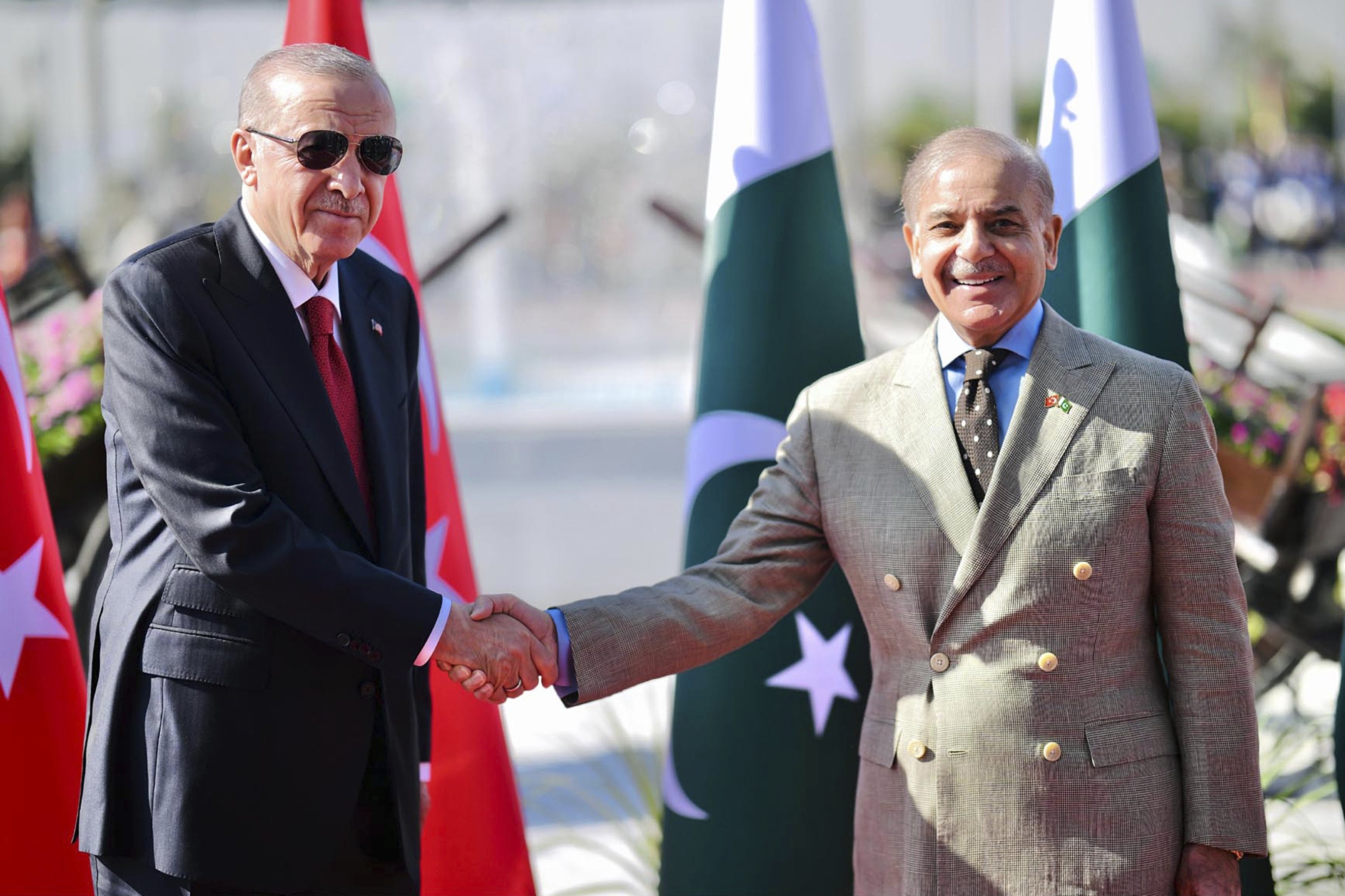
Last year February, Erdoğan arrived in Pakistan and received a formal welcome from Prime Minister Shahbaz Sharif in Islamabad. The leaders attended the seventh meeting of the High-Level Strategic Cooperation Council of Türkiye and Pakistan. The meeting ended with a joint declaration to deepen and diversify strategic partnerships and to sign 24 cooperation agreements in several fields.
Deals include the exchange of military and civilian personnel for social and cultural purposes, cooperation on electronic warfare between the air forces of two countries and cooperation on training for military health care. In the energy field, the two countries signed a deal amending cooperation on hydrocarbons and a deal on energy transformation and mining.
Other deals and memoranda of understanding include cooperation on industrial property, religious education, halal commerce, cooperation between the central banks of the two countries, cooperation on public affairs, communications and media, health care and pharmaceuticals.
Erdoğan named Pakistan as his "second home" and lauded Pakistan's founders, Muhammad Ali Jinnah and Allama Muhammad Iqbal, for establishing modern-day Pakistan with inspiration from the Republic of Türkiye.