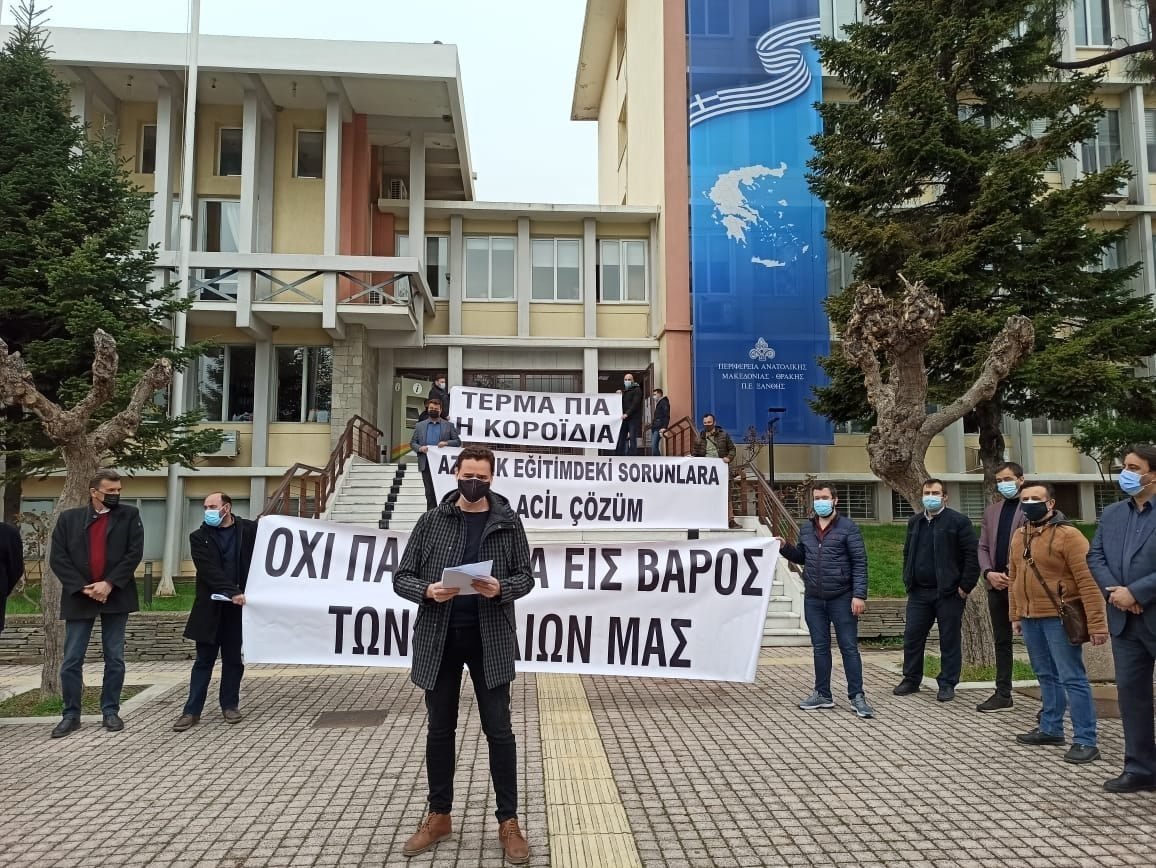
A school council representing the Turkish minority in Western Thrace’s Iskeçe (Xanthi) protested after its members were denied entry, denouncing the move as a violation of democratic and legal norms.
In a statement, the council of the Iskeçe (Xanthi) Minority Middle and High School in Western Thrace recalled that its office had been cleared out during renovation works over the summer and said the latest step further undermines its role as the legal authority of the school. “Now, as the administrators of the council, we are not allowed to enter the very school we are responsible for. School administrators are being prevented from entering their own institution,” the statement said.
The council noted that the ban was enforced under instructions from the Greek Education Ministry and condemned the decision as “an openly oppressive, undemocratic and unlawful intervention.”
Underscoring that councils are the legitimate governing bodies of minority schools in Western Thrace, the statement said: “Councils, which are obliged by law to fulfill their duties and responsibilities, are being sidelined by artificially created obstacles. Their institutional identity is being targeted. We cannot accept this.”
The statement also questioned whether similar practices were being imposed at Greek minority schools in Istanbul, which operate under the same status defined by the Treaty of Lausanne. “We are aware of the mentality that seeks to drive students away from our schools. Whatever the circumstances, we will continue to stand by our school and our children,” the council declared.
Calling on authorities to respect international obligations, the statement urged: “Decisions must be taken in line with the status and spirit of minority schools established under the Treaty of Lausanne, and in accordance with democratic values and the rule of law. We expect the voice of the İskeçe Minority Middle and High School Council to be heard.”
Some 150,000 Muslim Turks in Western Thrace, economically one of the poorest in Greece, have long complained about deteriorating conditions. Seeing the community as a “hostage” of its ties with Türkiye, the Greek government has committed numerous breaches of its treaty obligations and European Court of Human Rights (ECtHR) rulings over the years, including the closure of schools, the banning of Turkish-language education and refusing to legally allow the community to elect their religious leaders like muftis (Muslim clerics), which is also another treaty right.