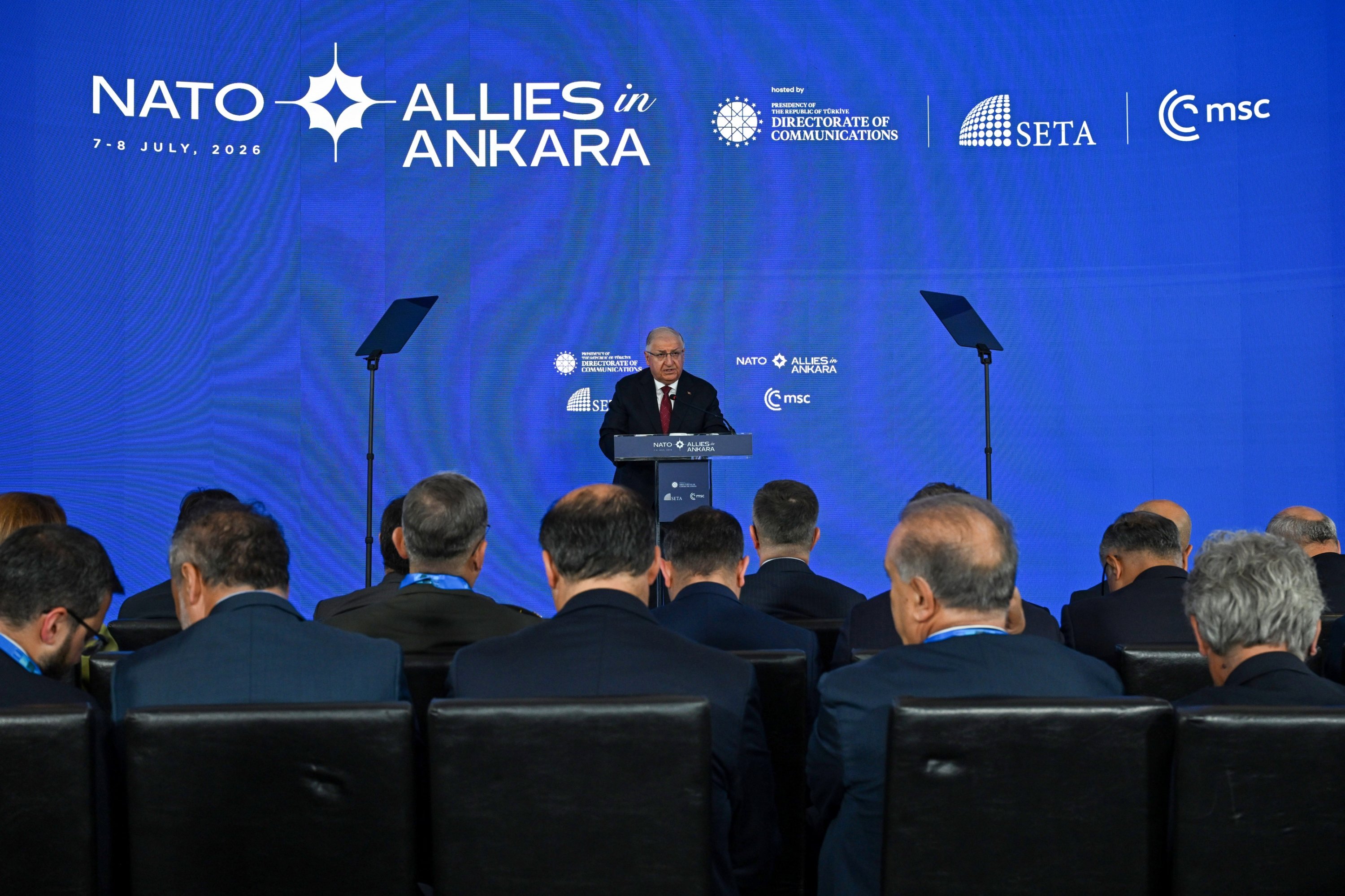
Speaking at the “Allies In Ankara” event in the Turkish capital on Tuesday, National Defense Minister Yaşar Güler emphasized Türkiye’s expanding role in NATO as the heads of state and government convened for a two-day summit.
“Türkiye possesses a very large, professional, active armed force. Its defense industry is also growing. The growth is sustained in this region where high security is needed. Türkiye’s efforts (for growth) are upgraded to a strategic gain and a significant edge,” Güler said.
Türkiye welcomes the growing commitment among NATO allies to increase defense spending, but higher budgets must be translated into concrete military capabilities, trained personnel and resilient defense industries, Güler also said.
The event is organized jointly by the Turkish Presidency’s Communications Directorate, the Foundation for Political, Economic and Social Research (SETA), and the Munich Security Conference and began on the same day as the summit, which is expected to decide the fate of the alliance in the changing global order.
"Increasing defense spending is important, yet spending money alone does not produce deterrence,” he said.
He stressed that NATO's credibility will depend on whether allies can turn political commitments into ready forces, ammunition, logistics, integrated air and missile defense, command-and-control structures and industrial capacity.
Noting that the alliance had gone through different phases since the end of World War II, first focusing on collective defense during the Cold War, then shifting toward crisis management and counterterrorism missions, Güler underlined that NATO has now entered a new phase requiring credible collective defense while preserving its ability to respond to crises from all directions.
He said Türkiye supports a stronger and more balanced alliance in which European allies assume greater responsibility for defense, while the trans-Atlantic bond and the U.S. security commitment remain indispensable. But, he added, burden-sharing should not be measured only by budget figures. Operational risks, geography, readiness, mission contributions, industrial capacity and the ability to act during crises should also be taken into account, he said.
Pointing to Türkiye's long-standing role within the defense alliance, Güler said the country preserved a sizable, professional and active military force while many European countries reduced their armed forces, stockpiles and defense production capacity after the Cold War.
Türkiye, which joined NATO in 1952, has never been merely a geographical frontline country, he said, adding that it has consistently assumed risks, carried responsibility in the field and contributed to deterrence when necessary. Initially rejected by some members, the country, which sought protection against the Soviet Union, was finally accepted into NATO after it pledged to send troops to support the United States in the Korean War.
Güler said Türkiye maintains NATO's second-largest army and has one of the alliance's most capable forces, with high readiness, operational experience, strong training standards and joint operational capacity.
Türkiye's contributions extend from the Baltic region to the Black Sea and include NATO missions, operations and exercises, as well as responsibilities in maritime security, crisis management, training and deterrence, he said. Türkiye also hosts critical NATO facilities, including Allied Land Command, which is located in the western city of Izmir, and Rapid Deployable Corps, which is based in Istanbul. The capital, Ankara, hosts the Centre of Excellence for Defence Against Terrorism (COE-DAT) and the Partnership for Peace Training Center. Istanbul hosts the NATO Maritime Security Centre of Excellence (MARSEC COE).
Güler highlighted Türkiye's defense industry, saying Ankara has developed advanced capabilities in unmanned systems, air defense, electronic warfare, ammunition, naval platforms, aviation and command-and-control technologies. Over the next three years, Türkiye will give greater priority to air and ballistic missile defense, long-range fires and unmanned vehicle systems to meet both NATO capability targets and national defense requirements, he said. He said these capabilities are not only national assets, but when properly integrated, can help close NATO's capability and production gaps.
Türkiye favors cooperation over rivalry, joint production over exclusion and capability-based cooperation over restrictions in the defense industry, he added.
On European security, Güler said Türkiye welcomes a stronger European defense contribution, provided that it reinforces NATO rather than competes with it. "NATO-EU cooperation must be inclusive, integrating and mutually reinforcing," he said.
Güler said the NATO summit in Ankara would be a critical threshold for the alliance to address unity, cohesion, defense investments, industrial production, support for Ukraine and future deterrence. He said the message from Ankara should be clear: NATO's Article 5 commitment remains ironclad, but pledges must be backed by credible military power. He also underlined that NATO must preserve a 360-degree approach to security, covering both the eastern and southern flanks, as well as challenges beyond the Euro-Atlantic area.
The Strait of Hormuz, the Gulf, Syria, Iraq, the Eastern Mediterranean, North Africa, the Sahel, the Black Sea and the Caucasus are all part of the same strategic environment, he said.
Today's security cannot be ensured only through tanks, aircraft and ships, but also through secure data, reliable supply chains, protected infrastructure, resilient societies and the ability to act faster than adversaries, he added. Türkiye will continue to contribute to NATO's deterrence and defense, cooperate closely with allies and support the alliance's transformation, the minister said.