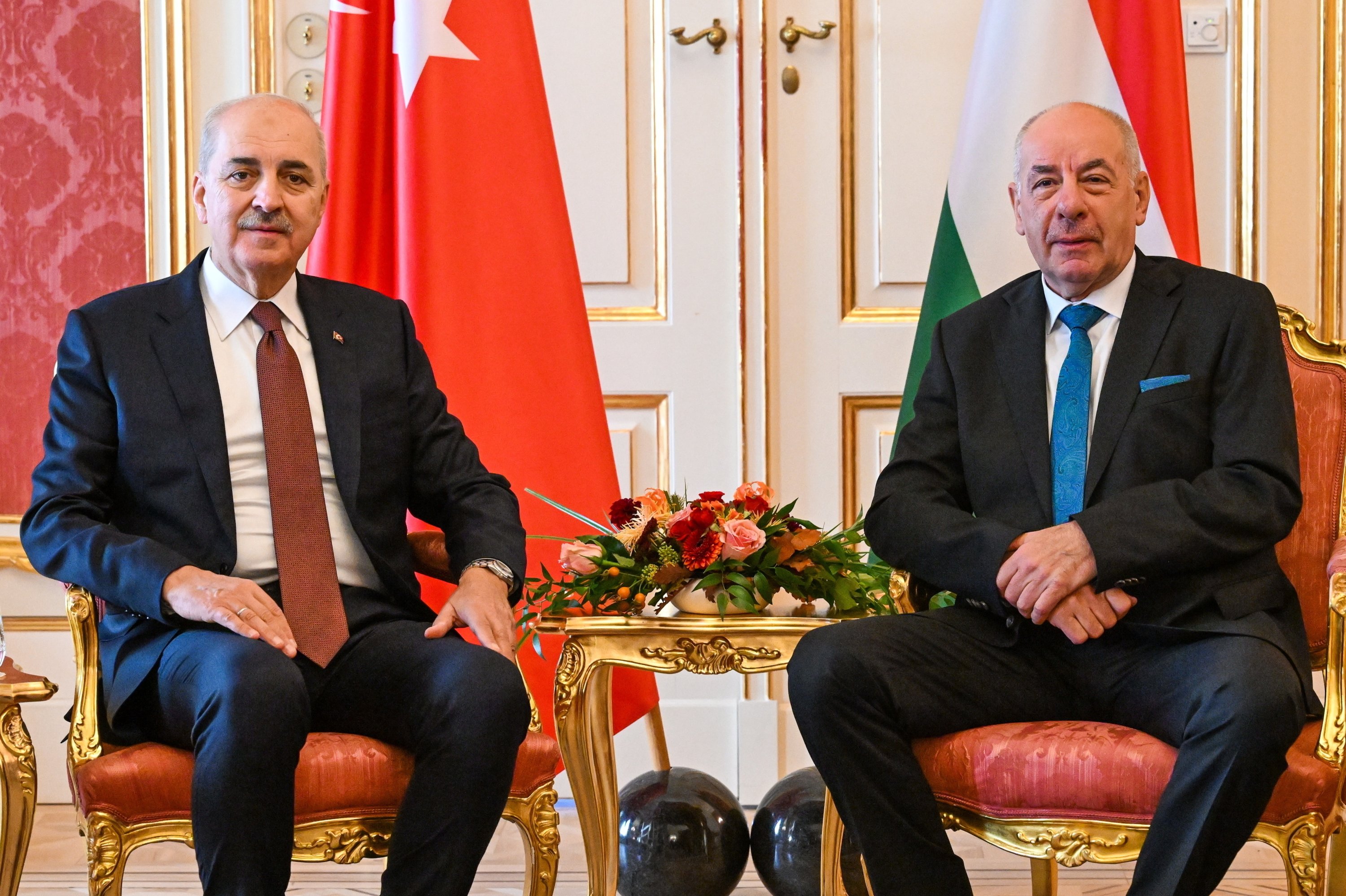
Parliament Speaker Numan Kurtulmuş said Tuesday that Türkiye and Hungary are key pillars of the Organization of Turkic States (OTS), calling the group of nearly 300 million people an emerging center of peace and stability in a world marked by conflict.
Speaking at the inauguration of a new Hungarian Maarif Schools building in Budapest, Kurtulmuş described Hungary as the “European outpost” of the OTS and underscored Türkiye’s role as its hub in Anatolia.
“The Organization of Turkic States will be one of the important centers of peace, stability, friendship and development,” he said, pointing to the bloc’s strategic position between Asia and Europe.
The Maarif Foundation school, opened with Hungarian Parliament Speaker László Kövér, reflects not only cultural diplomacy but also a deepening bond between Ankara and Budapest.
Kurtulmuş called Turks and Hungarians “cousins,” citing historical and cultural ties, and said the new school is “a hallmark of Turkish-Hungarian friendship” and an investment in shared futures.
With nearly 70,000 students worldwide, the Maarif Foundation is one of Türkiye’s most visible education initiatives abroad. Kurtulmuş also highlighted the Yunus Emre Institute, which promotes Turkish language and culture, and the Turks Abroad and Related Communities Institution, which funds scholarships for Hungarian students in Türkiye. These efforts, he said, strengthen both cultural and political ties.
The speaker emphasized that Hungary has consistently supported Türkiye in the European Union accession process, even during moments of what he described as “double standards” by Brussels. He also recalled the symbolic weight of shared heritage sites such as the Gül Baba Mausoleum in Budapest and Ottoman-era cemeteries in Esztergom and Višegrad as reminders of historical friendship.
“Above all, Türkiye and Hungary are deeply committed to family, tradition and cultural values,” Kurtulmuş said. “Both nations look to the future, not the past, and will work together hand in hand, heart to heart, for a stronger tomorrow.”
The OTS, originally founded in 2009 as the Cooperation Council of Turkic-Speaking Countries, seeks to integrate Turkic nations through shared values and cooperation in politics, education, security, and trade. Covering more than 4.25 million square kilometers and a population of roughly 160 million, the bloc has gained regional recognition while cultivating ties with observer states such as Hungary.
The next step in that process comes Oct. 7, when Azerbaijan will host heads of state in the city of Gabala for a summit themed “Regional Peace and Security.”
According to an OTS statement, leaders and delegations will “deliberate on pressing regional and international issues, enhance cooperation and adopt key documents aimed at further advancing unity, peace and prosperity across the Turkic World.”
The gathering follows improving stability in the Caucasus after a peace deal between Azerbaijan and Armenia, while regional uncertainty persists with the Russia-Ukraine conflict. Türkiye, maintaining ties with both sides, has positioned itself as a mediator, a role it hopes to extend within the broader Turkic world.