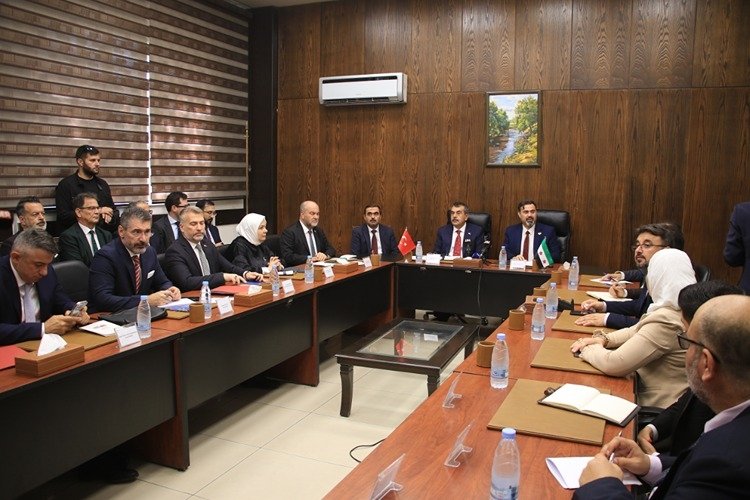
The Ministry of National Education mobilized education diplomacy to strengthen cultural partnerships and foster lasting international ties.
In recent years, the ministry has signed 350 agreements with 125 countries to build upon this education diplomacy.
These partnerships span a wide geography, from the Turkish Republic of Northern Cyprus (TRNC) to Qatar, from Greece to Mongolia. In the past two years alone, Türkiye has signed 16 new agreements with 14 countries, expanding its global education network.
A recent protocol signed with Syria covers teacher training, professional development and special education. Türkiye also cooperated with Moldova to open the Recep Tayyip Erdoğan Türkiye-Moldova College. Strategic agreements have been signed with Ukraine, Mongolia, Azerbaijan, Kazakhstan and Kyrgyzstan in areas ranging from higher education to vocational training. Negotiations with the TRNC, Turkmenistan and Uzbekistan are paving the way for the opening of new Turkish schools.
As of June 2025, Türkiye operates 65 educational institutions in 13 countries, serving more than 12,000 students with 679 teachers. Among the newly established institutions, the Recep Tayyip Erdoğan Türkiye-Moldova College and the Karabakh Turkish School stand out. These schools not only strengthen Türkiye’s presence in education but also serve as key instruments of cultural diplomacy.
Since 1994, the “Sister School Program” has paired Turkish schools with counterparts in 64 countries, creating 1,229 partnerships, 712 of which are with schools abroad. The initiative has enhanced cultural exchange and mutual understanding across nations.
The ministry also promotes inclusive education through adaptation classes for foreign students, the PIKTES+ Project and Turkish Language and Culture courses. During the 2024-2025 academic year, 2,174 students in eight countries are receiving Turkish language and culture instruction, with plans to expand the program to 11 countries in the coming years.
The Directorate General for Lifelong Learning leads adult education, social integration, and employment-focused initiatives in collaboration with the European Union and United Nations agencies. Projects conducted under Erasmus+, EPALE, and partnerships with UNICEF, UNDP and UNHCR further enhance Turkey’s education diplomacy capacity.
Ministry officials said the ongoing projects and agreements are part of Türkiye’s broader “soft power” strategy, reflecting the country’s growing role as not only a regional but also a global actor in education. They added that in the coming period, Türkiye aims to institutionalize its education diplomacy further and promote inclusive education models internationally.