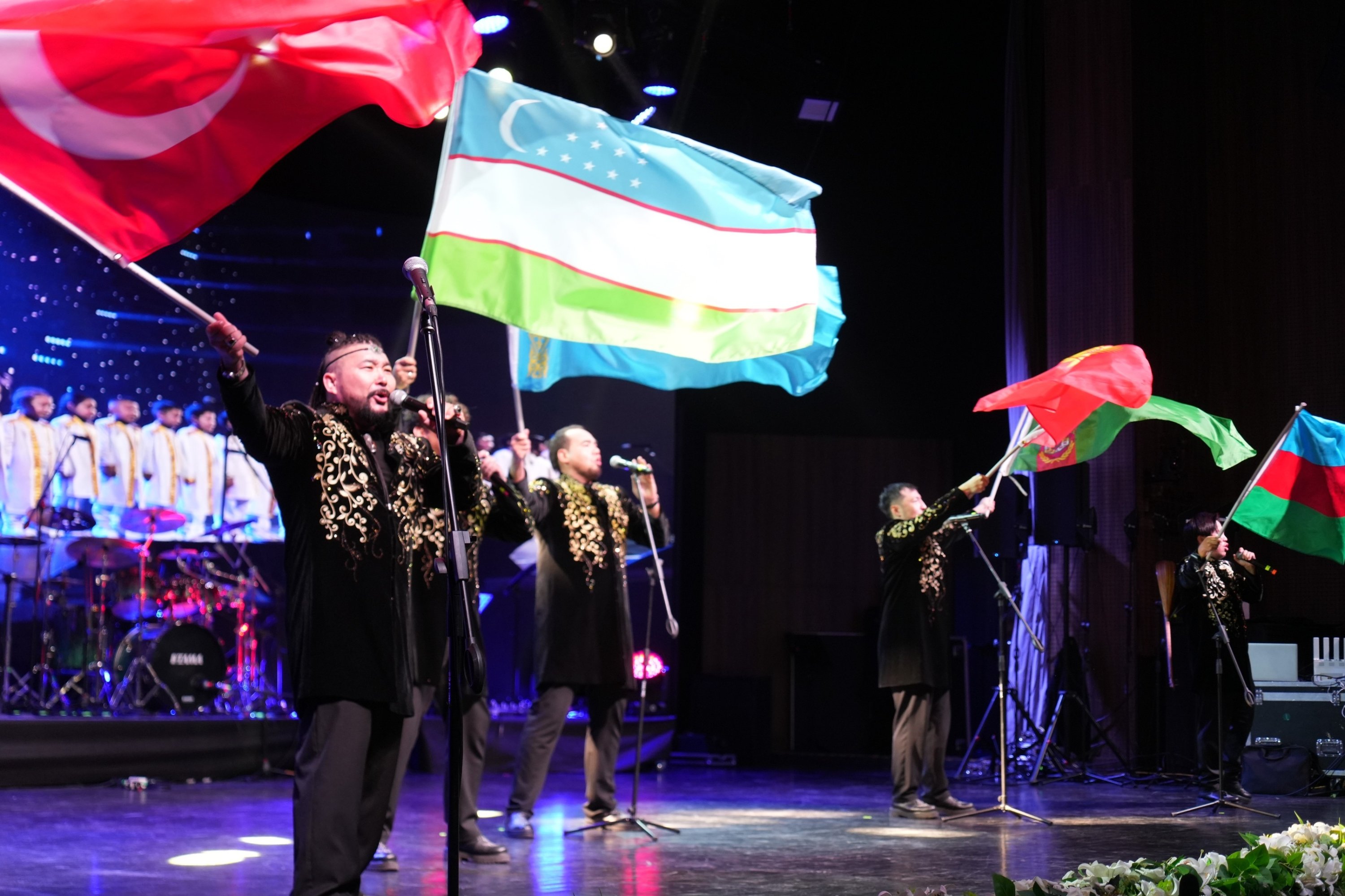
The Turkic World Youth Gathering brought together hundreds of youth in the northwestern Turkish province of Kocaeli this week. On Sunday, the last day of the event co-organized by the ruling Justice and Development Party (AK Party) and the local municipality, President Recep Tayyip Erdoğan addressed participants via a video message.
Erdoğan said that the partnership among Turkic nations extends far beyond geographical borders, emphasizing their shared history, rich culture and strong emotional bonds.
"Our partnership goes far beyond the borders drawn on maps. Our journey together is built on a deep-rooted history, a rich culture and very strong bonds of affection," he said.
He welcomed the young people attending the event from different parts of the Turkic world and asked them to pass along his greetings to their home countries.
Erdoğan also congratulated his party’s Directorate for Relations with Turkic States and everyone involved in organizing the gathering, which brought together young people from across the Turkic world under the motto "Shared Heritage, One Heart."
“I consider it very important that the children of Anatolia come together with you, my young brothers and sisters from different regions of the Turkic world," he said.
"We will continue to provide the strongest possible support to you, young people who unite your energies around a common ideal toward a prosperous future," he added.
Erdoğan noted that Türkiye would host the 13th summit of the Organization of Turkic States (OTS) at the end of this month, and they aimed to further their motto and concept “unity in language, ideas and work.”
Türkiye is expected to assume the rotating presidency of the OTS during the summit. The OTS membership now spans an area hosting more than 170 million people, and the combined gross domestic product (GDP) of the member countries exceeded $2 trillion (about TL 98.44 trillion). The rise of the Turkic world as a united force in the broader region has transformed it into a key actor in global affairs, rather than a bunch of post-Soviet states and their allies on the margins. For the U.S., for instance, it is now viewed as a hub of alternative supply chains and investment situated geographically on the periphery of Russia and China. For Türkiye, these states possess vast opportunities, both separately and as a composite entity.
Kürşad Zorlu, deputy chair of the AK Party who also heads the party’s Directorate for Relations with Turkic States, said at the event on Saturday that, as the Turkic states, they had recently been working on a common alphabet and stressed the importance of establishing a shared framework to bring their languages of communication closer together.
Zorlu said participants had come not only from Turkic states but also from Gagauzia, Iraq, Syria, Tabriz and many other places. He said they were united by the goal of expanding cooperation across all fields throughout the Turkic world.
“The foreign trade volume between Türkiye and our seven brotherly Turkic states has reached $115 billion in just five years. Last year, this figure stood at $26 billion,” Zorlu said.
“This is not yet our ultimate goal, as it accounts for approximately 4.5% of our total foreign trade. Our aim is to work toward increasing the share of trade with each of our Turkic states to 10% and to achieve that target.
“Recently, our cooperation in education, health care, tourism and many other fields has also been growing. This is bringing about a process that can stimulate and encourage areas of cooperation that directly connect our peoples.”
Zorlu said one of the issues under consideration was allowing citizens to travel between OTS member states using national identity cards.
“We currently travel using our passports. We are working to lay the groundwork and make the necessary preparations to enable us to travel using our identity cards,” he said.
Zorlu also said remarks by Kazakh President Kassym-Jomart Tokayev on the Middle Corridor had opened up new horizons for them.
“President Tokayev proposed carrying out the necessary work to connect the 44-kilometer (27-mile) route between Nakhchivan and Azerbaijan, which we know as the Zangezur Corridor and have made great efforts to open, to the Middle Corridor through railway and transportation networks.
“This proposal comes from a strategic shield on the shores of the Caspian Sea. Here in Anatolia, we are working with another country on the Caspian coast to ensure that trade corridors become integrated. “We will not allow anyone to stop this. I sincerely believe that when we stand united and together and focus on our goal, we will make the next 100 years the ‘Century of the Turkic World.’”