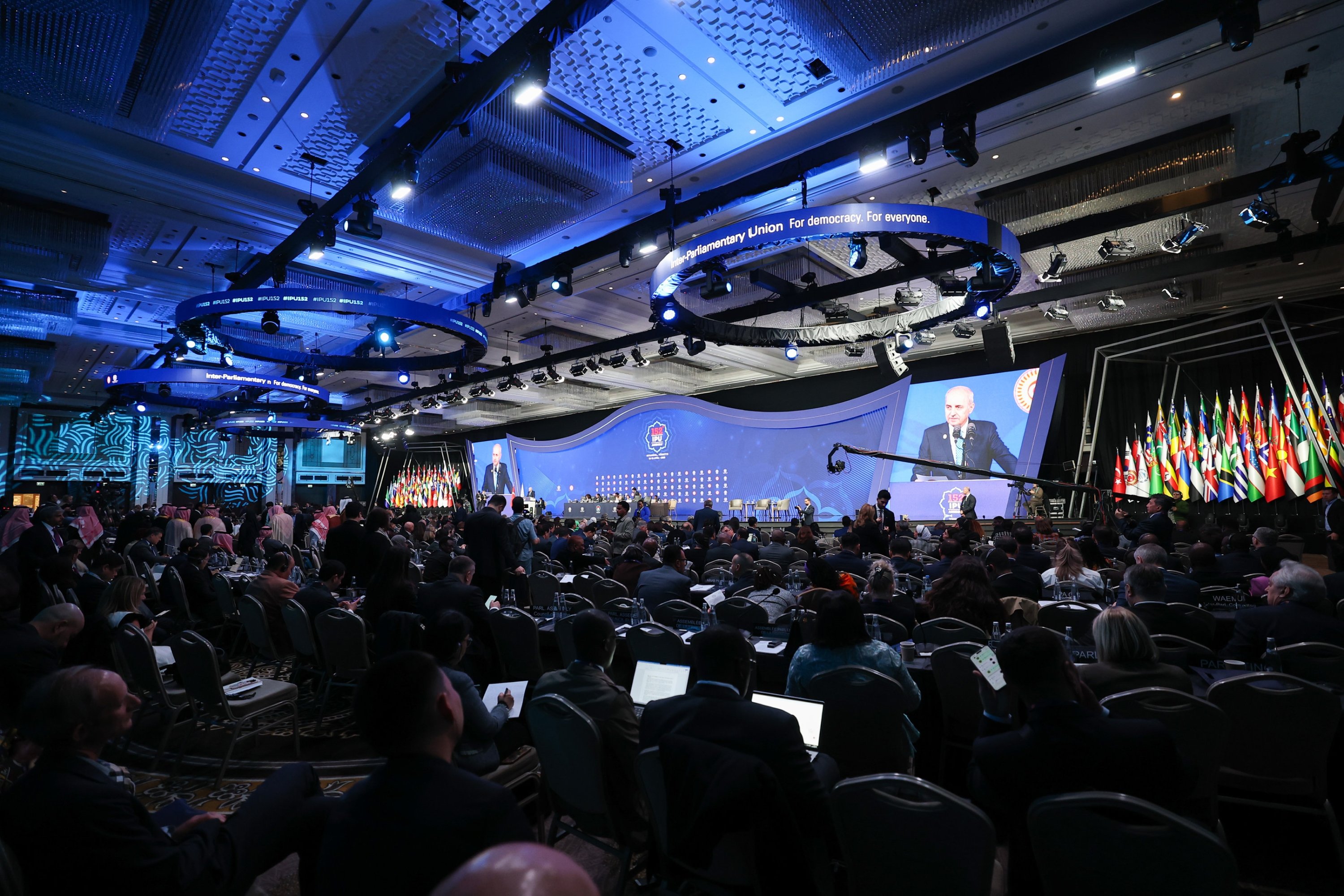
The Inter-Parliamentary Union (IPU) held its 152nd Assembly on Thursday in Istanbul, at a session chaired by Parliament Speaker Numan Kurtulmuş.
The situation in Gaza where tens of thousands of Palestinians were slaughtered by Israel since 2023 was the main theme of Kurtulmuş’s keynote speech at the General Assembly. He said hosting parliamentarians in Istanbul to deepen multilateral ties was a reflection of demonstrating humanity’s common conscience.
Referring to the event’s theme of “nurturing hope, securing peace and ensuring justice for future generations,” Kurtulmuş said it was a comprehensive goal addressing to the needs of the age.
Kurtulmuş noted that humanity is going through an extraordinarily difficult, critical and challenging period in which escalating and expanding conflicts, deepening inequalities, displacement, waves of hunger and the erosion of trust are all intertwined. He explained that a multilateral and multipolar political architecture had long been one of the main pillars of international balance.
Stating that developments in recent years have eroded the capacity of institutions to generate will, the ability to enforce rules and the moral weight of concepts, Kurtulmuş said: “The situation we face is not one that stems merely from certain technical deficiencies or disruptions, nor can it be explained solely by such shortcomings. We are confronted with a deeper, more comprehensive, and universal problem. While the global system maintains its claim to solve problems, unfortunately it fails to demonstrate the courage to implement norms. In principle, the texts remain in place and are in force; however, in the face of the destruction suffered by millions, these principles no longer have any protective effect. Law has been transformed into an instrument of pressure that bends for the powerful while becoming rigid against the weak.”
Emphasizing that the international system is in clear collapse and that the grave situation in Gaza is just one of the clearest manifestations of this collapse, Kurtulmuş continued: “In a situation where civilians cannot be protected, the right to life cannot be guaranteed, health infrastructure has been destroyed, humanitarian aid passages are blocked, and basic living conditions have been eliminated, the failure to present an effective and binding will constitutes a serious responsibility and a serious test for all of us in terms of the international system. There is no need to mince words here. An international structure that remains silent in the face of systematic attacks against humanity is in fact losing its founding claims. Centers that claim to represent conscience are content with merely watching the suffering. The Palestinian issue has gone far beyond being the tragedy of a particular region and has become a shared test for all of humanity,” he underlined.
Kurtulmuş stated that Gaza serves as a clear laboratory demonstrating the destructive consequences of selectively applied humanitarian law. “Gaza is a grave test that questions why institutions were established, whom rules are meant to protect, and how consistently the human family can act in the face of shared values and we are all confronted with this test. Silence maintained at the cost of the lives of the oppressed can never be considered neutrality. I would like to state clearly that political bargaining can never be conducted over the right to life of civilians,” he said.
He emphasized that the parliaments had a major responsibility in the face of these developments.
“We must not lose the ability to call an oppressor an oppressor under the guise of politeness. There is a difference between speaking in a measured way and speaking ineffectively, just as there is a difference between calmness and silence. Therefore, I would like to emphasize that parliaments bear a great responsibility in this period. We will both speak clearly and never adopt an attitude that hides the truth under the name of courtesy,” he said.
Founded in 1889 by parliamentary representatives to strengthen inter-parliamentary cooperation and dialogue, the IPU now stands out as the umbrella organization of the world’s parliaments, with 183 member countries.
Türkiye, which hosted General Assembly meetings in 1934 and 1951 and most recently 30 years ago, is set to once again demonstrate its experience and expertise in parliamentary diplomacy, as well as the importance it places on multilateral relations and international dialogue.
A highlight of the opening ceremony for the General Assembly was the arrival of the Iranian delegation with a bloodied school bag belonging to a student killed in a U.S.-Israel attack in the conflict that began on Feb. 28.
At the session of the peace and international security committee of the general assembly, lawmakers debated a resolution for the creation of post-conflict administrative mechanisms and works on ensuring fair and permanent peace by parliaments. Awni Al-Zoubi, a member of Jordan’s Parliament, told the session that a draft resolution he and fellow parliamentarians presented on the matter had references to the United Nations, noting that the parliaments had an important duty to convert political commitments to mechanisms and create follow-up, monitoring mechanisms. He said national agencies should lead post-conflict recoveries while other countries should provide support to the said agencies and ensure democratic legitimacy.
Benjamin Okezie Kalu, deputy speaker of the House of Representatives of Nigeria, told the session that a cease-fire is often confused with the “end of a war,” but post-conflict cease-fire agreements tend to be fragile and need structured efforts and frameworks.
“Without this framework, the countries are at risk of succumbing to the cycle of violence,” Kalu warned. He said parliaments can help turn fragile agreements into binding regulations.