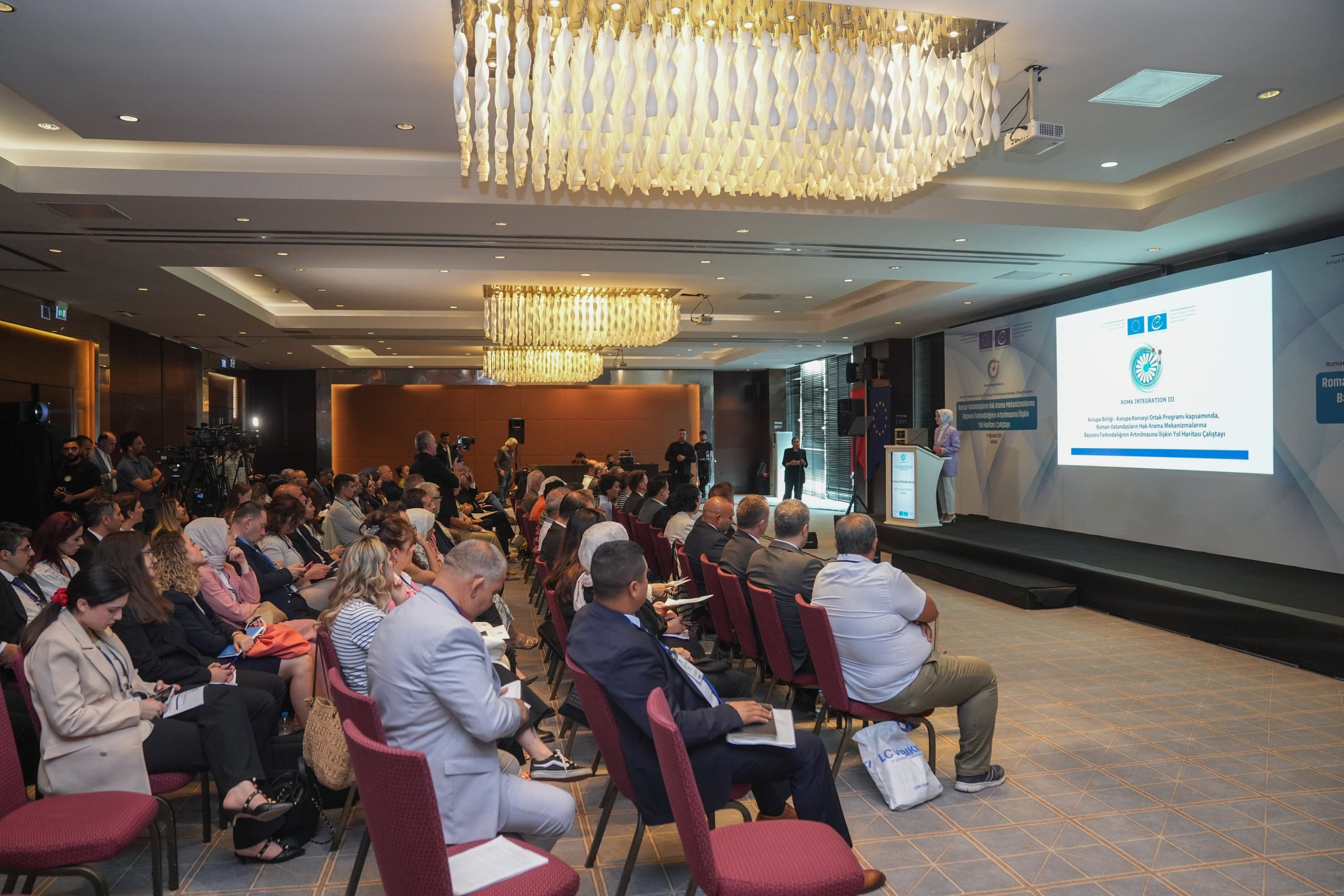
Addressing an event to raise awareness about the Romani community's right to an effective remedy, Family and Social Services Minister Mahinur Özdemir Göktaş said they were about to finalize work on an action plan regarding the matter.
Göktaş, on Wednesday, attended a workshop for a road map to improve Romani citizens’ awareness of access to legal remedies as part of a project in cooperation with the European Union. She said the workshop was a step toward advancing the country's Romani Integration Project.
Romani citizens have long been treated as second-class citizens in Türkiye, but affirmative action under the leadership of President Recep Tayyip Erdoğan, who hails from a working-class neighborhood with a large Romani population, changed this state mindset.
Göktaş said the project covers an area from Albania and Bosnia-Herzegovina to Serbia and Türkiye. “We will talk about problems, but also experience and how we can find well-informed solutions. A rights-based approach would be translated into concrete results,” Göktaş said. The minister noted that Türkiye, under the leadership of Erdoğan, launched in 2009 a comprehensive process to address the problems of the Romani community.
“We launched a new period in improving our Romani citizens’ access to services. We implemented numerous projects in collaboration with public institutions and relevant stakeholders. We then implemented our 2016-2021 strategy paper and action plan for Romani citizens. Our main goal was to enhance their living conditions and socio-economic well-being. Common goals were defined on education, employment, housing, social aid and social services,” she stated.
She provided the example of the SIROMA project, launched in 12 provinces to offer Romani citizens access to quality education and health care, and ROMSID, a project aimed at promoting the registered employment of Romani citizens who often work in informal jobs and tend to face discrimination in hiring. The minister pointed out a new strategy paper and action plan for the years 2023 and 2030 that included a comprehensive framework. She emphasized the importance of “localization” in addressing the issues faced by the Romani community. She noted that provincial governorates coordinated local action plans in provinces with a large Romani population “on a micro level.” So far, 25 provinces have established working groups to oversee plans, and they regularly hold meetings to address problems the community faces.
She noted that Türkiye has been observing World Roma Day since 2021 through events and has delivered more than 6,700 houses to the community since 2009.
“Our Romani Integration Project focuses on three points. One is promoting public policies for the community and secondly, to enhance socio-economic integration, supporting equality in various fields, from accommodation and education to employment and health care, to green and digital transformation. Lastly, we are aiming to increase the capacity of our institutions in this field,” she said.