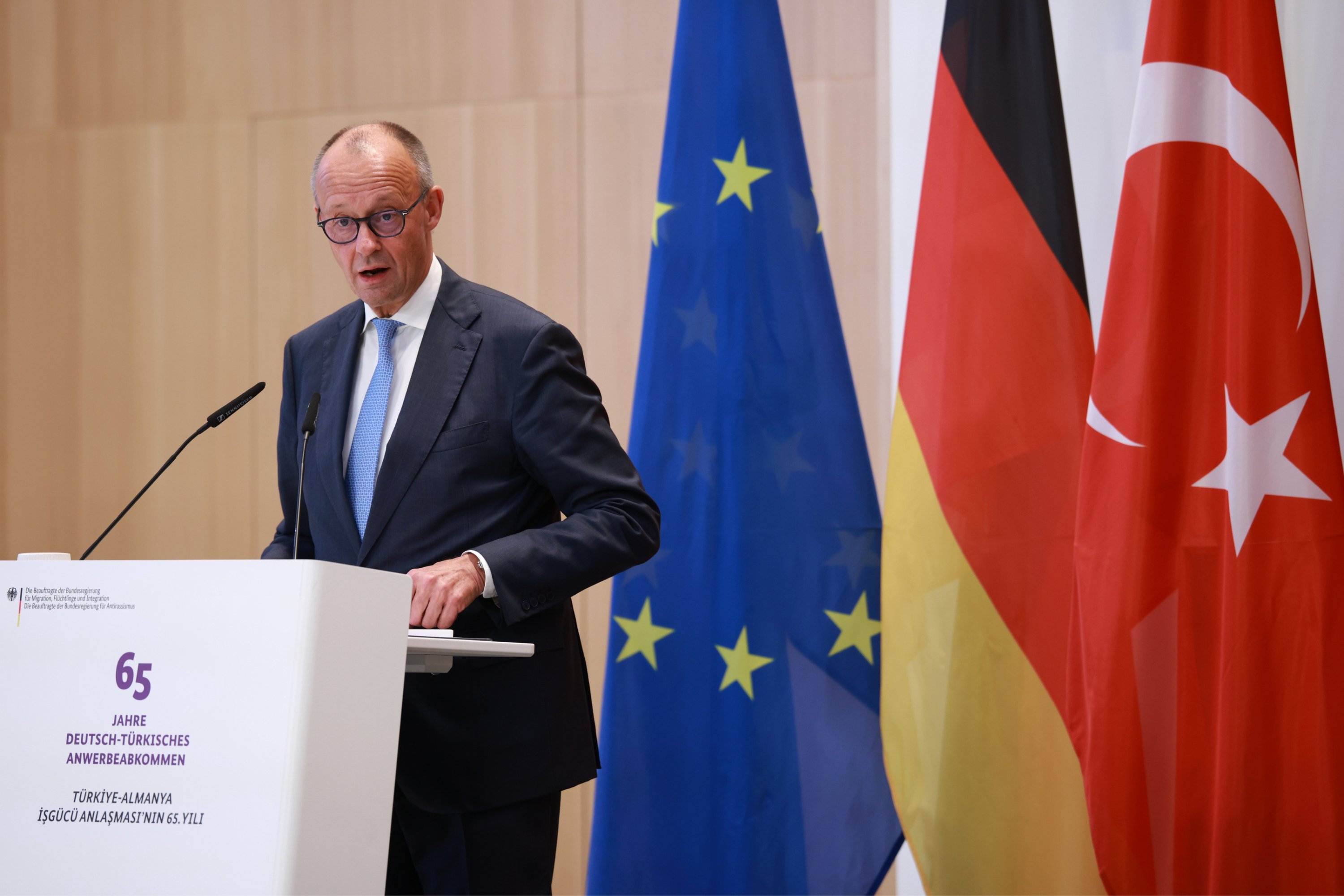
German Chancellor Friedrich Merz on Tuesday hailed the contributions of Turkish guest workers to Germany's postwar prosperity, describing their migration as a success story that helped transform the country's economy, culture and society over the past 65 years.
Speaking at a ceremony in Berlin marking the 65th anniversary of the German-Turkish labor recruitment agreement, Merz praised generations of Turkish workers for helping establish Germany's industrial foundations and contributing to its continued economic and cultural development.
"Turkish guest workers helped build the industrial foundation of our country," Merz said, referring to those who arrived following the Oct. 30, 1961, agreement. "They helped build the foundations of our nation. They created the infrastructure of the prosperity in which we live today."
Merz said decades of interaction between the two communities had helped shape modern German society.
"Germans and Turks became modern, open-minded and tolerant through encounters with each other in the 1960s, 1970s and 1980s," he said.
He added that Germany had become culturally, economically, scientifically and even through its cuisine richer thanks to migration from Türkiye, emphasizing that the country continued to need skilled workers from abroad.
The agreement brought hundreds of thousands of Turkish workers to West Germany during its postwar economic boom. Although many initially planned to return home after a few years, a significant number remained, reunited with their families and gradually became an integral part of German society.
Merz highlighted the achievements of subsequent generations, citing prominent German-Turkish figures including footballer Ilkay Gündoğan, filmmaker Fatih Akın and BioNTech founders Uğur Şahin and Özlem Türeci, whose research in oncology and immunology has gained international recognition. He also mentioned writers Aras Ören and Deniz Utlu.
"These are just the widely known figures – the particularly spectacular success stories," he said. "Yet there are thousands of others. They can be found in every federal state, in every sector of our society, across all political parties, within labor unions, and in employers' associations."
The chancellor described integration as a continuing responsibility shared by migrants and German society, emphasizing the importance of mutual respect and equal opportunities.
He said newcomers were expected to uphold Germany's democratic principles, including gender equality and responsibility toward Jewish people. In return, those who integrate should be able to expect equal opportunities and a sense of belonging regardless of their migration background.
Merz also acknowledged that many Turkish Germans across the first, second and third generations continued to face discrimination and exclusion despite their contributions.
"Fear of the foreign is poison for every free society," he warned, expressing concern that anti-immigrant sentiment was increasingly being exploited for political purposes.
He recalled deadly racist attacks in Mölln, Solingen and Hanau, as well as murders committed by the neo-Nazi National Socialist Underground (NSU) terrorist group, whose victims included eight people of Turkish origin.
The chancellor also condemned the term "remigration," used by politicians from the far-right Alternative for Germany (AfD) party, describing it as an attack on the multicultural society built over decades.
"Behind it lies an attack on modern Germany, which we have built together over the past 65 years," he said.
Germany's Integration Commissioner Natalie Pawlik echoed concerns about growing racism and discrimination, warning that members of migrant communities were increasingly experiencing exclusion.
"We are seeing how people are once again openly excluded," Pawlik said, noting that the trend was fueling fear among affected communities.
Turkish Ambassador to Germany Gökhan Turan, who also attended the ceremony, described the numerous events commemorating the anniversary as a testament to the longstanding friendship between Türkiye and Germany.
The ceremony brought together representatives of the first generation of Turkish guest workers alongside their children and grandchildren, highlighting the community's enduring role in German society.
The landmark recruitment agreement, signed Oct. 30, 1961, was initially designed as a temporary arrangement to address labor shortages in West Germany's rapidly expanding economy, with employment limited to two years.
The restriction was lifted in 1964, allowing workers to remain longer and facilitating family reunification.
Between 1961 and 1973, approximately 867,000 Turkish men and women traveled to West Germany under the recruitment program, finding employment primarily in the Ruhr region's coal mines, factories and industrial production lines.
About 500,000 eventually returned to Türkiye, while others settled permanently, establishing communities that would grow through subsequent generations and family reunification.
Today, Germany is home to approximately 3 million people of Turkish origin, making them one of the country's largest immigrant-origin communities and a significant part of its social, economic and cultural landscape.