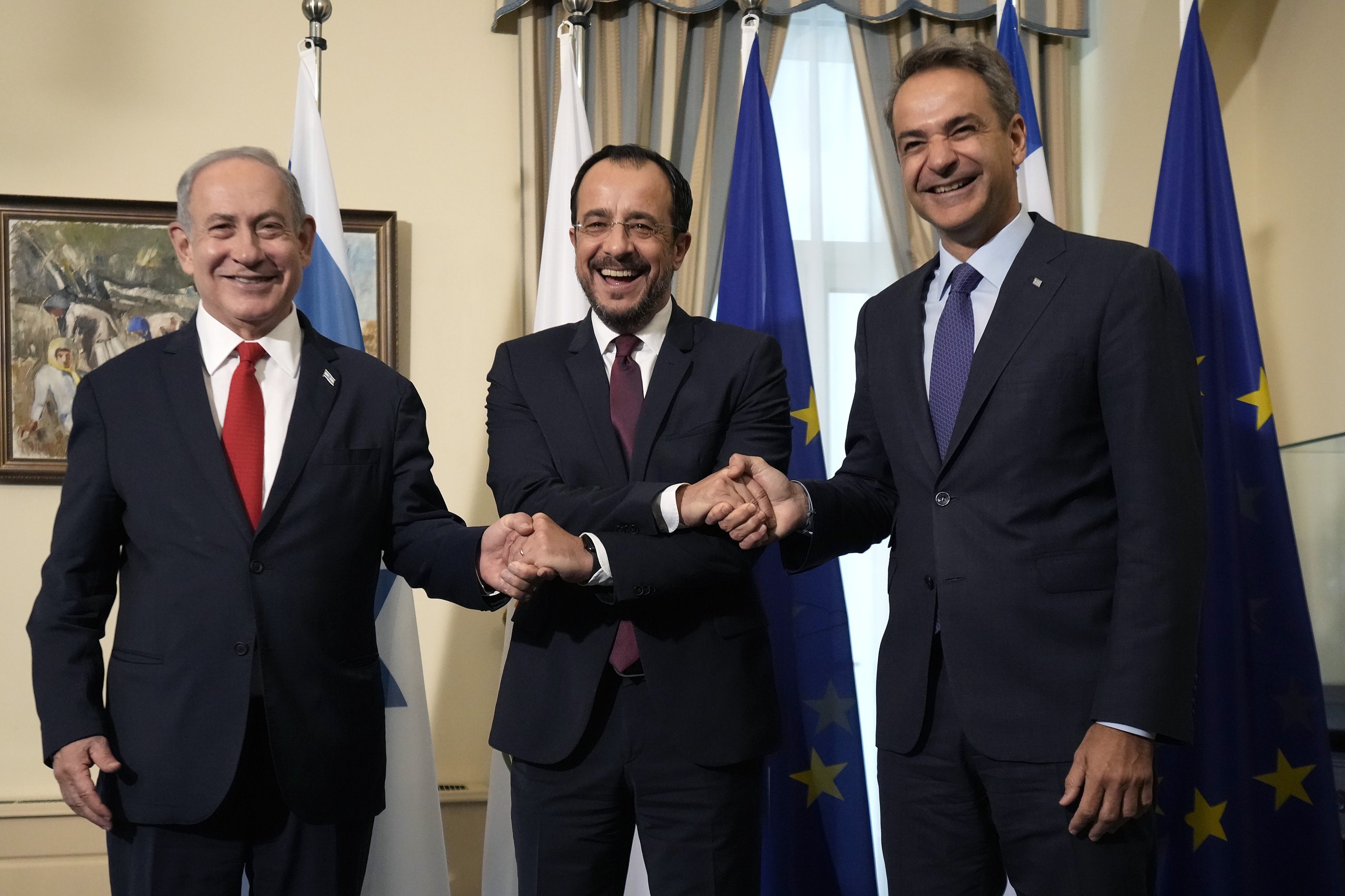
Israel, Greece and the Greek Cypriot administration's recent increasing trilateral partnership is an attempt to counter Türkiye’s growing regional influence, experts say.
“While the gatherings are publicly framed as part of a normal diplomatic process and regional cooperation, developments surrounding the summits point to a shared strategic outlook among the three countries, it is evident that all three regard Türkiye as a shared adversary and regional rival,” political scientist Ali Fuat Gökçe told Daily Sabah.
Israel’s Channel 12 television (N12), citing multiple sources with knowledge of the matter, reported that Greece is considering sending an engineering unit to Gaza as part of what Israeli officials describe as the territory’s “day after” phase, once large-scale fighting ends. The issue is expected to be discussed during talks on Monday between Israeli Prime Minister Benjamin Netanyahu and Greek Prime Minister Kyriakos Mitsotakis in Israel. Israel, Greece and the Greek Cypriot administration were scheduled to hold a meeting on Monday.
Emphasizing that Israeli concerns over Ankara’s regional influence and view Türkiye as a key obstacle to Israel’s military and political objectives, Gökçe stressed that the relations between Türkiye and Israel have also deteriorated, particularly over Gaza and Syria.
Channel 12 reported that a key driver of the growing Israel-Greece partnership is a shared desire to balance Türkiye. Israeli officials are increasingly wary of Ankara’s diplomatic and political influence in Gaza and its military footprint in northern Syria, while Greece views Türkiye as its primary strategic rival in the region.
According to an Israeli political source, Israel has been encouraging Greece to play an active role in Gaza’s future governance and reconstruction framework, viewing Athens as a partner capable of counterbalancing Türkiye’s expanding regional footprint. Israeli and Greek officials have intensified contacts in recent months amid concerns in both capitals over Ankara’s influence in Gaza and Syria.
The same source told Channel 12 that Greece has shown “clear willingness” to be involved in the postwar process in Gaza, an interest Israel shares. While no final agreement has been reached, the source noted that Israel would welcome a Greek presence in any future international force deployed to the territory, most likely in a noncombat capacity such as engineering or logistical support.
Mitsotakis’ political adviser, professor Sotiris Serbos, echoed that assessment in remarks to Channel 12, saying Israel favors Greek participation in the next phase in Gaza. “For Israel, it is extremely important to determine who will take part in any future force and under what mandate,” Serbos marked.
Greece’s interest in joining a postwar arrangement in Gaza has also been stated publicly. Greek Foreign Minister Giorgos Gerapetritis said last week that Greece would be prepared to contribute to a peacekeeping mission if such a framework is established, describing Athens’ ties with Israel as a “unique strategic partnership.”
The Gaza discussions are expected to feature prominently during a trilateral summit in Israel, where Netanyahu is set to host Mitsotakis and Greek Cypriot leader Nikos Christodoulides. Officials say the talks will also cover deeper cooperation in the eastern Mediterranean, including security coordination and energy projects.
Underlining that energy control over Eastern Mediterranean natural resources and east-west energy transit routes are widely seen as another unifying factor behind the trilateral summit, Gökçe remarked that “the region’s offshore gas reserves and pipeline corridors linking the Middle East to Europe have become a central focus of strategic competition.”
Serbos said Greece is preparing for multiple scenarios in the region and considers deeper military cooperation with Israel essential. Channel 12 described those comments as an indirect reference to Türkiye, noting that Serbos has argued the alliance is vital to counter Ankara’s “Blue Homeland” maritime doctrine.
Ahead of the trilateral summit in Jerusalem, President Recep Tayyip Erdoğan also addressed that Ankara has no territorial ambitions and does not want tensions with any country during a naval ceremony in Istanbul on Saturday.
Erdoğan said Türkiye desires peace and stability for its neighbors and aims to be a reliable partner during difficult times. He added, however, that Türkiye would not tolerate violations of its rights or sovereignty.
“All of our investments are not made to prepare for war. They are intended to protect peace, independence and our future,” he underlined.
Beyond Gaza, energy cooperation is also on the agenda. Israeli media reported that Netanyahu and Mitsotakis are expected to discuss Eastern Mediterranean energy projects and the India-Middle East-Europe Economic Corridor (IMEC), as well as a potential major arms deal that could include air defense systems.
According to Emete Gözügüzelli, associate professor from the Social Sciences University of Ankara, the recent trilateral summit between the Greek Cypriot administration, Greece and Israel reflects a continuing geopolitical alignment that aims to exclude Türkiye and the Turkish Republic of Northern Cyprus (TRNC) from regional decision-making under the banner of regional stability, energy security and cooperation.
“The choice of Jerusalem as the venue was widely seen as symbolic, while the renewed emphasis on projects such as the EastMed natural gas pipeline and the Great Sea Interconnector (GSI) electricity cable was interpreted as a deliberate strategic signal rather than a coincidence,” she asserted.
Gözügüzelli argued that these initiatives, presented as energy cooperation, seek to constrain Türkiye’s maritime rights in the Eastern Mediterranean, challenge interests Ankara says are protected under its “Blue Homeland” doctrine, and marginalize the Turkish Cypriot community’s claims over natural resources.
Greece recently announced plans to deploy a multibillion-euro missile defense initiative known as the “Achilles Shield” along its land border with Türkiye and across the Aegean and Eastern Mediterranean, with significant procurement from Israel.