A little-used clause buried in the European Union’s treaties has moved to the center of geopolitical debates, as the Greek Cypriot administration pushes to turn a vague commitment into a workable security mechanism, with Türkiye increasingly central to the discussion.
At issue is Article 42.7 of the EU’s Lisbon Treaty, a mutual assistance provision often likened to NATO’s Article 5. It obliges member states to aid a country under armed attack “by all the means in their power.” Yet unlike NATO’s collective defense clause, it leaves the nature of that assistance undefined and the process largely in national hands.
For years, the clause has existed more on paper than in practice. It has been invoked only once, by France after the 2015 Paris attacks, and even then, support came in varied, largely bilateral forms rather than through a unified EU response.
That ambiguity is precisely what the Greek Cypriot administration now wants to address.
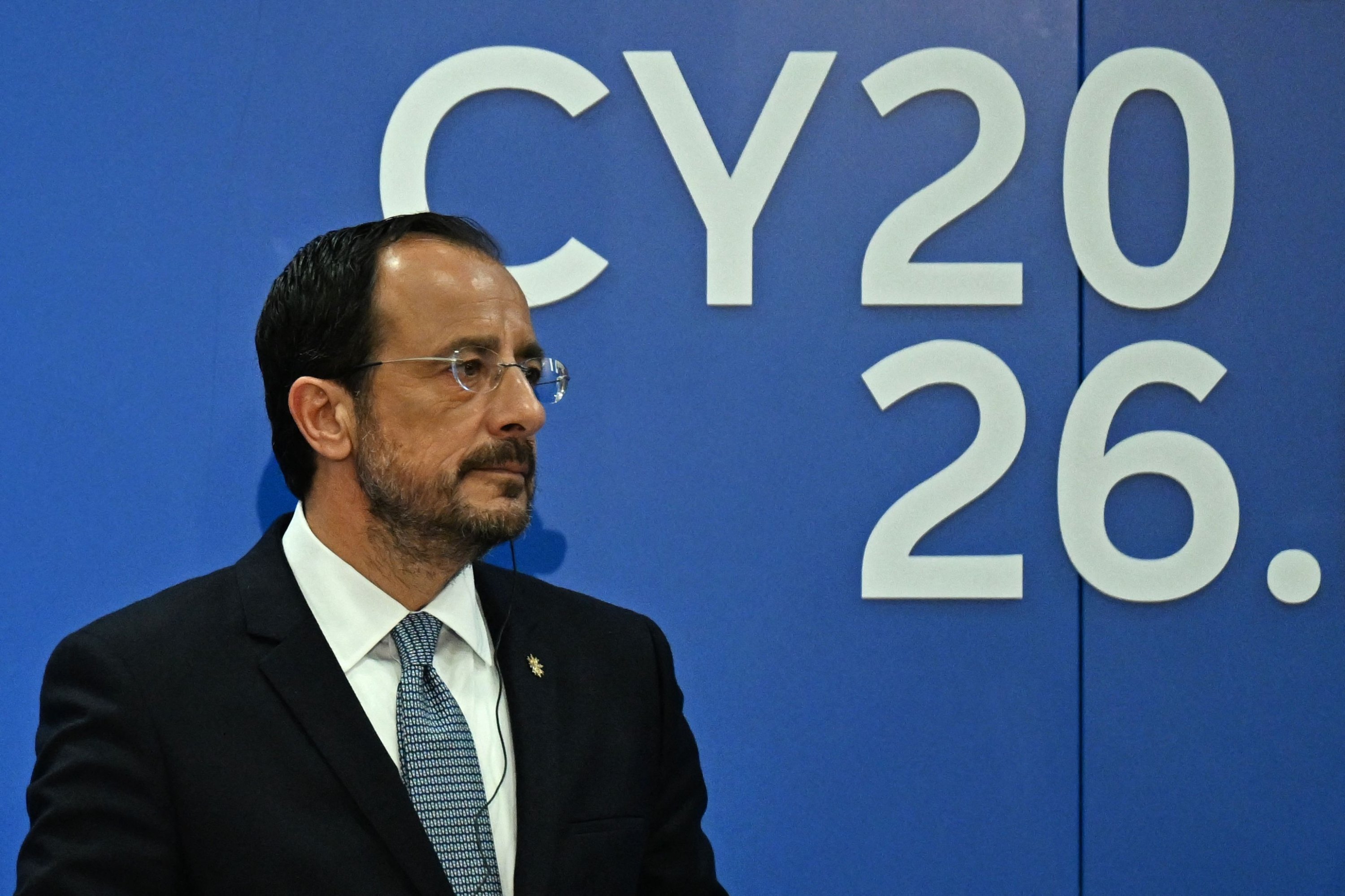
Speaking after an EU summit in Nicosia in late April, Greek Cypriot leader Nikos Christodoulides said the European Commission would prepare a “blueprint” detailing how the clause should function in the event of an attack. The move reflects growing concern within the bloc that, while the obligation exists, the mechanism to implement it does not.
The immediate trigger appears to be recent regional instability. A drone strike in March near a British military base on the island, during the height of the U.S.-Israeli attacks on Iran, underscored the island’s exposure. While the base lies on sovereign British territory, the incident sharpened anxieties in the Greek Cypriot administration about spillover risks and the limits of existing security arrangements.
Yet the push also reflects deeper, longer-standing concerns.
The Greek Cypriot administration occupies a distinctive position as one of the few EU member states outside NATO, meaning it cannot rely on the alliance’s Article 5 guarantee. That limitation has long shaped its security outlook, particularly in relation to Türkiye.
The island remains divided between the Greek Cypriot administration and the Turkish Republic of Northern Cyprus (TRNC), recognized only by Ankara. Türkiye maintains a military presence in the north, which the Greek Cypriot side continues to view as a security concern. Ankara, however, has consistently argued that its forces act as a guarantor of stability and protection for Turkish Cypriots, and not as a threat to the Greek Cypriot side.
This divergence has fed into wider tensions with Greece in the East Mediterranean, where disputes over maritime boundaries, energy exploration and sovereignty claims frequently overlap.
Within this context, Article 42.7 is increasingly seen in the Greek Cypriot administration as a potential framework for collective backing in the event of a crisis. Unlike NATO’s Article 5, which is widely understood to be inapplicable in a dispute involving two alliance members such as Greece and Türkiye, the EU clause could, in theory, be activated in a scenario involving an EU state and a non-member.
That distinction is central to its appeal, particularly in scenarios where tensions involving Türkiye could arise.
Diplomatic discussions in Brussels have increasingly focused on how the clause might operate in practice, including scenarios ranging from hybrid threats to conventional attacks. A series of “tabletop” exercises planned for later this year will simulate such contingencies, testing how EU member states could coordinate a response.
Yet enthusiasm for developing the clause is far from universal.
Many EU countries, particularly those firmly anchored in NATO, are wary of creating parallel structures that could dilute the alliance’s central role. Officials have repeatedly stressed that Article 42.7 is intended to complement, not replace, NATO’s Article 5, which remains the cornerstone of European collective defense.
The distinction is significant. NATO’s clause is backed by integrated command structures and decades of operational planning, whereas the EU provision relies on the political will of individual states. In practice, this means responses under Article 42.7 could vary in speed and scope.
For the Greek Cypriot administration, the initiative reflects both immediate and structural considerations: a response to recent regional shocks, and a longer-term effort to embed clearer security guarantees within EU structures, particularly in relation to Türkiye.
Türkiye, for its part, is likely to view these efforts cautiously. Any move that could broaden the EU’s role in regional security issues touching on Cyprus or the Eastern Mediterranean may be seen in Ankara as an attempt to shift the diplomatic balance.
Turkish officials have consistently rejected characterizations of their presence on the island as a threat, emphasizing instead their role under longstanding arrangements. From that perspective, steps to operationalize Article 42.7 risk reinforcing narratives that frame Türkiye as an external security challenge within the EU context.
Other EU members have their own reservations. Countries such as Hungary and Slovakia have expressed reluctance toward initiatives that could deepen security commitments, while neutral states including Ireland and Austria remain cautious about measures that might blur the line between cooperation and obligation.
The result is a careful balancing act. On one side is the push, led by the Greek Cypriot administration and supported by countries such as France and Greece, to give the EU’s defense clause practical meaning. On the other is a broader effort to ensure that such steps do not undermine NATO or create expectations the EU cannot fulfill.
For now, the “blueprint” being prepared in Brussels represents an attempt to reconcile those aims, offering reassurance without overextension. Whether that effort succeeds will depend less on legal detail than on political consensus and the willingness of states to act.