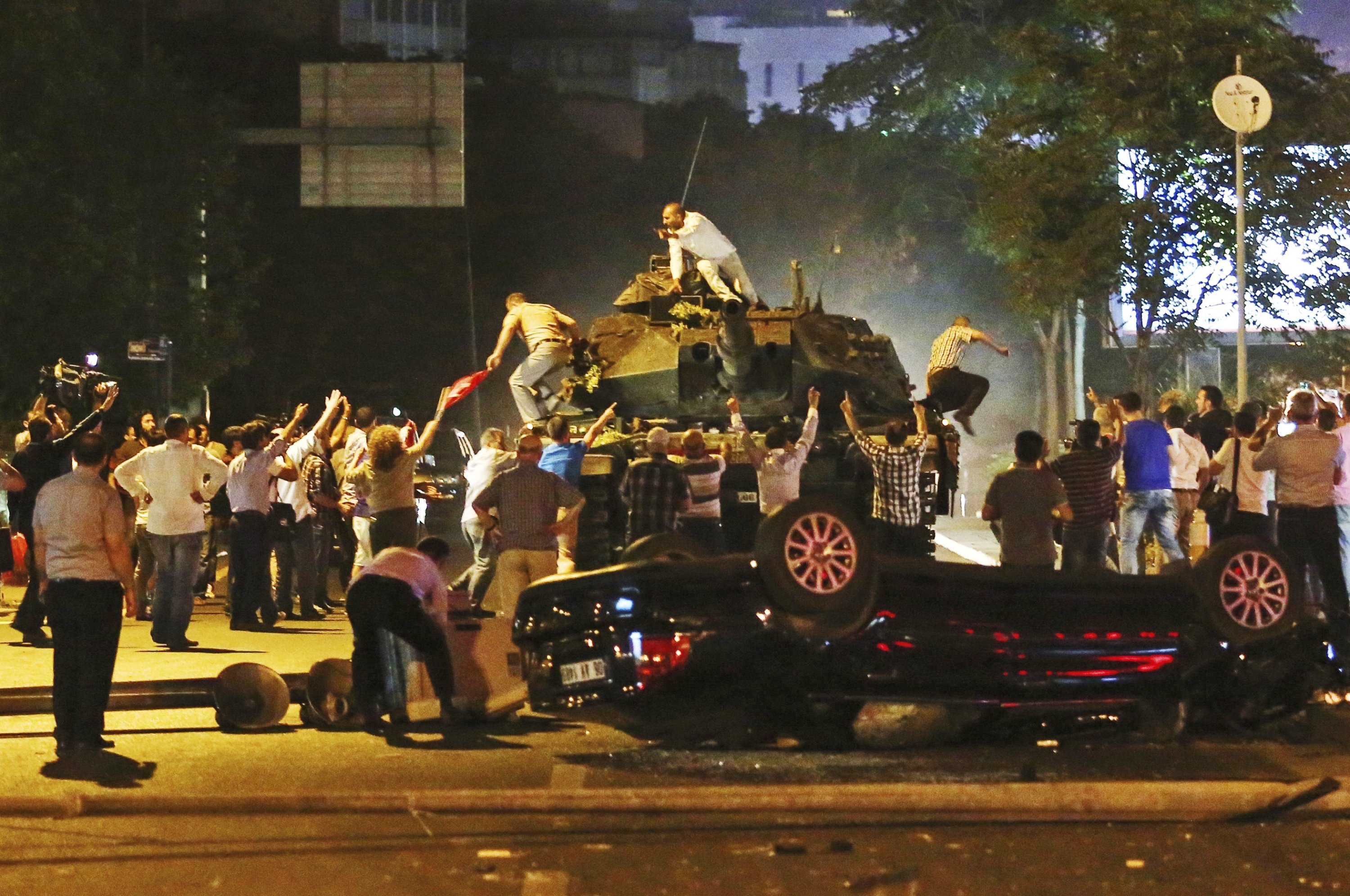
Burkay Karatepe's capture, 10 years after the Gülenist Terror Group's (FETÖ) coup attempt, has revived hopes for justice for the victims. Still, several generals and other senior officers involved in the coup attempt remain elusive.
Karatepe, an army captain, was the last member of the assassination team that plotted to kill or capture President Recep Tayyip Erdoğan during the president's stay at a hotel in southwestern Türkiye to be captured by authorities. The persistent pursuit of Karatepe, who was caught on security cameras in western Türkiye, paid off last week. Türkiye is now focused on bringing more putschists to justice, although some are believed to have fled the country after the coup attempt was foiled by public resistance.
Among them is Ali Kalyoncu, a member of the putschists' so-called Peace at Home Council, which would have governed the country had the coup succeeded. Brig. Gen. Kalyoncu headed the Human Resources Department at the Land Forces Command at the time of the coup attempt. He was slated to become commander of a brigade and deputy commander of the coup plotters' "martial law command." Kalyoncu was among the generals who attended a coup planning meeting four days before FETÖ attempted to seize power.
On the night of the coup attempt, Kalyoncu, together with former Maj. Gen. Osman Ünlü, who, like him, was a member of the so-called Peace at Home Council and had been designated commander of the 4th Corps in the coup plotters' assignment list, went to the 4th Corps Command and the 28th Mechanized Infantry Brigade Command at Eşref Akıncı Barracks and seized control of the facilities.
On Kalyoncu's orders, tanks commanded by coup plotters were dispatched to seize the Office of the Chief of the General Staff, the Turkish military's headquarters. He also sent tanks to seize the Ankara Provincial Police Headquarters and ordered a lieutenant colonel to reinforce other putschists attempting to take over the Gendarmerie General Command.
According to court records, Kalyoncu also instructed troops confronting civilians attempting to stop armored personnel carriers and other military vehicles, saying: "No civilians are to be allowed to climb onto the armored personnel carriers or any other vehicles. Intervene immediately and remove them." As a result of this order, 16 people, including police officers, were killed and 265 others were wounded. Kalyoncu is also wanted on charges of violating the constitutional order and attempting to assassinate the president, as well as responsibility for the deaths of 250 people and the injuries of 2,686 others during the failed coup attempt.
Former Brig. Gen. Mehmet Nail Yiğit commanded a brigade stationed in Istanbul during the coup attempt. He was appointed by the putschists to head Istanbul's martial law command. He was also tasked with detaining several politicians opposed to the coup. Acting on his orders, coup plotters attempted to seize several key locations in Istanbul, including Atatürk Airport, the Istanbul Provincial Police Headquarters, and the headquarters of pro-government broadcaster A Haber and the Sabah newspaper, sister outlets of the Daily Sabah. After the coup attempt failed, Yiğit went into hiding and has not been heard from since.
Former Rear Adm. Ayhan Bay, who commanded the Northern Task Group of the Turkish Naval Forces Command, sought to use the warships under his command to support the coup. He also ordered naval vessels to bombard coastal areas. Bay was among the users of ByLock, the encrypted messaging application developed for and exclusively used by FETÖ members. Investigators determined that he used the code name "Abdurrahman" while communicating through the application with FETÖ's civilian "imams," who supervised the organization's military infiltrators. He was aboard a naval vessel when he realized the coup had failed. After disembarking in the northwestern province of Kocaeli, he disappeared.
Former Vice Adm. Mustafa Zeki Uğurlu was serving on a NATO assignment in the United States during the coup attempt. He never returned to Türkiye and instead remained in the United States. Uğurlu has also been identified as one of the perpetrators behind the military espionage conspiracy cases centered in Izmir and is accused of facilitating the transfer of classified Turkish Armed Forces information to FETÖ leader Fetullah Gülen. He is wanted on charges including attempting to overthrow the constitutional order and membership in an armed terrorist organization.
Former Rear Admiral Ali Suat Aktürk, who served as head of the Force Development and Resource Management Department at the Office of the Chief of the General Staff during the coup attempt, was designated by the coup plotters to become governor of the Central Bank of Türkiye if the coup had succeeded. He disappeared after the coup attempt failed.
Former Staff Col. Ilhami Polat, who served as chief of staff of the Turkish Military Academy, detained Military Academy Commander Maj. Gen. Izzettin Çetingöz and directed coup-related activities at the academy.
Following the coup attempt, his wife, Judge Suzan Polat, became a cooperating witness in the investigation into her own FETÖ membership. She stated that her marriage had been arranged by FETÖ, which was known to choose spouses for infiltrators in key positions in order to maintain control over them.
According to her testimony, her husband told her that he would either surrender or flee.
"Ilhami dropped me off at a taxi stand near the metro station. I never saw him again," she said.
Suzan Polat also stated that during their final meeting, after saying, "Forgive me," her husband added, "The order came from above. Fetullah Gülen gave the order."
Former Brig. Gen. Mehmet Zeki Kıralp, who was serving at the Gülhane Military Medical Academy (GATA) during the coup attempt, reportedly received his general's rank insignia personally from Fetullah Gülen, who spent decades placing loyalists within the Turkish military. Kıralp also disappeared after the failed coup.
Serhat Pasha, a retired noncommissioned officer who had served as aide-de-camp to then-Chief of the General Staff Hulusi Akar until retiring two months before the coup attempt, and Şener Doğrugören, who was serving as Akar's aide-de-camp during the coup, participated in the detention of Hulusi Akar and then-Land Forces Commander Salih Zeki Çolak and in the seizure of the General Staff Headquarters while dressed in civilian clothes.
Although they held only the rank of noncommissioned officer, investigators allege that both men issued orders to FETÖ members who outranked them. Both fled after the coup attempt was suppressed.
Former Major Mehmet Murat Çelebioğlu, who also remains at large, was one of the key figures behind the Istanbul branch of the coup attempt. He coordinated the coup plotters through a WhatsApp group he created called "Yurtta Sulh Biziz" ("We Are Peace at Home").
Another fugitive, Ahmet Zeki Gerehan, ordered putschists to seize the headquarters of broadcaster CNN Türk after President Recep Tayyip Erdoğan addressed the nation through a live video call. Gerehan sought to cut off the broadcasts of CNN Türk and its sister channel Kanal D by dispatching troops to the stations. He also organized troops attempting to seize the Istanbul Governor's Office. An indictment against Gerehan alleges that he ordered soldiers under his command to fire on civilians resisting the coup. After the coup attempt was thwarted, Gerehan disappeared. A search of his home uncovered detailed notes listing locations the coup plotters planned to seize.