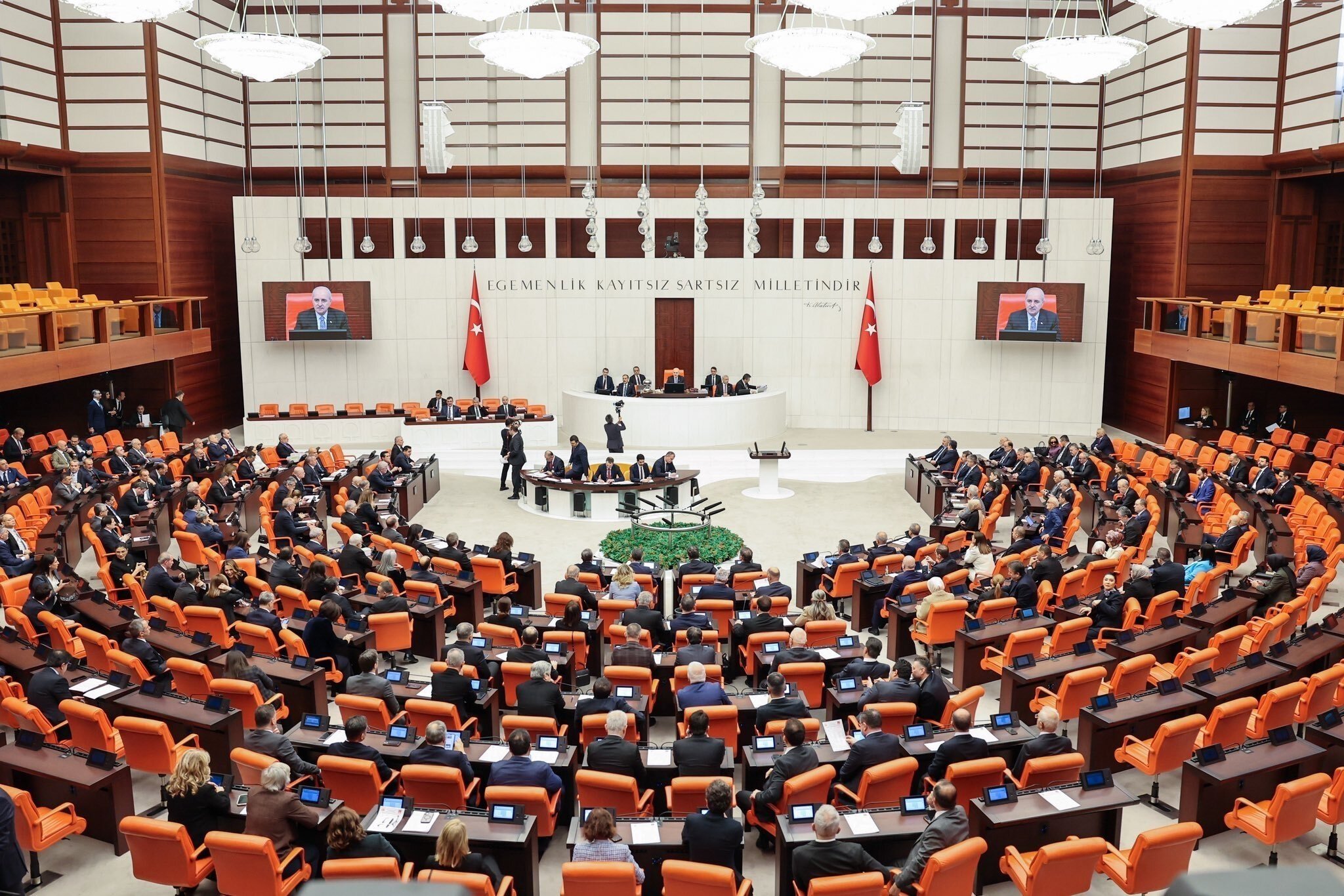
Parliament is debating a bill Wednesday approving the Mecca Joint Defense Agreement, a trilateral pact with Saudi Arabia and Pakistan aimed at strengthening collective defense, military cooperation and regional security coordination.
The agreement identifies Türkiye, Saudi Arabia and Pakistan as its three founding members, referred to as "Core Parties," and establishes mutual defense obligations based on respect for sovereignty, territorial integrity and international law.
Under Article 2, an externally initiated armed attack or military aggression against any signatory would be considered an attack against all three countries.
The provision draws on Article 51 of the United Nations Charter, which recognizes the inherent right of individual and collective self-defense.
However, military assistance would not be automatic or unconditional. The country facing an attack must first request support, after which the three parties would jointly assess the situation and determine the nature and scope of assistance through consensus.
Any deployment of Turkish troops abroad would remain subject to Article 92 of Türkiye's Constitution, which regulates parliamentary authorization for overseas military operations.
Beyond collective security commitments, the agreement outlines extensive cooperation in defense manufacturing, technological development and military logistics.
The three countries would pursue joint weapons production, research and development projects, technology transfers and specialized personnel training.
The framework also provides for coordinated logistical support, including supplies of ammunition, weapons, fuel and spare parts during peacetime, wartime and emergencies.
The agreement would establish a Strategic Political and Defense Committee comprising the foreign ministers, defense ministers and military chiefs of the three countries.
The committee would meet at least twice annually, with rotating host countries, while national leaders could convene once a year when necessary.
Saudi Arabia would host a permanent secretariat headed by a secretary-general serving a rotating three-year term. The first secretary-general would be a Pakistani national.
Articles 9 and 13 outline cooperation on counterterrorism and intelligence sharing through agreed secure communication channels.
Classified information would be protected under a "need-to-know" principle and could not be shared with third countries or companies.
The agreement would enter into force after the parties deposit their ratification documents with the secretariat and remain valid indefinitely.
Member countries would be prohibited from withdrawing during the first 10 years. After that period, withdrawal would require at least three months' written notice.
Additional countries could join only with the unanimous approval of the founding members and would be required to uphold principles of sovereignty, territorial integrity and noninterference.
For Türkiye, the proposed pact represents an effort to expand defense cooperation with Saudi Arabia and Pakistan while coordinating diplomatic and security initiatives through a formal trilateral framework.
Türkiye, Pakistan and Saudi Arabia held the first meeting of the Strategic Political and Defense Committee established under the agreement in Istanbul on Aug. 31. At that meeting, the three countries agreed to take further steps to institutionalize cooperation and establish a secretariat in Saudi Arabia headed initially by a Pakistani secretary-general for a three-year term.