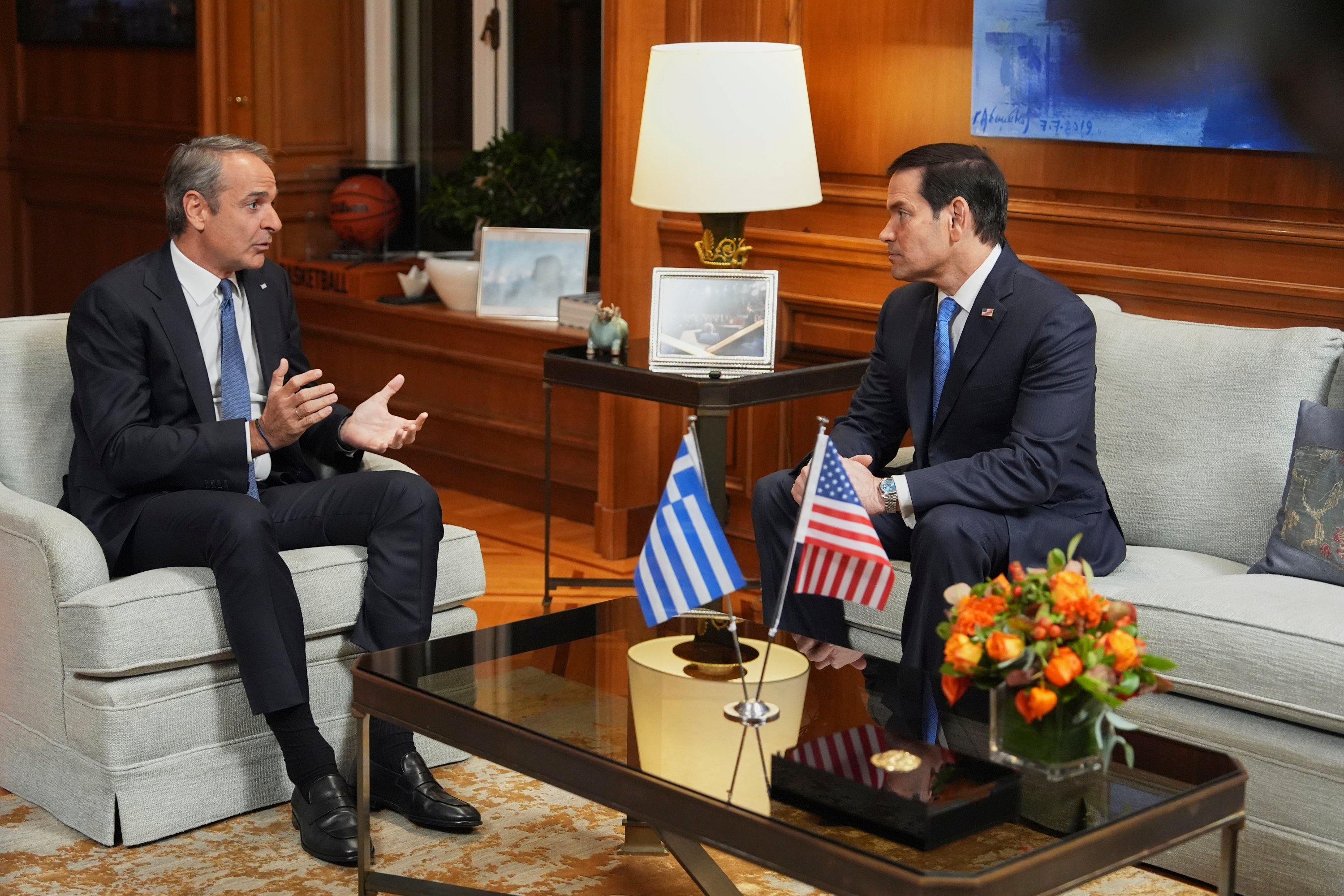
U.S. Secretary of State Marco Rubio said Wednesday that any confrontation between Türkiye and Greece over the Aegean Sea or the island of Cyprus would benefit neither country nor the U.S., stressing Washington's commitment to preventing tensions between the two NATO allies.
Speaking in an interview with Greek newspaper Kathimerini during a visit to Athens, Rubio dismissed the prospect of a conflict between Ankara and Athens, describing such a scenario as unthinkable.
"It wouldn't be good for anybody. It wouldn't be good for Greece. It wouldn't be good for Türkiye. It wouldn't be good for the United States," Rubio underlined, adding that Washington would not allow such a situation to develop.
Rubio also addressed the proposed Great Sea Interconnector (GSI) electricity project linking Greece, the Greek Cypriot administration and Israel, acknowledging potential obstacles and emphasizing the importance of diplomatic engagement.
He said Washington intended to use diplomatic channels to encourage solutions, arguing that sensitive disagreements were best addressed through private negotiations.
Highlighting Türkiye's strategic importance, Rubio noted that Ankara had previously hosted negotiations between Russia and Ukraine and maintained cooperation with Washington on several regional issues.
On Türkiye's efforts to acquire U.S.-made F-35 fighter jets, Rubio reiterated that President Donald Trump supported a potential sale but acknowledged that existing U.S. legislation remained a significant obstacle.
He said restrictions tied to Türkiye's acquisition of Russian S-400 air defense systems must be resolved before Washington could legally proceed with the transfer.
"The issue is the S-400 system," Rubio said, adding that the matter remained unresolved despite possible diplomatic solutions.
Türkiye was removed from the multinational F-35 program in 2019 after acquiring Russia's S-400 air defense system, prompting U.S. sanctions despite Ankara's role as a production partner in the fighter jet program.
The U.S. and Greece announced $4 billion (TL 196.86 billion) in military sales under the Foreign Military Sales program to support Athens' long-term defense plans, as the two countries pledged Wednesday to strengthen security and economic cooperation.
The announcement followed the sixth round of the U.S.-Greece Strategic Dialogue in Athens, co-chaired by Rubio and Greek Foreign Minister George Gerapetritis, according to a joint statement released by the U.S. State Department.
Both sides said the sales would bolster Greece's defense capabilities and improve military interoperability, while also pledging to explore further cooperation between their defense industries, particularly in emerging and innovative technologies.