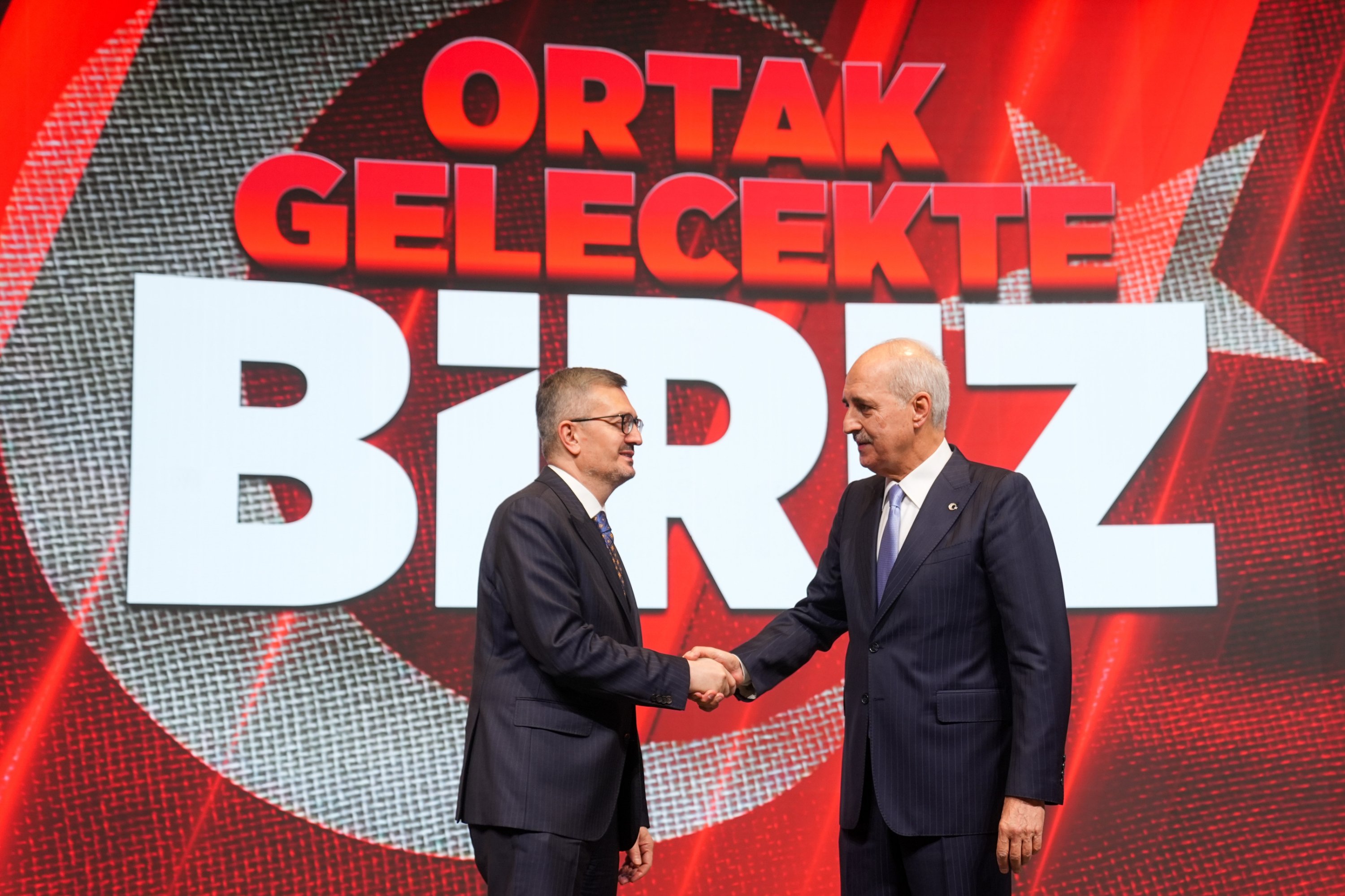
Parliament Speaker Numan Kurtulmuş said Thursday that the state's determination and the public's conscience have converged in Türkiye's efforts to end terrorism, describing the ongoing "terror-free Türkiye" initiative as one of the most significant projects of the republic's second century.
Speaking at the launch of the "United in a Shared Future" communication campaign organized by the Presidential Directorate of Communications in Ankara, Kurtulmuş emphasized that public support and the PKK terrorist group's willingness to abandon armed activities were essential to the success of the initiative.
"For the first time in Türkiye's fight against terrorism, the legitimacy of the state's position and the conscience of the nation have converged," Kurtulmuş said.
"The alignment of the state's determination with the public's conscience is extremely important for the success of the steps being taken. Without this convergence, it would not have been possible to implement the current measures successfully," he added.
Kurtulmuş identified the PKK's declared willingness to lay down its arms, surrender weapons and dissolve its organizational structure as a crucial stage in the process.
Kurtulmuş expressed confidence that the initiative would ultimately remove terrorism from Türkiye's national agenda, contrasting the country's decades-long struggle with its aspirations for the future.
"Terrorism was one of the most significant problems of the republic's first century. A terror-free Türkiye is the greatest project of its second century," he said.
He acknowledged that previous governments had pursued initiatives to end PKK terrorism but had failed to achieve lasting results.
Since the 1980s, the PKK terrorist group has waged a violent campaign that has killed tens of thousands of people. The group's campaign, aimed at establishing a so-called Kurdish state in southeastern Türkiye, posed the country's greatest security threat for decades.
Kurtulmuş also emphasized the historical and cultural ties between Türkiye's ethnic communities, rejecting attempts to portray their relationship as inherently divided.
"Turks, Kurds, Arabs and other communities living in this country have coexisted for centuries. We are all people of the same land, civilization and tradition," he underlined.
He argued that external interventions and regional divisions, rather than differences between communities, had contributed to instability.
Reflecting on the human and economic consequences of terrorism, Kurtulmuş said decades of violence had claimed tens of thousands of lives and consumed substantial national resources.
Presidential Communications Director Burhanettin Duran, also addressing the launch, described the initiative as a historic opportunity to strengthen national unity, economic development and regional stability.
"We stand at a historic turning point," Duran said, crediting President Recep Tayyip Erdoğan's leadership and Nationalist Movement Party (MHP) Chairperson Devlet Bahçeli's call with advancing the initiative.
He said ending terrorism could create new opportunities across sectors, including tourism, energy, education, investment and employment.
"The real question is how Türkiye, freed from the shadow of terrorism, will use its opportunities, strengthen its social bonds and shape the country it leaves to future generations," he said.
Duran also highlighted Parliament's role in providing a democratic and legal foundation for the initiative.
"Our shared future will be built through the democratic discussion of different views and expectations," he noted.
The National Solidarity and Social Integration Law was adopted by the Turkish Parliament on Aug. 10, 2026, with a record number of votes in favor.
The legislation passed the Grand National Assembly of Türkiye with 467 votes in favor, 87 against and seven abstentions.
Duran stressed that dialogue and reconciliation would remain central to the process, while preserving the authority of Parliament and respecting public sensitivities.
He also paid tribute to those killed or injured in Türkiye's decades-long struggle against terrorism, emphasizing the importance of protecting their legacy.
The nationwide communication campaign launched under the theme "United in a Shared Future" was not merely an effort to inform the public but also aimed to listen to the expectations and concerns of different segments of society, according to Duran.
He outlined three main objectives of the campaign: providing accurate information about the ongoing process, engaging with different segments of society and fostering a shared vision for the future.
Workshops would be organized through the Presidential Directorate of Communications' 17 regional offices, while cooperation with universities would seek to encourage young people to contribute to the process, Duran said.