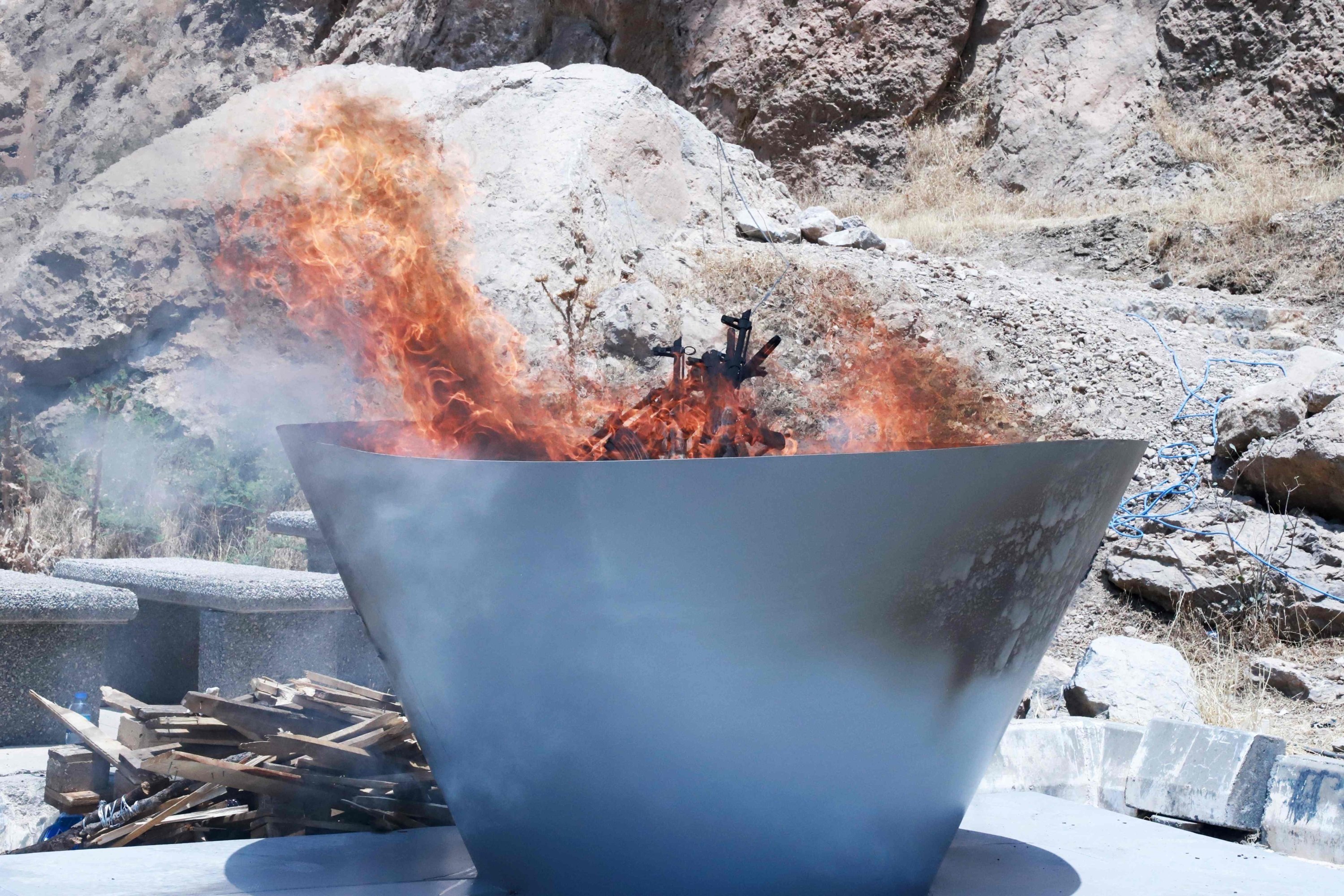
Türkiye has entered a historic new phase in its decadeslong fight against the PKK terrorist group, following nearly 40 years of conflict.
After the PKK laid down its arms and dissolved itself, attention has shifted to establishing the legal framework for the process. A new law adopted by Parliament at the beginning of this week sets out the legal basis for overseeing the group’s disarmament and dissolution.
“The conflict is estimated to have cost Türkiye approximately $2.5 trillion (TL 119.39 trillion) in economic terms alone,” Ali Fuat Gökçe, a professor and military strategist, told Daily Sabah.
“But the toll cannot be measured solely in economic terms. In a society where nearly every extended family has lost someone or has a veteran, bringing this conflict to an end had become a necessity for Türkiye,” he added.
In Türkiye’s 600-seat Parliament, the legislation was approved with 468 votes in favor, 88 against and seven abstentions. The measure allows investigations and prison sentences for some PKK members to be deferred under certain conditions, provided that the group lays down its arms. Those involved in serious crimes, including murder, are excluded from the legislation.
Gökçe stated that as a former soldier who experienced this firsthand, both in the field during operations and in having to inform families that their loved ones had been killed, “I can say that it was devastating. Those of us who lived through these experiences know perhaps better than anyone why this conflict needed to end.”
“For decades, Türkiye has had to devote a significant share of its energy and resources to fighting terrorism at home,” he stressed, offering that overcoming this challenge would allow the country to redirect those resources toward improving the welfare of its people and advancing economic and social development.
The measure allows investigations and prison sentences for some PKK members to be deferred under certain conditions, provided that the group lays down its arms. Those involved in serious crimes, including murder, are excluded from the legislation.
“No terrorist group would be receptive to such an offer if it believed it was operating from a position of strength,” he noted, arguing that the fact that the PKK has engaged with the process indicates it has lost much of its operational capacity. It had become largely unable to carry out attacks inside Türkiye, while its activities abroad were increasingly constrained.
Since the 1980s, the PKK terrorist group has waged a violent campaign that has killed tens of thousands of people. The group's campaign, aimed at establishing a so-called Kurdish state in southeastern Türkiye, posed the country's greatest security threat for decades.
Once it became clear that the group could no longer achieve its objectives through armed means, the conditions emerged for it to respond to the state’s initiative, according to Gökçe.
“A certain amount of progress has been made so far, but from this point onward, much of the responsibility lies with the group.”
Türkiye has significantly weakened the PKK's influence across the region through cross-border operations in Iraq and Syria, while strict counterterrorism measures, particularly in the southeast where PKK members operated from mountainous terrain, have substantially reduced the group's presence.
The country has established the necessary legal framework, and PKK members now have six months to surrender under the process.
Reiterating that the government is conducting the process itself with no third-party mediator involved, “The fact that the state has set a six-month deadline is itself an indication that it is acting from a position of strength,” he added.
The Law on Strengthening National Solidarity and Social Integration was approved with 468 votes in favor and 88 against. A total of 562 lawmakers took part in the vote, with six abstentions.
Looking at the parliamentary vote, we saw divisions within several opposition parties and with some lawmakers in favor of the legislation, Gökçe pointed out.
He argued that the divisions also raised questions over whether opposition to the legislation was driven primarily by objections to the substance of the process or by broader political opposition to President Recep Tayyip Erdoğan and the governing Justice and Development Party (AK Party).
“It is difficult to determine whether their opposition stems from genuine concerns about the process of ending terrorism or simply from political opposition to the government,” he underlined.
The legislation cleared the General Assembly after lawmakers completed deliberations on all 12 articles. It had previously been approved by Parliament’s Justice Committee following a marathon session lasting over 17 hours.
He said the differing votes within opposition parties reflected what he viewed as a distinction between lawmakers assessing the legislation on its merits and those approaching it primarily through a partisan lens.
“Some may oppose even measures that could produce positive results simply for political reasons, while others take a more pragmatic approach and are willing to support the government when they believe a measure serves the country’s interests,” he said.