The Turkish Republic of Northern Cyprus (TRNC) President Ersin Tatar reiterated on Tuesday the need for a two-state solution to the Cyprus question, arguing that the Greek Cypriot side has shown “no intention” of achieving a solution.
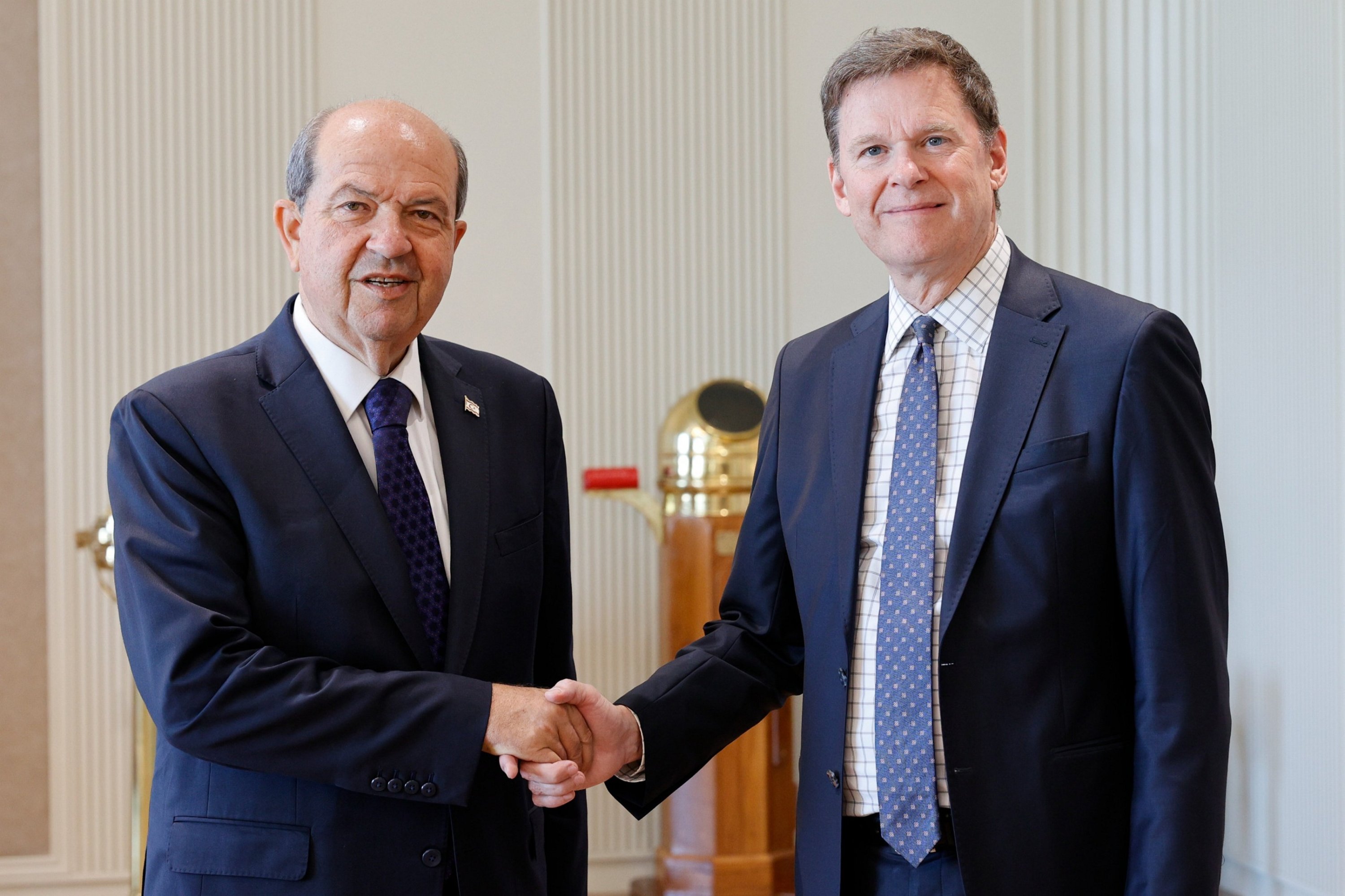
Tatar reiterated his stance as he received Colin Stewart, the U.N. secretary-general's Cyprus envoy and head of the U.N. Peacekeeping Force, for a farewell visit as Stewart is stepping down on Saturday.
After the meeting, Tatar thanked Stewart for his service, saying that he had always maintained an open and transparent stance.
In his statement, Tatar referred to the U.N. Security Council's inclination toward a "two-zone, two-community" federation on the island, saying that no solution had been found in the negotiations held so far and that the Greek Cypriot side has shown no intention of reaching a solution.
"We insist on a two-state solution on Cyprus. The TRNC is a sovereign state in every sense of the word. The decision taken by the U.N. Security Council on Cyprus is outdated and has lost its validity. The region has changed, the status has changed, the Eastern Mediterranean has changed and Türkiye has reached a completely different point," said Tatar.
Stewart, whose term as special representative began in 2021 and will end on Saturday, thanked Tatar for having good, productive meetings over the years.
"I know that he deeply cares about Turkish Cypriots and looks after their interests, and he always tried to be constructive about this,” he said.
The island has been split between the Greek and Turkish Cypriot communities since 1974, when a Greek Cypriot coup aimed at Greece's annexation of the island led to Türkiye's military intervention as a guarantor power to protect Turkish Cypriots from persecution and violence. As a result, the TRNC was founded in 1983.
Greek Cypriots control the southern part of the island and are recognized by the international community as a state, despite protests from Turkish Cypriots and Türkiye. The TRNC is located in the northern part of the island and is recognized only by Türkiye.
It has seen an on-and-off peace process in recent years, including a failed 2017 initiative in Switzerland under the auspices of guarantor countries Türkiye, Greece and the U.K.
The Greek Cypriot administration entered the EU in 2004, the same year that Greek Cypriots single-handedly blocked a U.N. plan to end the longstanding dispute.
More recently, informal U.N.-led meetings have continued, including one in Geneva in March at the request of Secretary-General Antonio Guterres. That meeting focused on practical cooperation in areas such as crossing points, demining and environmental protection. While progress was made on some issues, others stalled due to the stance of the Greek Cypriot side.
To help advance the process, Maria Angela Holguin Cuellar, the U.N. secretary-general’s personal envoy on Cyprus, was reappointed in May and has since conducted multiple visits and consultations with leaders and officials on the island, Türkiye, Greece, the U.K. and the EU. Despite her efforts, core political disagreements remain unresolved.