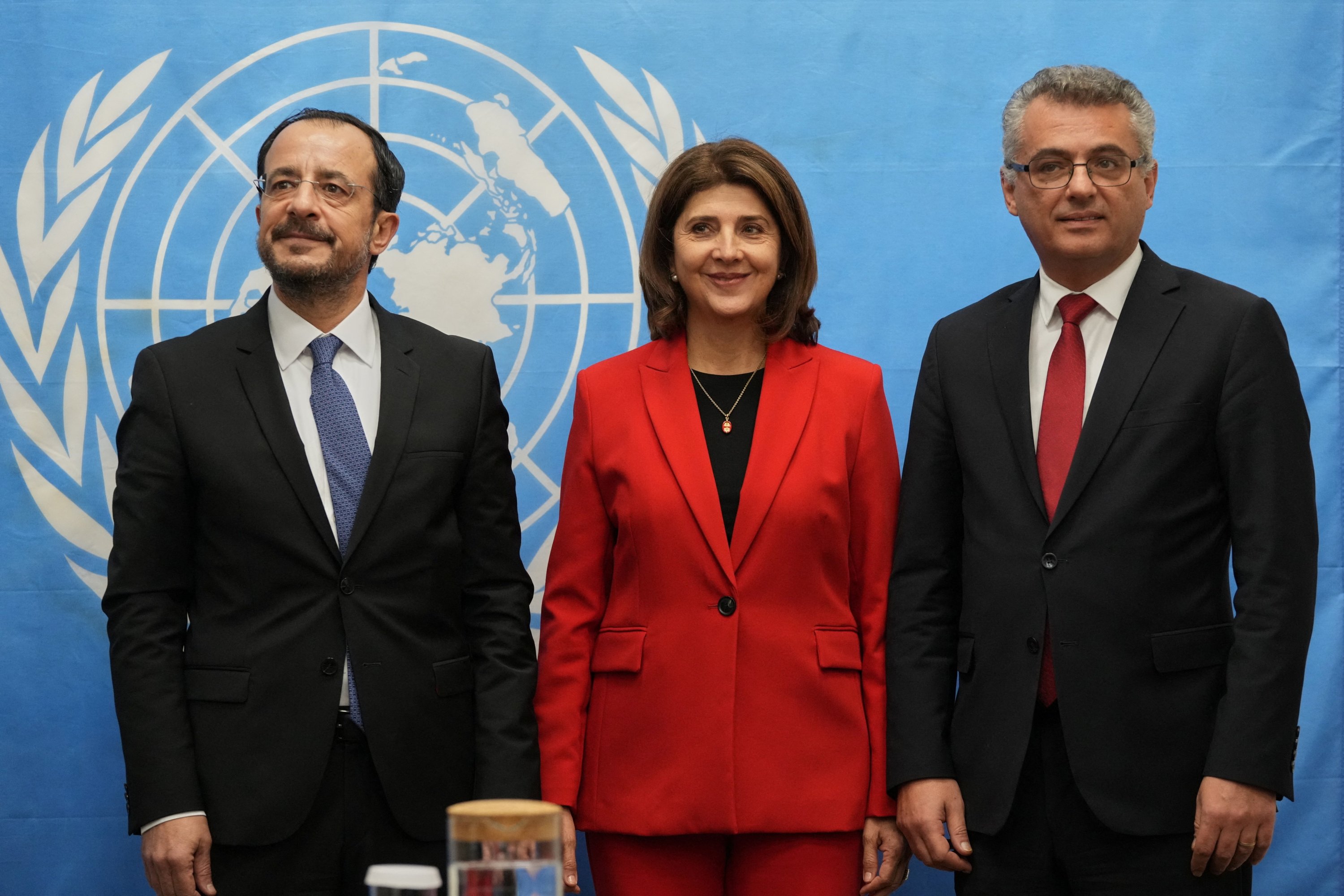
The Turkish and Greek leaders of divided Cyprus on Thursday agreed on multiple projects to boost mutual trust in hopes of getting back on track with long-stalled formal talks to resolve the island's 51-year-old ethnic cleave.
The meeting, which also marked the first time Greek Cypriot community leader Nikos Christodoulides sat down with newly elected Turkish Republic of Northern Cyprus (TRNC) President Tufan Erhürman, took place in the presence of U.N. envoy Maria Angela Holguin at the U.N. compound in Nicosia (Lefkoşa).
The two leaders agreed to work out a deal that would allow Turkish Cypriot manufacturers of Halloumi cheese, or Hellim in Turkish, a rubbery, squeaky cheese that's the island's top export, to access European markets.
They also agreed to help expedite traffic at some of the busiest nine crossing points across a United Nations buffer zone that separates Greek Cypriots in the south and the TRNC in the north.
In addition, the two leaders will concentrate on completing construction of pipelines from a water treatment plant in the TRNC to supply water to Greek Cypriot farmers in the south, in line with an agreement that remained unfulfilled for a decade.
The announcement that the leaders would work on getting these trust-building measures off the ground offered some positive news for reviving the dormant talks.
According to the U.N., the meeting followed a March summit in Geneva at which Cypriot leaders made their first meaningful progress in years. In a statement issued after the talks, the U.N. said the leaders were committed to moving the process forward and had agreed to participate in a broader informal meeting to be convened by U.N. chief Antonio Guterres, who hosted the March summit.
“They committed to continue to work in the meantime in Cyprus to produce tangible results for the benefit of Greek Cypriots and Turkish Cypriots and to ensure the success of the next informal meeting,” the U.N. statement said. “To this end, they expressed their willingness to meet as often as needed,” it added, while cautioning that confidence-building was “not a substitute for achieving a solution to the Cyprus problem.”
Christodoulides said after Thursday’s meeting that he was particularly pleased that much of the discussion also touched on core issues of the long-running dispute “after a long time.” Also speaking after the meeting, Erhürman said these are “the first steps” toward full-fledged talks and underscored that the ground must be adequately prepared so that talks will lead to a comprehensive peace deal. He said a Greek Cypriot acceptance of Turkish Cypriot political equality is a prerequisite to a talks resumption.
Aleem Siddique, the spokesperson for the U.N. peacekeeping force on the island, said in a statement that the leaders agree that “confidence building measures are important for creating a conducive environment but are not a substitute to achieving a solution to the Cyprus problem.”
Cyprus was split since 1974 when a Greek Cypriot coup aimed at Greece’s annexation of the island led to Türkiye’s military intervention as a guarantor power to protect Turkish Cypriots from persecution and violence. The TRNC was founded in 1983, recognized only by Türkiye.
More than 35,000 Turkish troops are stationed in the north. Greek Cyprus joined the European Union in 2004, but only the south enjoys full membership benefits. The Turkish-speaking north covers about a third of the island, including parts of Lefkoşa (Nicosia).
A peace deal in Cyprus would help unlock the Eastern Mediterranean's full energy potential, including expanding the search for sizable natural gas reserves off the island.
Erhürman has indicated he favors a federal state that would include both sides of the island, much to the chagrin of Turkish government ally Devlet Bahçeli. The Greek Cypriot administration advocates the idea of federation for resolving the conflict, while Türkiye and past Turkish Cypriot governments called for a solution to the issue based on recognition of a sovereign Turkish Cypriot state. There are other demands, including by a minority of Turkish Cypriots for a permanent Turkish troop presence, military intervention rights for Türkiye and veto powers on all government decisions, demands that Greek Cypriots reject.
Decades of U.N.-backed talks have failed to reunify the island. The last major round of peace talks collapsed in Crans-Montana, Switzerland, in July 2017.
In March, Guterres said there was now a “new atmosphere” and sense of urgency after both sides agreed to open additional crossing points and remove landmines. Earlier Thursday, the EU's special envoy for Cyprus, Johannes Hahn, said “there's an opportunity, and it's time to deliver” after meeting Christodoulides.
Both leaders also reaffirmed their commitment Thursday to taking part in a meeting with U.N. Secretary-General António Guterres, which is hoped could signal the resumption of full-fledged peace talks.