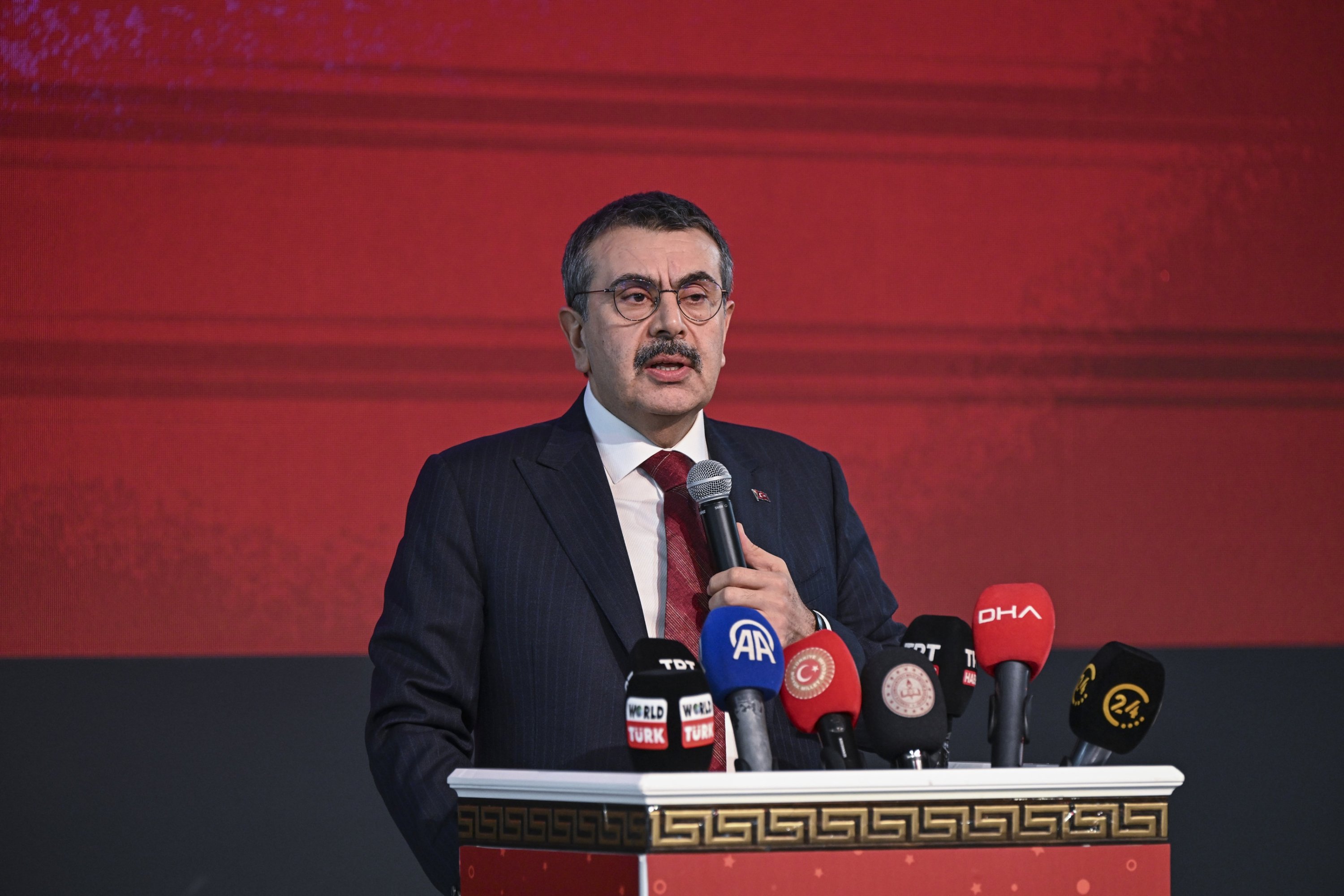
Education Minister Yusuf Tekin, who found himself at the heart of a secularism debate after he instructed schools to organize Ramadan-themed events, stood his ground as more people came out to endorse the practice.
Prior to Ramadan, a so-called “secularism declaration” by a group of celebrities, writers and intellectuals claimed Türkiye was becoming “Talibanized” and with Ramadan, the debate heightened, with the opposition parties joining the chorus against the events.
Speaking at an event in Istanbul on Saturday, on the anniversary of the Feb. 28, 1997 coup, Tekin drew parallels with that process, which was basically a witch hunt targeting Muslims in Türkiye.
Tekin said that during the Feb. 28 process, pressure spread from school gates and campus corridors to teachers’ lounges and even into families’ private decisions at home. Girls wearing headscarves, students of imam-hatip schools (which offer additional curriculum on religion) and devout working families all bore the heavy burden of the intervention together.
Referring to recent criticism surrounding Ramadan activities in schools, Tekin said the country is now facing an updated version of the same language used by proponents of the coup and that the issue should be addressed openly and directly.
“When our children learn about Ramadan, understand the discipline of fasting, grow curious about the meaning of prayer and meet the voice of their own civilization through hymns in the schoolyard, who exactly is triggered into an ideological alarm, and why?” he asked.
“How can a child learning about iftar, patience, charity and respect be construed as a threat? What kind of regime crisis can you manufacture from children decorating for Ramadan? Please explain to me which legal order is harmed by children singing hymns during recess. Those who speak of pedagogy, by what pedagogical standard do you exclude children’s right to know their own culture? Those who speak of freedom, why do you resort to prohibitive language when it comes to the nation’s faith and this country’s spiritual memory? How do those who claim to defend secularism justify portraying the joy of Ramadan in a schoolyard as reactionism, children’s engagement with values education as a threat and society’s genuine bond with faith as a danger?”
Tekin said statements circulated in response to the activities once again revealed what he described as a longstanding intolerance toward the public visibility of the nation’s faith.
“The language that labels a Ramadan event a regime crisis, while targeting the joy of children in schoolyards, clearly shows discomfort with the authentic bond formed with the essence of these lands,” he said. “From this perspective, we can better understand why debates on secularism are repeatedly dragged into the same channel.”
Tekin underlined that secularism in Türkiye had been turned into one of the sharpest tools of tutelage. Responding to those who repeat that “defending secularism is not a crime,” Tekin said, “Of course it is not. The problem lies in a mentality that uses that sentence as a shield while hurling insults at women wearing headscarves, people in religious attire or even an elected mayor because of traditional dress.”
He said the same mindset that once expelled headscarf-wearing students from campuses as centers of reactionism and profiled teachers as “bearded, unionized, risky personnel” now appears in those who cry that “secularism is under threat” over Ramadan activities.
“The problem is not secularism,” he said. “The problem is an obsessive and arrogant understanding of secularism. Those who try to manufacture a regime crisis out of children singing hymns during recess or learning about their own culture and calendar under values education are effectively saying: ‘This society’s faith cannot be visible in the public sphere.’”
Tekin noted that in Western countries, a vast industry has grown out of church-based gospel music without prompting concerns that secularism is under threat.
He said there is an effort to confine children’s awareness of national and spiritual values and their singing of hymns to the home, opposing the reflection of those values in schools, streets or even Parliament. In Türkiye, however, he said, a single hymn, a single piece of traditional clothing or a single Ramadan activity is enough to trigger what he called secular anxiety.
“This is nothing more than the marketing of naked Islamophobia under the packaging of secularism,” Tekin said. “This nation does not have to feel embarrassed for defending its faith and its children’s education. Our objection is to a tutelary language that repeatedly turns the principle of secularism into a pretext for attacking the nation’s beliefs and values.”