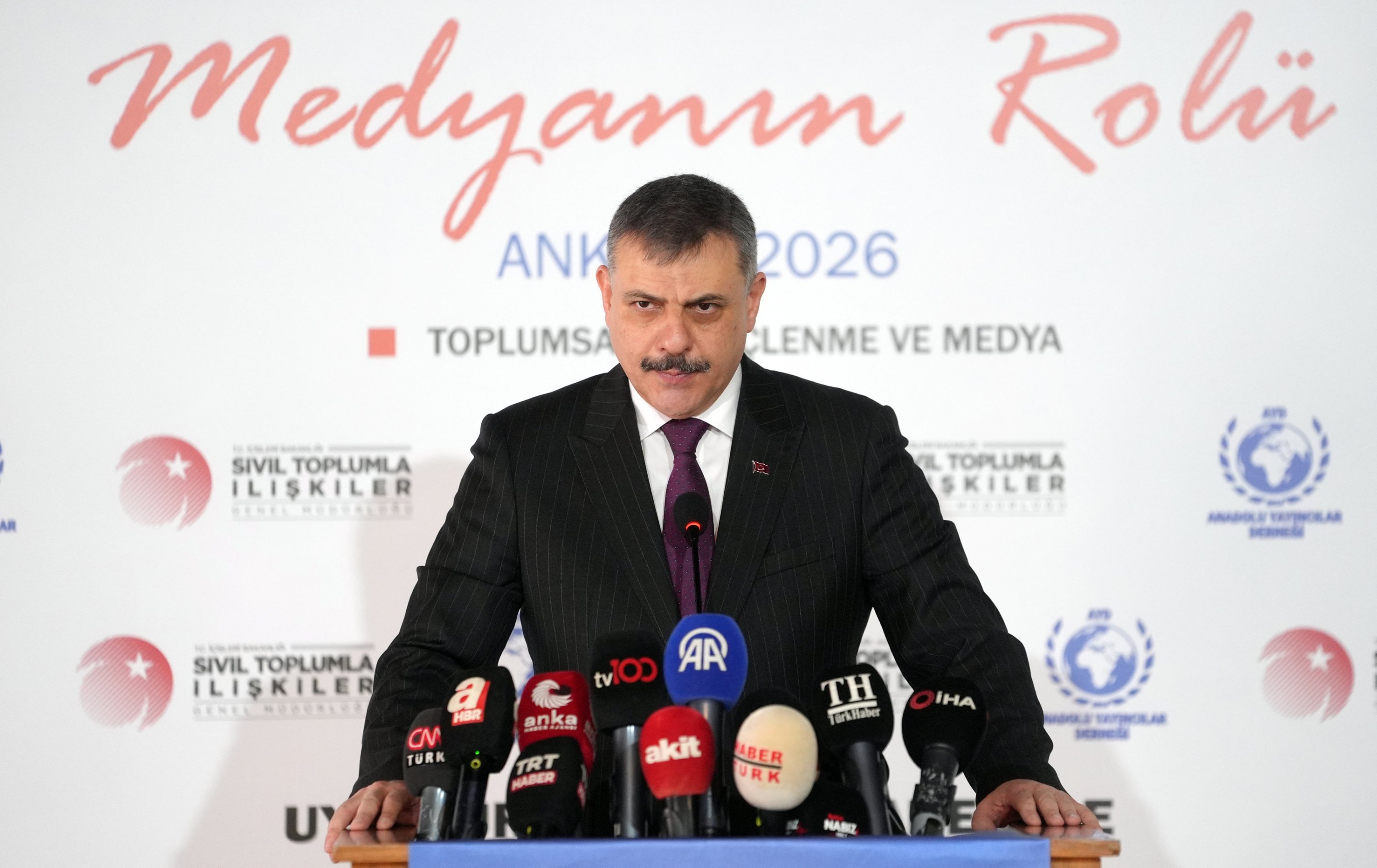
Mustafa Çiftçi, who was appointed as Interior Minister in February, underlined that they were working for the “Century of Peace” as the Republic of Türkiye is now in its second century. “Our security paradigm is centered on prevention,” he told journalists at a panel in Ankara on Tuesday about the media’s role in the fight against drugs.
Çiftçi said drugs were “a cluster of problems” and expanded organized crime networks, adding that they were also a source of revenue for financing terrorism. “It is a dark swamp feeding many crimes. It is our responsibility as the state to drain it,” he said.
Türkiye has long been a critical transit hub for illicit drug trafficking due to its location bridging Europe and Asia. It is on the so-called Balkan Route where heroin from Asia is trafficked to Europe, while synthetic drugs manufactured in Europe are trafficked to Asian countries.
The minister said Türkiye’s strategic location meant great opportunities in other fields, but it also meant a greater responsibility for the fight against crimes across borders. He noted that Türkiye’s struggle was not only a security matter confined to its own borders, citing the drug trafficking routes, international crime rings and regional instability, adding that it contributed to regional and global security. “Under the leadership of President Recep Tayyip Erdoğan, we are building upon a vision for peace, security, stability and a strong social structure. We center our vision on family, youth, the future,” he said.
Çiftçi noted that the fight against drugs was not limited to counternarcotics operations, capturing suspects and legal procedures. “We are operating on a holistic approach, diagnosing the risk at its source, closing the paths to crimes, protecting the youth, raising awareness among families,” he said. The minister stated that one of the most important tools of this approach is the Project Support System (PRODES), carried out within the ministry’s Directorate General for Relations with Civil Society. "Our ministry provides grant support to associations in exchange for projects, the institutional capacities of our NGOs are strengthened, public-NGO cooperation is improved, and solutions to social problems are produced through voluntary organizations."
Referring to the prevention projects carried out by the Ministry of Interior, Çiftçi reported that 9,798,000 citizens have been reached through these efforts.
"Between Jan. 1 and April 25, 2026, we carried out 17,188 operations against drug manufacturing and trafficking. In these operations, 16.8 tons of narcotics, 51.2 million drug pills, and 49,000 cannabis and skunk drugs (a cheap hybrid drug) were seized. The fact that 46 of the 298 organized crime groups we targeted were focused on narcotic crimes clearly shows how intertwined the drug threat is with organized crime, street violence, illegal money networks and the financing of terrorism."
Expressing that the role of the media in the fight against drugs is a matter of utmost importance, Çiftçi said: "We see the media as one of our most strategic stakeholders that raises social awareness, warns families, protects youth, brings the public together with accurate information, and carries the will to fight to the broad masses. I would especially like to state that every media representative here undertakes a very valuable responsibility that appeals to the common conscience of society. This is because, in this struggle, words are at least as important as operations. News language, visual choices, headlines, repeated expressions and broadcast flow directly affect social perception. Any narrative that encourages, normalizes, sensationalizes or arouses curiosity about drugs causes great harm to the struggle."
Çiftçi stated that any expression that portrays drugs as attractive, pleasurable, or easily accessible creates a risk for young people. He emphasized the need to avoid news language that marginalizes, hurts or portrays addicted individuals as helpless or dangerous. Since last year, a string of high-profile drug busts targeted celebrities, from singers and actors to social media influencers. Dozens of suspects were detained and tested for drugs.