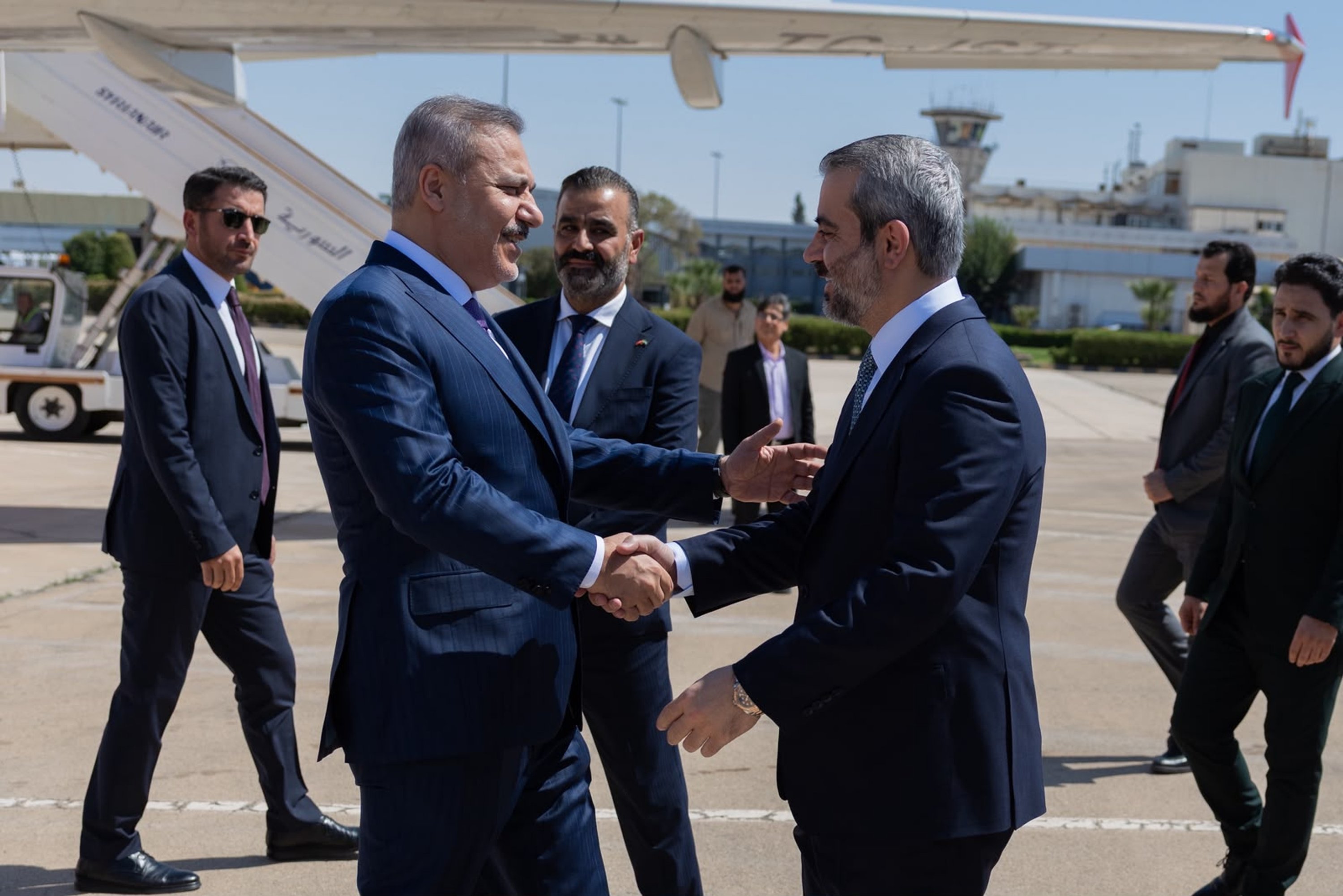
Foreign Minister Hakan Fidan was in Damascus on Sunday for a meeting with Syria’s top diplomat Asaad al-Shaibani.
Speaking at a news conference with his counterpart, Fidan said they discussed several matters, including details for a planned inaugural visit by President Recep Tayyip Erdoğan in the post-Baathist Syria.
Fidan also welcomed the dissolution of the SDF (another name for the PKK's Syrian wing, YPG) in the country and its integration into Syria's security forces. “It is a precious, important step,” he said.
“Türkiye’s perspective is that Kurdish citizens of Syria will have more prosperity and freedom (in line with the SDF’s dissolution),” Fidan said.
The YPG claimed to fight for the autonomy of Kurds in Syria during the Syrian civil war.
The SDF announced its dissolution in August while its leader Ferhat Abdi Şahin was appointed as an adviser to Syrian President Ahmed al-Sharaa. The dissolution was part of an early deal between Damascus and the group, which was the Syrian wing of the terrorist group PKK. Türkiye, which was often targeted by the PKK, has carried out a process for its dissolution. Its border towns suffered from YPG attacks during the Syrian civil war.
Ankara, however, was supportive of al-Sharaa's efforts for the integration of the YPG into the Syrian security forces as part of a deal that aimed at more control in northern Syria by the central administration. Just like the terror-free Türkiye initiative it pursues with the PKK, Türkiye views the matter in Syria as a stepping stone for unity of the country. National unity is particularly essential for Syria, which remained fragmented for years under the Assad rule and thus suffered from weakened stability and fears of an expanding civil war.
Fidan also commented on Israel's incursion into Syria and an attack by Israel on a military base that Tel Aviv claimed hosts Turkish forces.
“Israel is an actor working to destabilize Syria; it is the biggest obstacle to Syria’s stability. The attack on the Abu Al-Duhur base is an example of Israel’s attack on the stability of Syria. Israel systematically targets Syria’s military capacity, indirectly supporting terrorist groups like Daesh,” Fidan said.
For his part, al-Shaibani said, “The partnership between Türkiye and Syria is advancing rapidly and the main contours of the strategic orientation are taking shape.”
He said that the fact that only a few days had passed since their talks in Ankara in August “demonstrates the momentum of the partnership between the two countries,” adding that relations between Türkiye and Syria “are progressing on solid foundations.”
He stated that Türkiye was among the first countries to reopen its embassy in Damascus after Syria was liberated on Dec. 8, 2024. He said Türkiye had reopened its border crossings and supply routes and taken a leading role on international platforms in efforts to lift the sanctions that had been imposed on the Syrian people for many years.
“Türkiye’s leadership will always have a place in the national memory of Syrians. Damascus and Ankara have made progress that will surpass all other bilateral relations,” al-Shaibani said.
He noted that dozens of meetings had been held between the two countries at the presidential and ministerial levels, adding that 40 agreements and memorandums of understanding had been signed and an institutional communications network had been established linking 22 Syrian ministries and institutions with their counterparts in Türkiye.
The Syrian minister said these developments had translated into tangible results that directly affect the lives of citizens, citing the energy agreement signed in May 2025, the delivery of electricity across the border to northern Syria, the establishment of sister-city ties between Aleppo and Gaziantep, and the resumption of 24-hour road transit through the Bab al-Hawa and Salama border crossings.
On the SDF deal, al-Shaibani said Syria was moving forward “with determined steps toward establishing a single national army, bringing weapons under the control of legitimate institutions and fully reintegrating the northeast into national unity through a process that belongs entirely to Syria.”
He emphasized that, as a result of 20 months of intensive efforts, the “Caesar Act” sanctions imposed by the U.S. had been brought to an end and Syria had been removed from the list of state sponsors of terrorism, thereby regaining its natural position on Arab and international platforms. The Syrian minister said that, as a result of this stability, approximately 1.6 million Syrians had returned to Syria from abroad, while approximately 2 million internally displaced Syrians had returned to their own regions.
On Israel, the Syrian foreign minister said that the country continued “to violate national sovereignty and carry out territorial incursions into the southern regions.”
“Israel is targeting secure villages and the property of civilians. Israel’s Aug. 18 attack on Abu Al-Duhur Airport carries meanings beyond its direct military dimension. The attack represents a destructive message targeting the process of rebuilding the Syrian state,” he said.
Al-Shaibani said the effort to prevent closer ties between Syria and Türkiye “reflects a clear desire to keep the region in a state of weakness and division,” adding that Syria’s position in response to the escalation remained firm and resolute.
He said Israel must withdraw to the lines it held before Dec. 8, 2024, and fully comply with the 1974 Agreement on Disengagement of Forces.
“We remain committed to the diplomatic struggle because we are deeply aware of the cost of wars,” he said.
He added, “We are doing this also to thwart any pretext that the aggressor could use.”
The minister said they greatly appreciated Türkiye’s position, noting that, “Türkiye has clearly condemned these attacks, called for the implementation of the 1974 Agreement and firmly supported Syria’s sovereignty and territorial integrity.”
Emphasizing that Syria was now freely charting the road map for its national policies with full sovereignty, Shaibani said it was “choosing its partnerships and determining the direction of its investments and development in line with its national interests.”
“The Israeli attacks on Syrian territory and institutions are not affecting Syria-Türkiye relations. Relations between the two countries are going through their best period,” he said.