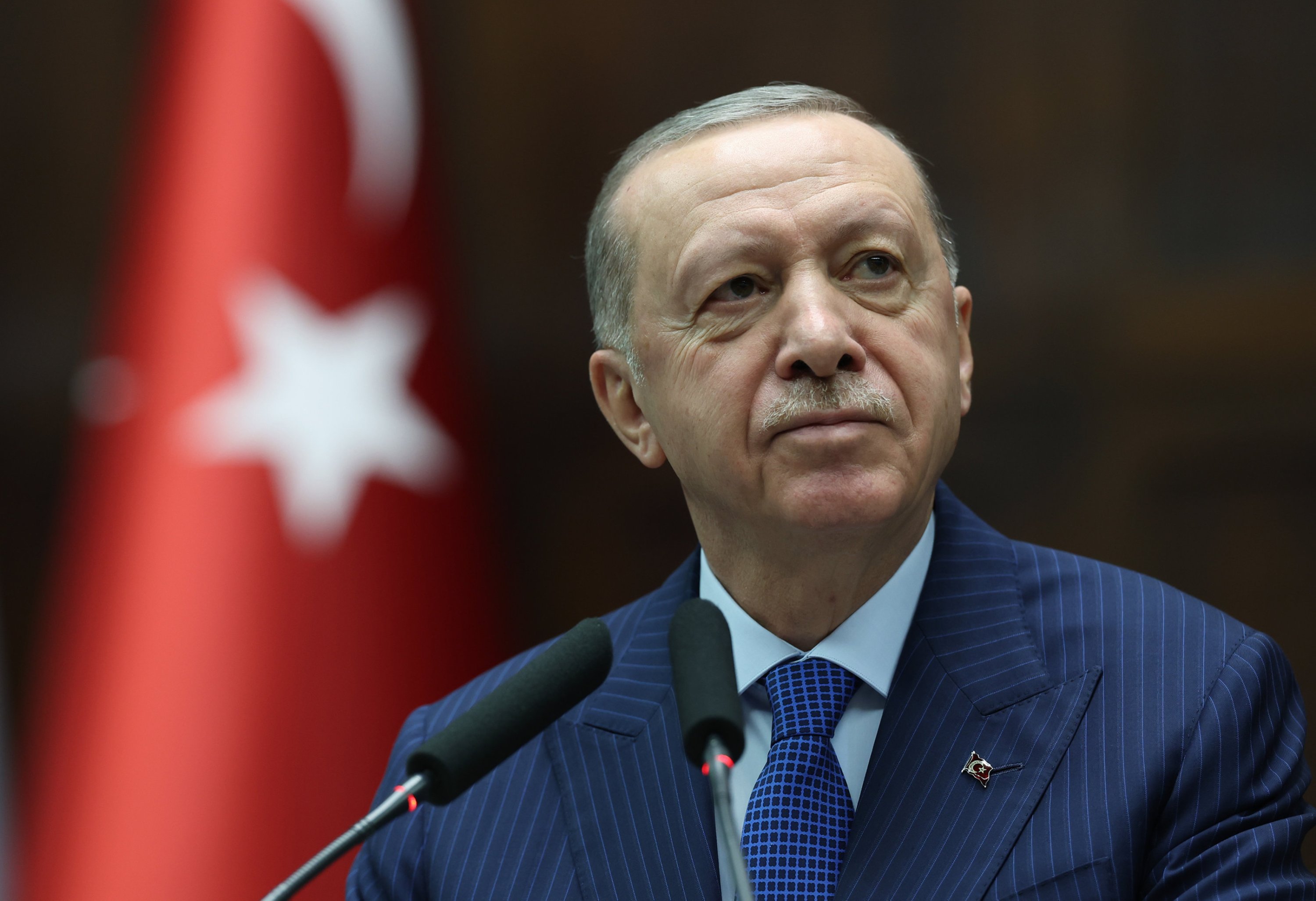
President Recep Tayyip Erdoğan on Wednesday called on all countries to “take their hands off” Syria and said Türkiye has the power and ability to crush all terrorist organizations in the country, including the PKK's Syrian wing YPG and Daesh.
Speaking to lawmakers from his ruling Justice and Development Party (AK Party) in Ankara, Erdoğan said the PKK/YPG terrorist group, which occupies one-third of Syrian territory, was the biggest problem in Syria now after the ousting of regime leader Bashar Assad.
Ankara has said the new Syrian administration must be allowed to address the PKK/YPG presence but also threatened to mount a new cross-border operation against the terrorists based in northeast Syria if its demands are not met.
Türkiye considers the YPG as linked to the PKK, which has waged a decades-long terror campaign in Türkiye to establish a so-called Kurdish state in the southeast of the country. It is proscribed as a terrorist group by the European Union, the U.S. and Türkiye.
"The YPG terrorist organization, which also plunders Syria's natural resources, will not be able to escape the inevitable end if it does not disband and lay down its weapons," Erdoğan said.
"Regarding fabricated excuses like Daesh, these have no convincing side anymore," Erdoğan said, referring to the U.S. position that the YPG was a key partner against Daesh in Syria and that it plays a vital role in guarding prison camps where the Daesh terrorists are kept.
"If there is really a fear of the Daesh threat in Syria and the region, the biggest power that has the will and power to resolve this issue is Türkiye," he said.
"Everyone should take their hands off Syria and we, along with our Syrian siblings, will crush the heads of Daesh, the YPG and other terrorist organizations in a short time."
Türkiye has repeatedly asked its NATO ally, the U.S., to halt support for the YPG and has said the new administration in Syria had offered to take over the management of the prisons.
Syria's de-facto ruler, Ahmed al-Sharaa, has also said the YPG would be integrated into the new national army.
Washington has been insisting on preventing a Turkish offensive against PKK/YPG in Syria.
Erdoğan reiterated Türkiye's dedication to protecting its Kurdish citizens and securing their future.
"We are followers and supporters of the solution to all the issues of our Kurdish brothers, just like every other group in Syria, and we are the guarantor of the security of the Kurds,” he said.
"I have instructed our relevant colleagues to carry out efforts to dissolve the separatist organization with great care and in a comprehensive manner,” Erdoğan continued, referring to what has been dubbed the “terror-free Türkiye initiative.”
The tentative push to end 40 years of PKK terrorism in Türkiye began in October when Erdoğan’s close ally Devlet Bahçeli, a hardline politician who had previously strongly opposed any concessions to the PKK, suggested jailed PKK leader Abdullah Öcalan could be granted parole if he renounced violence and disbanded the PKK.
Erdoğan has since endorsed Bahçeli's stance and called the move a “historic window of opportunity.”
In a message relayed by his nephew in December, Öcalan said he has the power to end the conflict if the conditions are right.
If the PKK disregards any potential call from Öcalan to lay down arms, Türkiye will achieve its goal of eliminating terrorism through other means, Erdoğan said.
"If the organization turns a deaf ear to this call and affiliated groups fail to show the expected resolve, we will realize our goal of a terror-free Türkiye through other methods," Erdoğan said.
The PKK violence, which has spread beyond Türkiye's borders into Iraq and Syria, has killed tens of thousands of people.
There have been several efforts to end the PKK’s campaign over the years, including secret negotiations between the Turkish state and the PKK held in Oslo, Norway, from 2009 until 2011. However, none have yielded results.
The last attempt to reach a peace deal took place between 2013 and 2015 with a series of talks between Turkish officials and Öcalan, who declared a cease-fire and withdrew PKK members to bases in northern Iraq.
Turkish officials took steps to improve Kurdish rights, including allowing Kurdish-language broadcasts. The process collapsed in July 2015 after a series of violent attacks by the PKK.
Ankara has mounted multiple operations against the YPG/PKK in Syria since 2016. In Iraq, it maintains dozens of military bases and airstrikes regularly target terrorist hideouts.
Ankara also says it’s wrong to classify Türkiye’s battle against the PKK/YPG as a battle against Kurds, insisting its only aim is to ensure "stability" in Syria after the toppling of Assad.