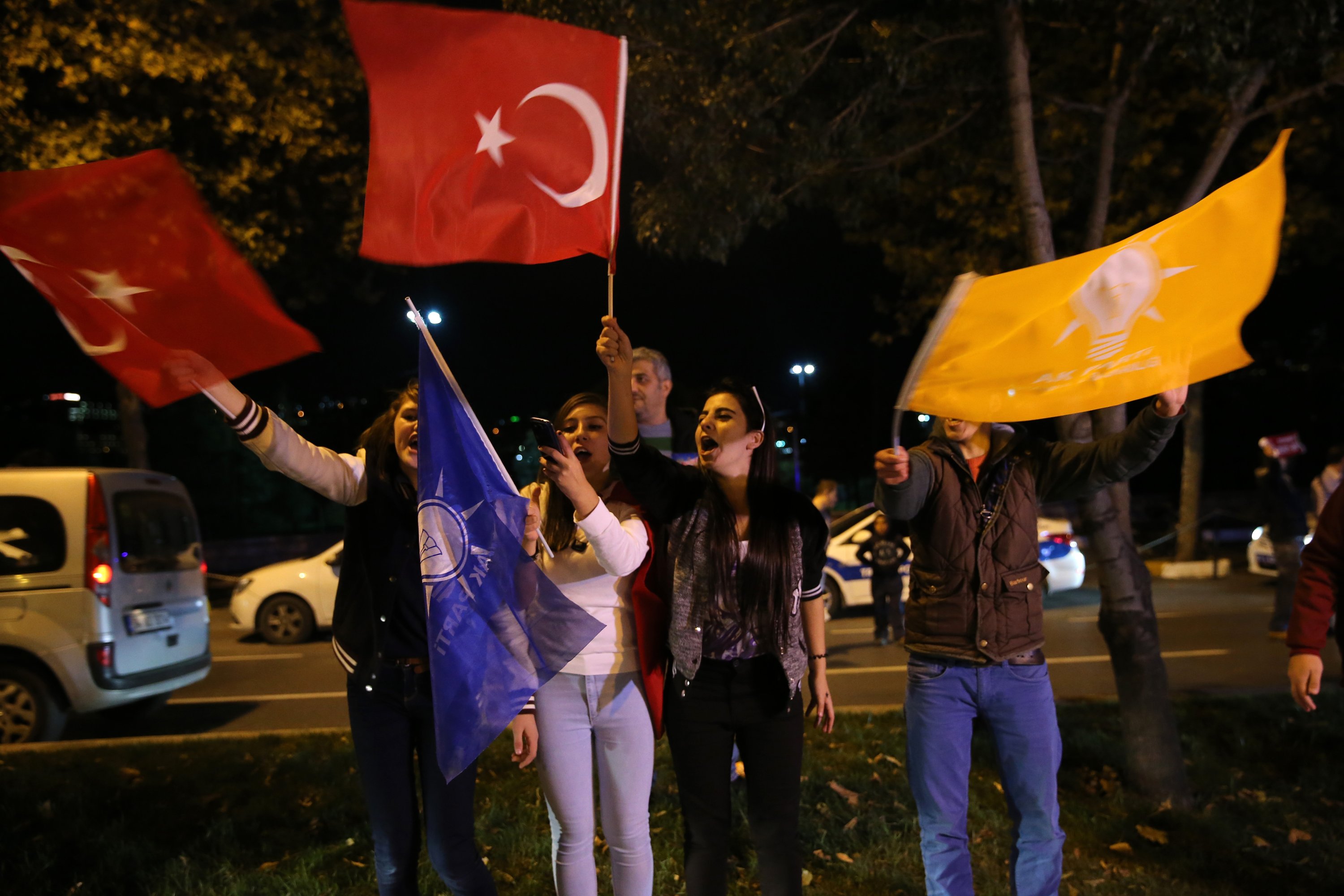
The ruling Justice and Development Party (AK Party) will celebrate the 24th anniversary of its first general election win on Tuesday. The party plans to hold a panel on its political journey at its headquarters, with the participation of its top officials and Minister of Treasury and Finance Mehmet Şimşek.
Party Deputy Chair Hüseyin Yayman, who will moderate Tuesday’s panel, spoke to Anadolu Agency (AA) about the anniversary and future of the party. “In the past 24 years, the AK Party saved Türkiye from becoming a less developed country and made it a global power,” Yayman said.
Founded in 2001 under the leadership of President Recep Tayyip Erdoğan, the AK Party was a true underdog in Turkish politics back then, a mixture of people with different political views, mostly those who split from the defunct Welfare Party (RP), including Erdoğan.
Erdoğan himself was in a difficult period in his life. He was recently released from prison for reciting a poem during his tenure as Istanbul mayor and had a political ban continuing after his release. Undaunted, the future president started laying the groundwork for his future political party. Apparently encouraged by the massive support he received after the unfair ban, Erdoğan embarked on a tour of Türkiye with fellow-minded veteran politicians and people from all walks of life. This grouping evolved into the “Movement of the Virtuous,” which sought to rally people across Anatolia to found a new political movement. This movement turned into a party in August 2001. The AK Party, which adopted a lightbulb as its symbol, was quick to reach a bright victory in the Nov. 3, 2002, general elections.
Campaigning under the slogan “On our own, into power” (“Tek başına, iş başına”), the party won 34.28% of the vote, becoming the leading party and forming the 58th government.
Yayman said 76 years have passed since Türkiye transitioned to a multiparty political system, adding that a comparison of the time different parties have spent in power during this period highlights the difference made by the AK Party. Emphasizing that the party has remained in power uninterrupted and governed alone since its establishment, winning all 18 elections it has contested, Yayman said: “This is a record in the history of Turkish democracy and European democracies. It is also a tremendous victory and achievement, one worthy of a place in the Guinness World Records. This is not only the AK Party’s victory but also that of our nation. It is the realization of the dream of a great Türkiye.”
He said the AK Party had changed the political, state and governance paradigms in Türkiye. “City hospitals, roads, highways and airports have been built, and universities have been established in Türkiye. However, the greatest achievement of our president and the AK Party has been instilling in the Turkish nation the feeling that ‘I, too, can succeed and accomplish things,’” he said.
Noting that Türkiye had undergone a major transformation and leaped forward under AK Party rule, Yayman said Erdoğan’s pledge that “the 21st century will be Türkiye’s century” had gradually become a tangible goal.
He said the AK Party was competing with itself to build on its achievements, improve its services and take state-citizen relations in Türkiye to a higher level.
“I believe that, Allah willing, we will elect our president once again in the upcoming elections. Türkiye needs our President Recep Tayyip Erdoğan, the AK Party and the People’s Alliance,” he said, referring to the next election that is scheduled to be held in 2028 but will likely be rescheduled to an earlier date to ensure Erdoğan’s eligibility to run again.
Stating that the party was focusing on the future and the needs of the new era in the coming period, Yayman emphasized that it had adopted development through change and progress through development as political principles.
He said the political system and the state's governance framework needed to be updated, adding: “With a population of 86 million, Türkiye is one of the countries with the largest populations in Europe, while its territory of 780,000 square kilometers makes it one of the largest countries in terms of land area. Therefore, it has tremendous social dynamism. The need for reform is an important item on the agenda. We must keep the reform agenda alive in Türkiye because our country is a developing, growing and dynamic society, and its needs are constantly changing. The AK Party has achieved tremendous successes over 24 years. We are setting new goals for the second 24-year period. At the forefront of these goals are the Century of Türkiye vision and the goal of a great Türkiye. In this regard, we need to update the AK Party's political software and overhaul our political legislation, from the Law on Political Parties to the Election Law,” he said.
Yayman said most political parties in Türkiye were little more than parties in name and needed to be brought under a system of discipline.
Referring to the need to update the Constitution, which he said formed the underlying framework of all these processes as society, governance and politics changed, Yayman described as a major “paradox” the fact that some critics characterized the 1980 coup as a disastrous event that cost Türkiye valuable time but failed to comment on the Constitution produced by that coup.
“You constantly condemn the coup at the level of rhetoric and criticize its programs, yet you say nothing about the Constitution, the coup's most significant legacy. I am saying this with regard to the (opposition) Republican People's Party (CHP) and the New Party (YP). There is a toxic understanding of opposition here. Unfortunately, the CHP and YP do not produce projects or provide any services. They have no promises that would help realize our nation's aspirations. They constantly adopt an obstructive attitude, opposing everything. They have only one project: opposition to Erdoğan and demanding that ‘Erdoğan must go.’ No matter what you say, as we have seen in 18 elections, Erdoğan will not leave office simply because they want him to. Nor will he come to power simply because they want him to. Our president comes to power because the nation wants him to, and the nation will decide his fate when it chooses,” he said.
The party faced one of its most serious challenges in 2008, when the chief prosecutor filed a closure case on March 14, seeking to ban 71 party members, including President Abdullah Gül and then-Prime Minister Erdoğan, and dissolve the party. The Constitutional Court accepted the indictment on March 31, but on July 30, it voted against closure, as the required qualified majority was not achieved.
The 2010 constitutional referendum, held on the 30th anniversary of the 1980 coup, brought a “yes” vote of 57.88% to amend the 1982 Constitution. This reform period preceded the 2011 general elections, during which the AK Party achieved a record 49.53% of the vote. In the 2014 local elections, the party maintained its lead with 45.60%, winning 818 municipalities, including 18 metropolitan cities.
On Aug. 10, 2014, Erdoğan was elected Türkiye’s 12th president with 52% of the vote, becoming the first president to be chosen directly by the people. Konya Deputy Ahmet Davutoğlu succeeded him as chair, leading the party through the June 7, 2015, general elections and the Nov. 1 snap elections, in which the AK Party regained its parliamentary majority.
Leadership changed again on May 22, 2016, when Binali Yıldırım was elected chair at the 2nd Extraordinary Congress and formed the 65th government. That year, on July 15, Türkiye faced the deadliest coup attempt in its history, staged by the Gülenist Terrorist Group (FETÖ). President Erdoğan’s call for citizens to take to the streets and airports was decisive in stopping the attempt. The solidarity displayed between the AK Party and the Nationalist Movement Party (MHP) in its aftermath laid the groundwork for the formation of the People’s Alliance.
On April 16, 2017, Türkiye held a constitutional referendum, initiated by an AK Party proposal signed by 316 deputies and submitted to Parliament on Dec. 10, 2016. Following parliamentary approval, President Erdoğan signed the law on Feb. 10, 2017, and voters went to the polls, approving the changes with 51.41% “yes.” The reform removed the rule that presidents must sever ties with their party, opening the way for Erdoğan’s return. On May 2, 2017, after a 979-day absence, Erdoğan rejoined the AK Party and was reelected chair on May 21 with all valid votes.
The first elections under the new presidential system were held on June 24, 2018, following a call for early elections from MHP leader Devlet Bahçeli. On the same day, voters cast ballots for both the presidency and Parliament. Erdoğan was reelected with 52.38% of the vote, and the AK Party secured 42.28% of the vote in parliamentary elections, marking its 13th consecutive national victory.
At the Aug. 18, 2018, 6th Ordinary Congress, Erdoğan was reelected chairperson with all valid votes. The party amended its bylaws to include electoral alliances and to prevent members from simultaneously holding positions on the Central Executive Board (MYK) and in Cabinet. Continuing its alliance with the MHP in the subsequent local elections, the AK Party won 44.33% of the vote, remaining the leading party.
For the 2023 elections, Erdoğan announced on March 10 that the vote would be moved from June 18 to May 14. In the first round of the presidential election, he received 49.52% of the vote, leading to a May 28 runoff, in which he prevailed with 52.18% of the vote. The AK Party won 35.62% of the parliamentary vote, taking 268 seats and retaining its status as Türkiye’s longest-serving ruling party since 1946.
On Oct. 7, 2023, at the 4th Extraordinary Congress, Erdoğan was reelected chair with all 1,399 valid votes. The Central Decision and Executive Board welcomed 49 new members, while 14 of the 18 Central Executive Board members retained their seats.
In the March 31, 2024, local elections, the AK Party won 35.49% of the vote, gaining 24 provincial and 357 district municipalities. After the results, Erdoğan stated that the party would “carefully weigh the messages from the ballot box with reason and conscience” and initiated a process of cadre renewal, replacing several provincial and district heads.
Recalling that the AK Party's biggest promise for the coming period was to draft a new constitution, Yayman said: “A new constitution that is civilian, democratic and pluralistic, that will carry Türkiye into the 21st century and turn it into a global power, is indispensable for us. We need to update our political and constitutional frameworks to institutionalize the reforms we have made and the progress we have achieved, and to ensure that Türkiye moves confidently toward its goals.”
He stressed that the AK Party's success extended beyond Türkiye's borders, emphasizing that a conservative party maintaining power for 24 years in a functioning democratic system through elections and implementing numerous reforms was particularly significant for the Muslim world.
“President Erdoğan's success is followed with great admiration and regarded as a model by European democracies, countries around the world and the Muslim world,” Yayman said.