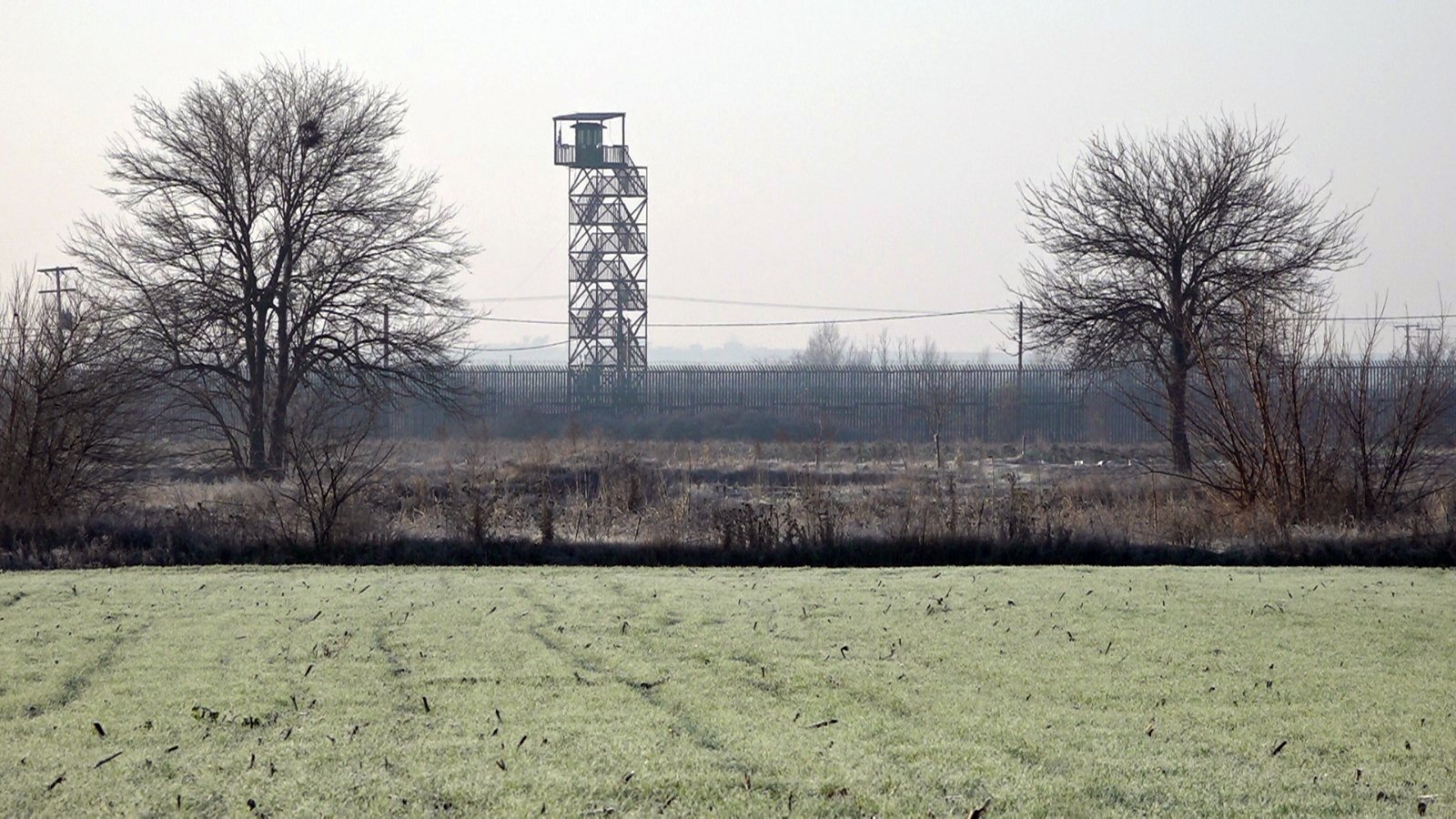
Plans for building a barrier on Türkiye’s border with Greece are vital for security measures, hindering terrorist activity, irregular migration, migrant smuggling, as well as criminals trying to flee the country, the Interior Ministry’s Directorate of Migration Management said Thursday.
The directorate said works on physical barriers on the Edirne-Greece front are one of the main elements of Türkiye’s border security.
“As a result of decisive and effective efforts, a total of 2,304 people, including 887 migrant smuggling organizers, 652 terrorist members (PKK/FETÖ) and 765 people sought for criminal activity were caught trying to flee abroad only on the Edirne-Kırklareli border front since January 2024,” it underlined.
The directorate elaborated that plans are worked on quickly to address needs.
Saying that physical barrier types and heights may vary depending on terrain conditions, road conditions and risk perception, the directorate added: “Physical barrier systems are supported by towers, cameras and other similar security systems. In this context, the heights of physical barrier systems built on our eastern and southern land borders generally reach a total of 4-6.5 meters (13-21 feet) by manufacturing panel fences on 3-4 meter concrete blocks.”
The risk evaluation for the Edirne-Greece border was completed, and works started for 2-meter panel fences built upon 1-meter concrete blocs, it said.
Türkiye has, in the past, built walls on its border with Iran and Syria.
Türkiye shares a 200-kilometer frontier with Greece, and the border is separated by the Evros River, which is called Meriç in Turkish.
In 2012, Greece built 3-meter-tall barbed wire barriers along 11 kilometers of its frontier with Türkiye, which was previously mined. It later tripled the length of the fence, with Prime Minister Kyriakos Mitsotakis vowing to extend it to more than 100 kilometers by 2026.
In 2014, Bulgaria put up a 30-kilometer razor wire fence along its border with Türkiye as migrants flocked there to avoid the perilous Mediterranean Sea crossing. Four years later, the fence was extended to cover almost all of the 259-kilometer border. Türkiye's western coasts are also a starting point for migrants aiming to reach the Greek islands. In February, six migrants drowned, while another 27 were rescued by the coast guard when their boat started sinking off the western coast of Türkiye.
Irregular migration has thrived in the past two decades in Türkiye, which sits between Asia and Europe, amid escalating conflicts, poverty and other challenges plaguing the home countries of migrants. Türkiye has caught over 1.1 million irregular migrants within its borders since 2020, according to official figures from the Interior Ministry.
Türkiye boosted security in its land borders while coast guard patrols were increased amid the influx, especially in the Aegean Sea, where Türkiye and migrants’ main gateway to Europe, Greece, are littoral. Over the past five years, 105,437 migrants were intercepted in Turkish seas and rescued by the Coast Guard Command as they headed into rough seas that claimed many lives over the years.
Türkiye also strives to keep its borders secure against illegal crossings by criminals and terrorists, as well as those in Türkiye to infiltrate Europe. Tight security measures prevented hundreds of members of the Gülenist Terror Group (FETÖ) from fleeing Türkiye, along with scores of PKK terrorists, from infiltrating Europe and vice versa.
Most recently, a PKK member was caught trying to flee to Greece on Thursday. Wanted for the crime of "being a member of an armed terrorist organization," procedures at the gendarmerie for the suspect, M.G., are continuing.