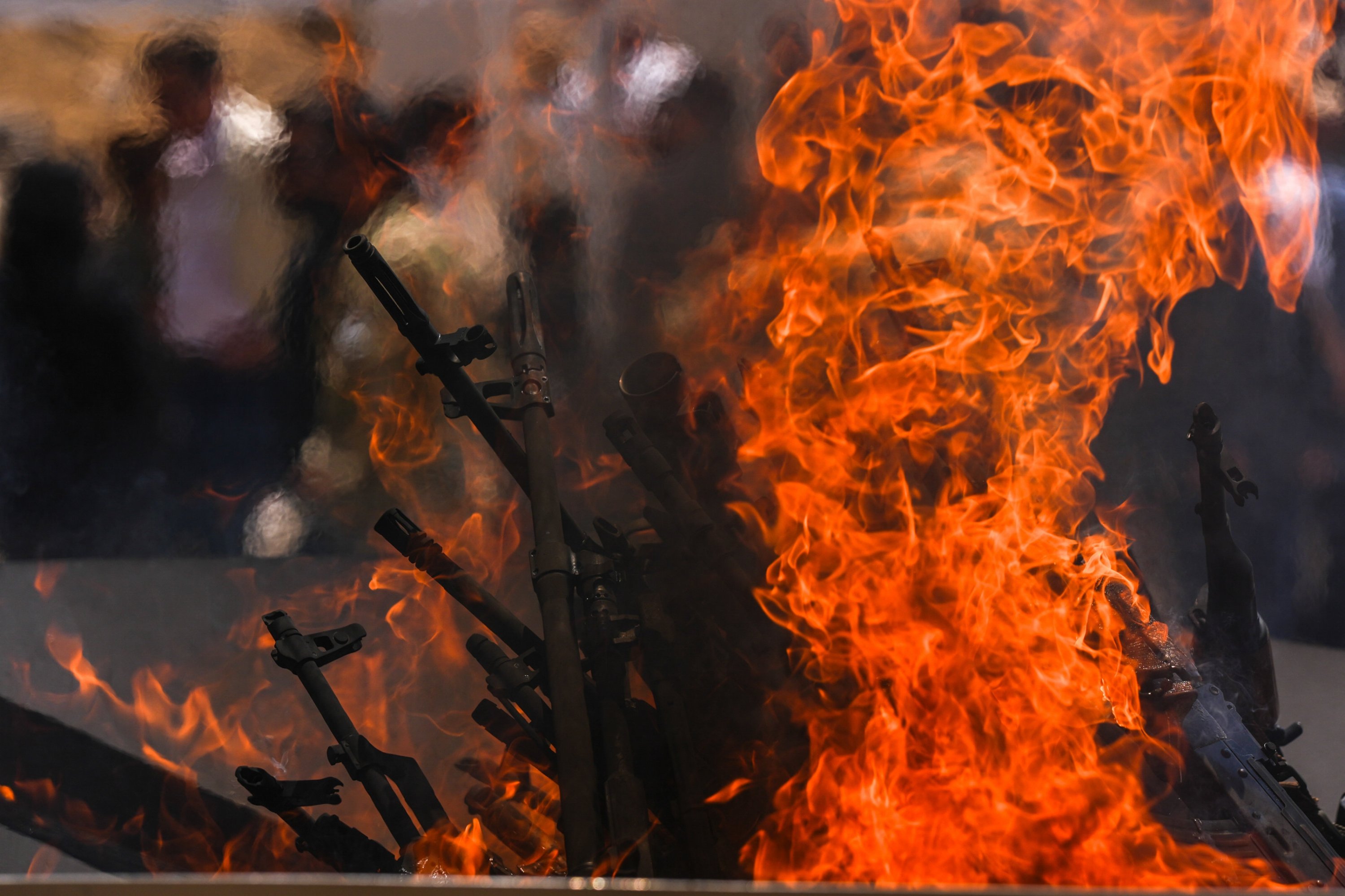
PKK terrorists began laying down their arms at a ceremony in northern Iraq on Friday, two months after the terrorist group ended its violent campaign against the Turkish state.
The move comes in response to a historic call by jailed PKK founder Abdullah Öcalan in February, urging them to end their decadeslong attacks.
The PKK has long exploited the Kurdish community in Türkiye, brainwashing Kurdish youth to join it to conduct terrorist attacks for "Kurdistan."
Here are five key dates in the history of Öcalan and the PKK, whose violence left more than 40,000 dead in Türkiye:
With Marxist-Leninist roots, the PKK was formed in 1978 by Ankara University students, with the ultimate goal of forming a separatist Kurdish state in southeastern Türkiye. They chose Öcalan, a political science student, as leader.
A Turkish military coup in 1980 forced the PKK and its leader to flee to Syria and Lebanon. The group then took up arms against the state in 1984. Its members trained in Lebanon's Beqaa Valley, east of Beirut, while attacking Turkish military posts and convoys.
The group’s attacks intensified in the 1990s, showing no discrimination between security forces and civilians.
Türkiye hit back, in response to which the terrorist group upped its terrorist attacks, especially in the Kurdish-majority southeast, that left the region in a state of near-civil war.
Öcalan was forced to leave Syria in 1998 after Ankara threatened Damascus over its backing for the PKK, with the terrorist leader fleeing between several European states.
He was eventually arrested in Kenya on Feb. 15, 1999, flown back to Türkiye and sentenced to death.
There, he was placed in solitary confinement on the Imralı prison island, off the coast of Istanbul.
In 2002, his sentence was commuted to life imprisonment when Türkiye started the process of abolishing the death penalty as part of reforms backed by the European Union.
Öcalan urged the PKK to lay down their arms in a letter on March 21, 2013, as part of talks with the government of then-Prime Minister Recep Tayyip Erdoğan, who is now president.
Türkiye's National Intelligence Organization (MIT) had also held talks with the PKK in Oslo.
But the truce collapsed in July 2015 after the PKK’s deadly bomb attack in Suruç, a town near the Syrian border.
Türkiye struck PKK targets in Iraq and led a vast military offensive at home. The PKK responded with what they called "urban warfare."
There were fierce daily battles in the southeast, including in the city of Diyarbakır.
Efforts for peace deteriorated after a failed 2016 coup.
Türkiye also deployed troops in northern Syria to protect its frontier.
After a decade of status quo marked by occasional attacks, a hardliner ally of Erdoğan extended Öcalan an olive branch, urging him to renounce violence in a shock move backed by the Turkish leader.
Indirect talks facilitated by the pro-PKK Peoples' Equality and Democracy Party (DEM Party) began, and on Feb. 27, Öcalan made a historic call, urging his PKK to disband and his terrorists to lay down their weapons.