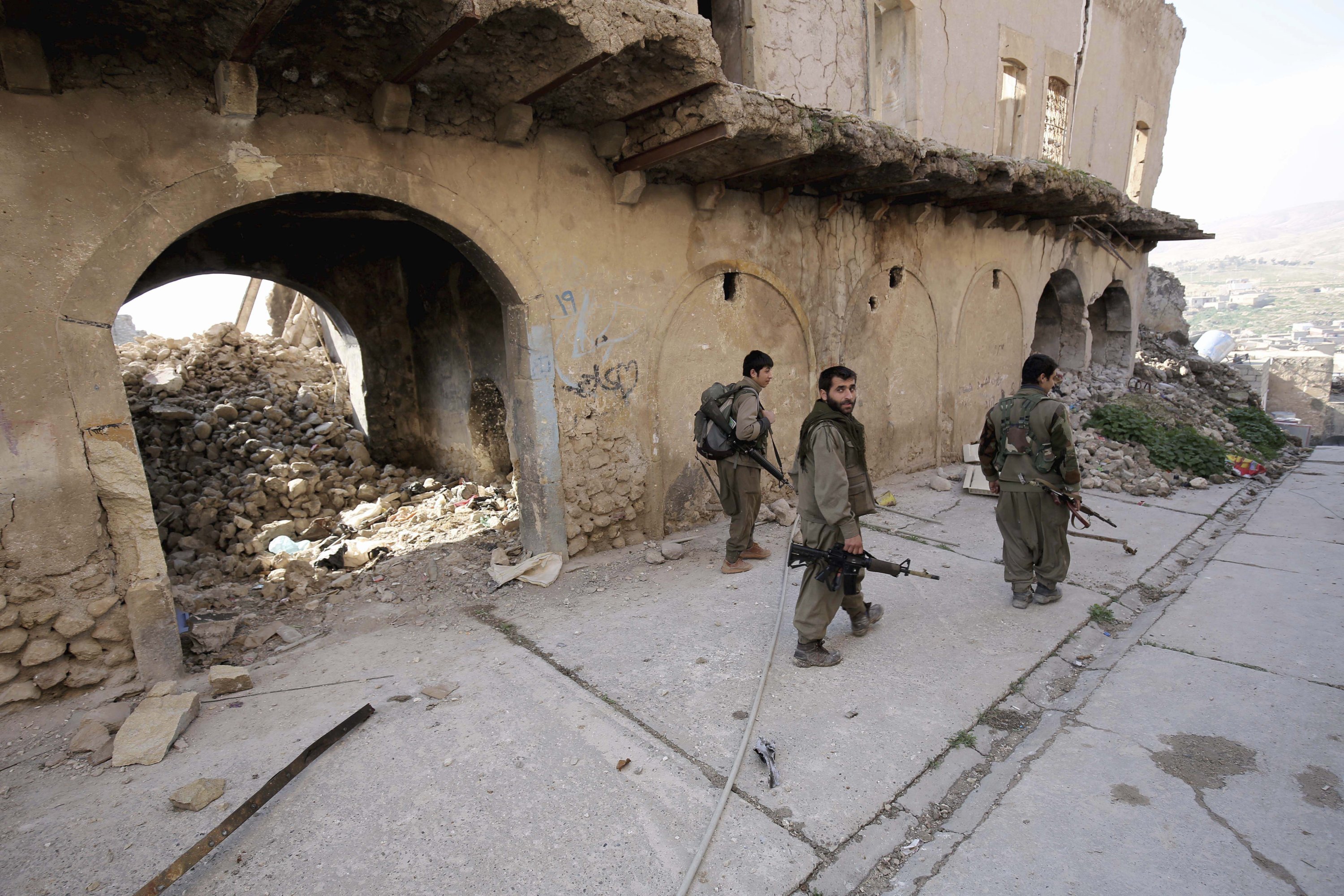
Barely two months after YPG, the Syrian wing of the terrorist group PKK, announced dissolution following integration into Syrian security forces, another part of the PKK apparently follows the example. Sinjar Resistance Units or YBS, an offshoot of the group active in the eponymous Iraqi region, will disarm and integrate into the Iraqi army under the supervision of Prime Minister Ali al-Zaidi, an Iraqi official said Monday.
Sabah al-Numan, military spokesman for the Iraqi prime minister, said procedures to reorganize military ties between the group and Iraqi security forces would be carried out on Monday, according to a statement carried by the Iraqi News Agency. He said members of the group would be integrated into Iraqi security institutions. The move would also transfer security responsibility for Sinjar Mountain to the relevant federal government authorities, al-Numan said. He added that the step was part of the Iraqi government's policy to bring all weapons under state control. The implementation would mark the beginning of a new phase in security arrangements in the Sinjar district, he said. Al-Numan also noted that the Iraqi Constitution prohibits the formation of armed groups outside the country's official armed forces.
The PKK announced its disarmament and dissolution last year following the launch of the terror-free Türkiye initiative in 2024. The initiative was proposed by the leader of the Nationalist Movement Party (MHP) Devlet Bahçeli, a government ally. Both Bahçeli and President Recep Tayyip Erdoğan repeatedly said that the initiative was part of the ambition of a "terror-free region," that is, eliminating terror threats not just for Türkiye but also for regional countries, such as Syria.
YBS was originally founded in 2007 but rose to prominence as a force claiming to fight against Daesh, which launched an offensive to capture Sinjar in 2014.
Iraq is coordinating closely with Türkiye to remove the PKK terrorist group from its territory, a government spokesperson said last week, pledging that Iraqi soil would never be used to threaten neighboring countries. Iraqi government spokesperson Haider Abboudi told the country's official INA news agency that Baghdad was maintaining high-level coordination with Ankara to resolve the PKK issue and ensure the terrorist group's removal from Iraq. Abboudi stressed that Iraq would not allow its territory to serve as a base for threats against neighboring states.
On Oct. 12, Turkish security sources said the PKK had evacuated four accommodation areas in Metina, a region in northern Iraq, as a process aimed at the group’s full disarmament continued. The statements confirmed remarks by a senior PKK figure who claimed the group had left tunnels in Metina on Oct. 8. Sources said the Hebat, Yajk, Sabri and Sason shelter areas in Metina’s Baze region were evacuated on Oct. 8, while Turkish media outlets broadcast footage showing PKK members leaving the areas, which served as terrorist hideouts. The footage showed empty tunnels and members of the group walking away with their belongings. Earlier, Murat Karayılan, a senior PKK figure, said in an interview that the group had completed its withdrawal from Metina to demonstrate that it posed no threat to Türkiye. Karayılan also claimed that the PKK had ordered its clandestine units in major cities, including Istanbul, to withdraw. Security sources said the shelter areas had posed a security risk to Türkiye and described the PKK’s withdrawal as decisive progress in the process.
The sources described the move as an indication that the process was continuing, saying efforts under the initiative were aimed at strengthening regional stability and reinforcing Turkish-Kurdish fraternity.
Following the termination of the PKK’s activities in all areas, members of the group who return to Türkiye under prospective legal arrangements are expected to undergo a social integration process. Comprehensive programs in areas including education and the economy are also planned to facilitate their reintegration into society. The sources said the broader process aims to establish lasting domestic peace in Türkiye and enable all segments of society to live together in peace and security. They added that steps taken under the initiative were intended to strengthen regional stability and social cohesion.
Bahçeli, who has long taken a hard-line stance against the PKK and previously called for the execution of its jailed ringleader, Abdullah Öcalan, argued that the group’s dissolution would serve Turkish-Kurdish unity amid growing threats to Türkiye’s security and existence. Öcalan responded to Bahçeli’s call by instructing the PKK to lay down its arms. The group complied in 2025, beginning to destroy its weapons at a ceremony in northern Iraq in a symbolic move. Since then, Turkish intelligence has been monitoring progress toward full disarmament. Meanwhile, the Turkish Parliament passed legislation in August providing for the deferral of sentences and prosecution for PKK members who were not involved in deadly terrorist acts.