Justice Minister Akın Gürlek said Türkiye is not considering a general amnesty for terrorism convicts following the PKK’s dissolution, stressing that any legal steps under the country’s “terror-free Türkiye” initiative will not amount to impunity.
In remarks to Hürriyet released Friday, Gürlek said potential legislative changes linked to the new phase of the initiative would be shaped by Parliament and carried out transparently, in line with the rule of law and public sensitivities.
The comments come as a parliamentary commission approved a report setting out a road map for legal reforms alongside the disbandment of the PKK terror group. The commission voted overwhelmingly on Wednesday to approve the report, advancing the terror-free process designed to end decades of PKK terrorism.
“Let me be clear: Any possible regulation will not turn into a general amnesty,” Gürlek said. “Such measures will not mean a lack of punishment. The scope will be determined by the Turkish Parliament.”
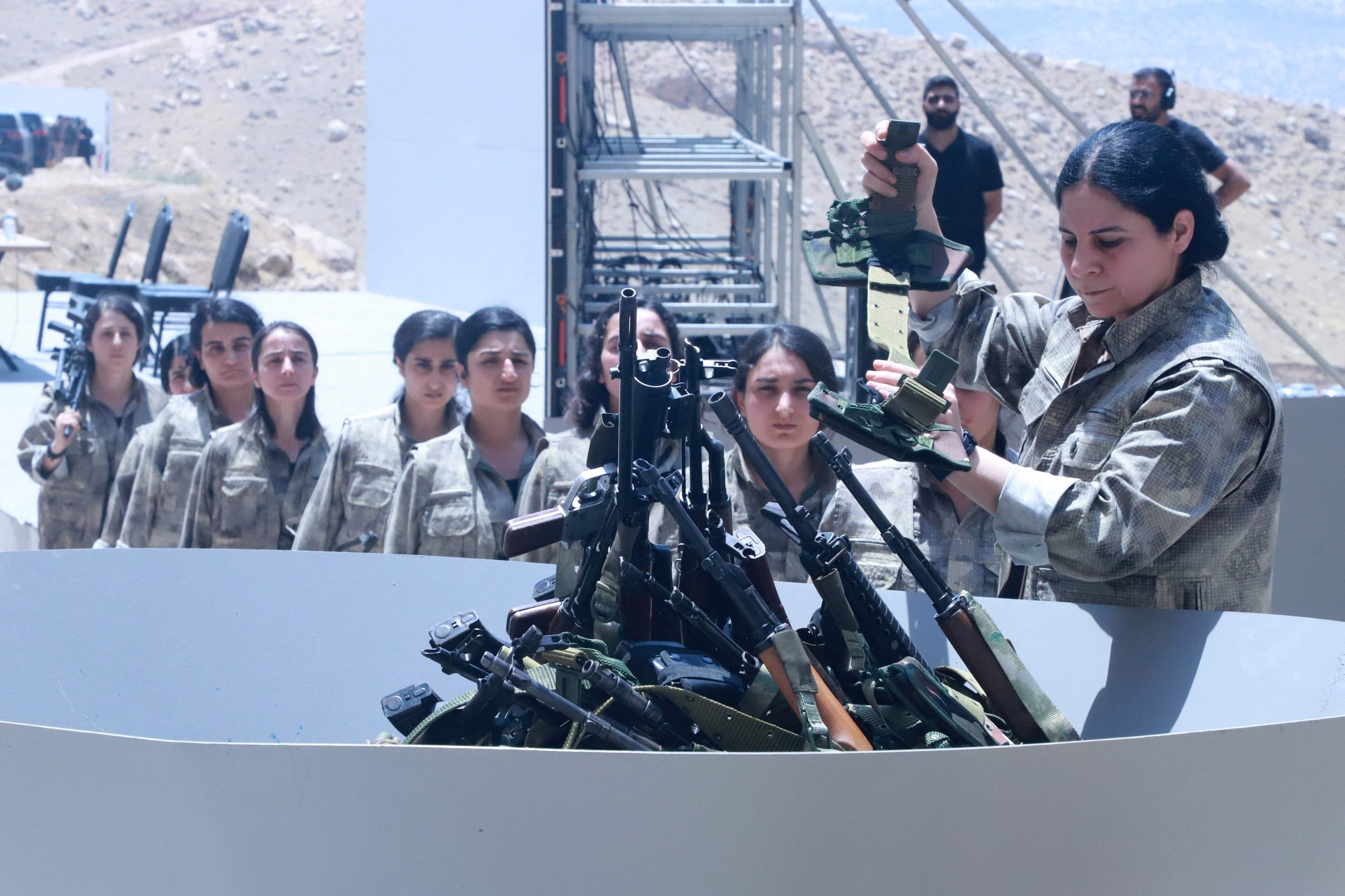
The PKK, designated a terrorist organization by Türkiye, the U.S. and the EU, halted attacks last year and said in May it had decided to dissolve itself in response to a February 2025 call by its imprisoned ringleader, Abdullah Öcalan, to end its decades-long attacks.
The parliamentary vote shifts the process to the legislative theater as Ankara advances efforts to end PKK terrorism that began in 1984 and killed more than 40,000 people, sowing discord at home and spreading violence across borders into Iraq and Syria.
A prominent issue in the process has been legislation concerning the integration of former PKK members into society.
Under current Turkish law, most prison sentences allow conditional release after a set period. However, Gürlek noted that different rules apply to terrorism-related convictions, particularly aggravated life sentences.
Those whose death sentences were previously commuted to aggravated life imprisonment, or who were convicted of terrorism and received the same penalty, are not eligible for conditional release under existing legislation.
“There is currently no such thing as a ‘right to hope’ for these cases in our legal system,” Gürlek said, referring to discussions about whether long-term prisoners should have a possibility of release after decades, namely Öcalan.
Ankara has repeatedly ruled out any “right to hope” for Öcalan or other terrorists as “nonnegotiable” and incompatible with the objective of a terror-free Türkiye.
Any change on that issue, Gürlek added, would be at the discretion of lawmakers and would be designed around societal needs rather than individual cases.
Officials have repeatedly emphasized that the terror-free Türkiye initiative is intended to eliminate the security threat while preserving justice for victims and preventing any perception of blanket forgiveness for violent crimes.
Government officials say the initiative builds on years of counterterrorism operations that significantly weakened the PKK’s operational capacity inside Türkiye and across its borders.
Parliamentary work has also focused on legal and institutional preparations for the post-disbandment phase, including frameworks for disarmament monitoring, preventing recruitment and ensuring that any transition process does not undermine public security.
Authorities describe the approach as balancing reconciliation opportunities with strict legal accountability, aiming to prevent the re-emergence of terrorist structures while supporting long-term social stability.
While discussions continue on issues such as long-term sentencing frameworks and prison regulations, Gürlek reiterated that the guiding principle will remain accountability.
“This is not about individuals,” he said. “Any step must be shaped by society’s needs and by the goal of ensuring that the process does not suffer harm.”
Officials say further legislative proposals tied to the terror-free Türkiye road map are expected to be debated in Parliament in the coming months.
Gürlek also outlined a separate legal proposal that would allow courts to restrict lawyer-client meetings in prisons in terrorism and organized crime cases under specific conditions.
“No right is unlimited,” he said. If a concrete and serious security risk emerges, such as evidence that meetings are being used to transmit organizational instructions or destroy evidence, courts could impose temporary procedural measures based on judicial decisions.
He said the aim was not to eliminate the right to defense but to prevent abuse.
“While detainees benefit from the presumption of innocence, the legal system cannot ignore situations where lawyer contacts become part of an organizational chain,” Gürlek said.
According to the minister, any restriction would require a judge’s order and concrete findings, and would be limited in duration. He noted that rulings by the European Court of Human Rights recognize that narrowly tailored restrictions in terrorism cases can be lawful when supported by evidence.