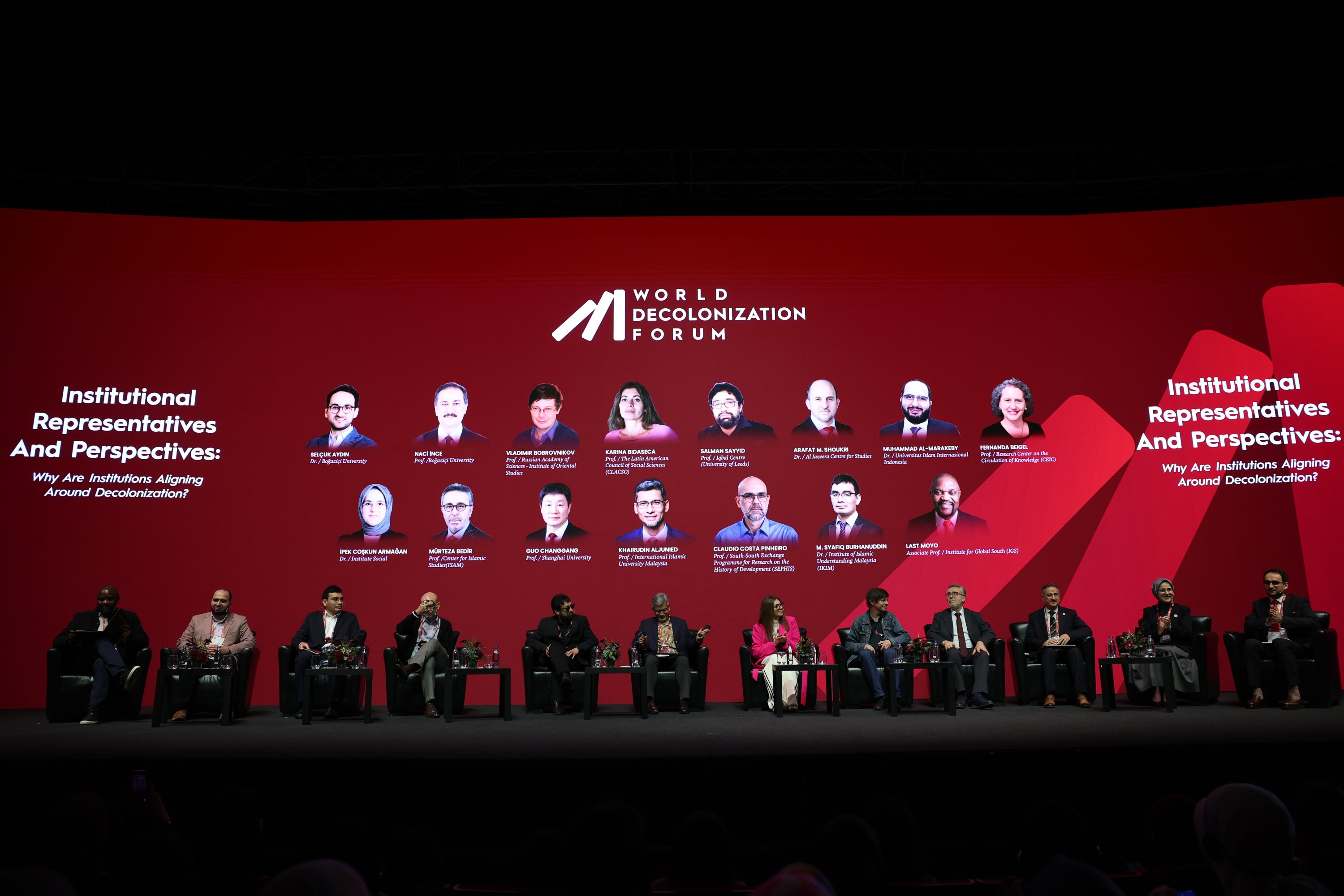
International scholars and experts scrutinized the impact of colonization and decolonization efforts as the World Decolonization Forum opened in Istanbul Monday.
The forum, organized by Institute Social, continued with a session entitled "Why Are Institutions Aligning Around Decolonization?" after a keynote speech by Dr. Esra Albayrak, chair of the NÛN Foundation for Education and Culture and a member of the forum’s scientific committee.
Participants discussed how to break free from Western-centric concepts of knowledge, the role of universities and other institutions in knowledge as part of the decolonization process.
Professor Mürteza Bedir, from the Centre for Islamic Studies (ISAM), told the session that the Encyclopedia of Islam published by Türkiye’s Presidency of Religious Affairs was a reflection of a “more local viewpoint to knowledge generated on Islam.”
Professor Naci Inci, the rector of Boğaziçi University, said discussing decolonization was not merely confronting the past but also rethinking the university of the future.
Institute Social's Dr. Ipek Coşkun Armağan told the session that they needed to focus on decolonizing the concepts and this should be the first stage of decolonization.
“The case of Palestine moves decolonization debates beyond a historical matter, calling for a rethinking of pressing global issues such as sovereignty, self-determination, displacement, and structural violence.” Mireille Fanon Mendes-France, chairperson of the Frantz Fanon Foundation, told a session entitled The Reason for Unreason.
"The concept of decolonization is gaining ground; yet the real question is whether we can genuinely transform the intellectual frameworks through which we make sense of the world," said Salman Sayyid, a professor of Decolonial Thought and Rhetoric at the University of Leeds.
“A decolonized university is one that can view knowledge production as a public value, and that can open space for different intellectual traditions, disciplines and epistemologies. Such a transformation can only be conceived alongside a broader process of decolonization in culture and society,” he added.
“Colonialism hasn’t disappeared. It has transformed its instruments of control, spreading into cultural, intellectual, military and political domains. We live in a world that colonialism built, a world where many of us, both in the Global South and the Global North, are left out. And the starting point is simple: questioning the ideas and assumptions we’ve been taught to take for granted,” Syed Farid Alatas, Professor of Sociology & Anthropology at the National University of Singapore, told the plenary session entitled The Problem of Knowledge Production: Decolonizing Methodologies.