Daily Sabah logo

Politics
Diplomacy Legislation War On Terror EU Affairs Elections News Analysis
TÜRKİYE
Istanbul Education Investigations Minorities Expat Corner Diaspora
World
Mid-East Europe Americas Asia Pacific Africa Syrian Crisis Islamophobia
Business
Automotive Economy Energy Finance Tourism Tech Defense Transportation News Analysis
Lifestyle
Health Environment Travel Food Fashion Science Religion History Feature Expat Corner
Arts
Cinema Music Events Portrait Reviews Performing Arts
Sports
Football Basketball Motorsports Tennis
Opinion
Columns Op-Ed Reader's Corner Editorial
PHOTO GALLERY
JOBS ABOUT US RSS PRIVACY CONTACT US
© Turkuvaz Haberleşme ve Yayıncılık 2025

Daily Sabah - Latest & Breaking News from Turkey | Istanbul

  • Politics
    • Diplomacy
    • Legislation
    • War On Terror
    • EU Affairs
    • Elections
    • News Analysis
  • TÜRKİYE
    • Istanbul
    • Education
    • Investigations
    • Minorities
    • Expat Corner
    • Diaspora
  • World
    • Mid-East
    • Europe
    • Americas
    • Asia Pacific
    • Africa
    • Syrian Crisis
    • Islamophobia
  • Business
    • Automotive
    • Economy
    • Energy
    • Finance
    • Tourism
    • Tech
    • Defense
    • Transportation
    • News Analysis
  • Lifestyle
    • Health
    • Environment
    • Travel
    • Food
    • Fashion
    • Science
    • Religion
    • History
    • Feature
    • Expat Corner
  • Arts
    • Cinema
    • Music
    • Events
    • Portrait
    • Reviews
    • Performing Arts
  • Sports
    • Football
    • Basketball
    • Motorsports
    • Tennis
  • Gallery
  • Opinion
    • Columns
    • Op-Ed
    • Reader's Corner
    • Editorial
  • TV

Dinosaur ancestors looked like crocodiles, new study reveals

by

LONDON Apr 13, 2017 - 12:00 am GMT+3
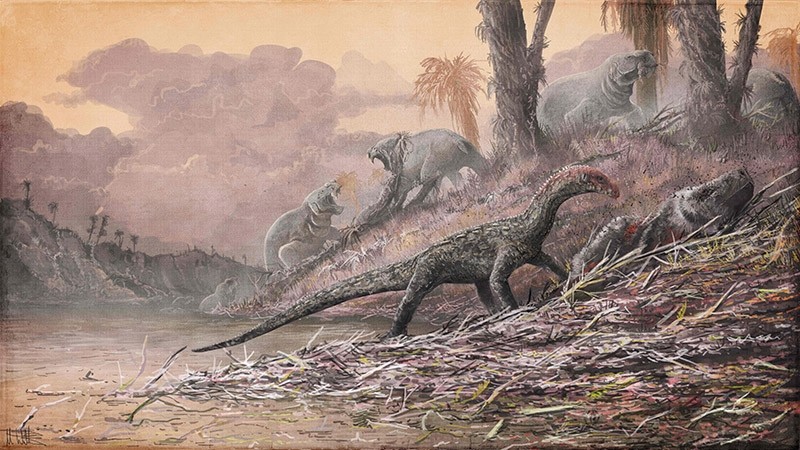
This handout picture released on April 13, 2017 by the Nature publishing group shows a life reconstruction of Teleocrater rhadinus feasting on a deep relative of mammals, Cynognathus. (AFP Photo)
by Apr 13, 2017 12:00 am

Fossils discovered in Tanzania in the 1930s have helped identify a "missing link" in dinosaur evolution that reveals their ancestors had long necks, walked on four legs and looked like crocodiles.

The 245-million-year-old fossils held in Britain's Natural History Museum were studied by paleontologist Alan Charig in the 1950s.

But they were incomplete and it was only more fossils found in Tanzania in 2015 that helped build up the skeleton of "Teleocrator rhadinus".

"The finding forces a rethink of early dinosaur evolution," the journal Nature, where the research was published on Wednesday, said in a summary.

"The discovery of such an important new species is a once-in-a-lifetime experience," said Sterling Nesbitt, one of the authors and an assistant professor of geosciences at Virginia Tech in the US.

The international research project focuses on the evolution of a large group of reptiles called archosaurs into two branches: crocodiles and birds.

Dinosaurs evolved from the bird branch but the scientists found Teleocrators, which were already extinct by the time dinosaurs appeared, kept crocodile features and did not conform to a classic conception of early forms of dinosaur.

"Teleocrator has unexpectedly crocodile-like features that are causing us to completely reassess what we thought about the earliest stages of dinosaur evolution," said Ken Angielczyk, another author who is the associate curator of fossil mammals at the Field Museum of Natural History in Chicago.

"Surprisingly, early dinosaur relatives were pretty profoundly not dinosaur-like," he said.

"Scientists generally don't love the term 'missing link' but that's kind of what Teleocrater is: a missing link between dinosaurs and the common ancestor they share with crocodiles," he said.

Paul Barrett at the Natural History Museum said: "My colleague Alan Charig would have been thrilled to see one of 'his' animals finally being named and occupying such an interesting position in the Tree of Life.

"Our discovery shows the value of maintaining and re-assessing historical collections: many new discoveries, like this one, can be made by looking through museum collections with fresh eyes," he said.


  • shortlink copied
  • Last Update: Apr 13, 2017 3:30 pm
    KEYWORDS
    life
    The Daily Sabah Newsletter
    Keep up to date with what’s happening in Turkey, it’s region and the world.
    You can unsubscribe at any time. By signing up you are agreeing to our Terms of Use and Privacy Policy. This site is protected by reCAPTCHA and the Google Privacy Policy and Terms of Service apply.
    No Image
    In photos: More than 60 years of Castros' rule in Cuba ends
    PHOTOGALLERY
    • POLITICS
    • Diplomacy
    • Legislation
    • War On Terror
    • EU Affairs
    • News Analysis
    • TÜRKİYE
    • Istanbul
    • Education
    • Investigations
    • Minorities
    • Diaspora
    • World
    • Mid-East
    • Europe
    • Americas
    • Asia Pacific
    • Africa
    • Syrian Crisis
    • İslamophobia
    • Business
    • Automotive
    • Economy
    • Energy
    • Finance
    • Tourism
    • Tech
    • Defense
    • Transportation
    • News Analysis
    • Lifestyle
    • Health
    • Environment
    • Travel
    • Food
    • Fashion
    • Science
    • Religion
    • History
    • Feature
    • Expat Corner
    • Arts
    • Cinema
    • Music
    • Events
    • Portrait
    • Performing Arts
    • Reviews
    • Sports
    • Football
    • Basketball
    • Motorsports
    • Tennis
    • Opinion
    • Columns
    • Op-Ed
    • Reader's Corner
    • Editorial
    • Photo gallery
    • DS TV
    • Jobs
    • privacy
    • about us
    • contact us
    • RSS
    © Turkuvaz Haberleşme ve Yayıncılık 2021