Daily Sabah logo

Politics
Diplomacy Legislation War On Terror EU Affairs Elections News Analysis
TÜRKİYE
Istanbul Education Investigations Minorities Expat Corner Diaspora
World
Mid-East Europe Americas Asia Pacific Africa Syrian Crisis Islamophobia
Business
Automotive Economy Energy Finance Tourism Tech Defense Transportation News Analysis
Lifestyle
Health Environment Travel Food Fashion Science Religion History Feature Expat Corner
Arts
Cinema Music Events Portrait Reviews Performing Arts
Sports
Football Basketball Motorsports Tennis
Opinion
Columns Op-Ed Reader's Corner Editorial
PHOTO GALLERY
JOBS ABOUT US RSS PRIVACY CONTACT US
© Turkuvaz Haberleşme ve Yayıncılık 2025

Daily Sabah - Latest & Breaking News from Turkey | Istanbul

  • Politics
    • Diplomacy
    • Legislation
    • War On Terror
    • EU Affairs
    • Elections
    • News Analysis
  • TÜRKİYE
    • Istanbul
    • Education
    • Investigations
    • Minorities
    • Expat Corner
    • Diaspora
  • World
    • Mid-East
    • Europe
    • Americas
    • Asia Pacific
    • Africa
    • Syrian Crisis
    • Islamophobia
  • Business
    • Automotive
    • Economy
    • Energy
    • Finance
    • Tourism
    • Tech
    • Defense
    • Transportation
    • News Analysis
  • Lifestyle
    • Health
    • Environment
    • Travel
    • Food
    • Fashion
    • Science
    • Religion
    • History
    • Feature
    • Expat Corner
  • Arts
    • Cinema
    • Music
    • Events
    • Portrait
    • Reviews
    • Performing Arts
  • Sports
    • Football
    • Basketball
    • Motorsports
    • Tennis
  • Gallery
  • Opinion
    • Columns
    • Op-Ed
    • Reader's Corner
    • Editorial
  • TV

China launches relay satellite to explore moon's dark side

by Associated Press

BEIJING May 21, 2018 - 12:00 am GMT+3
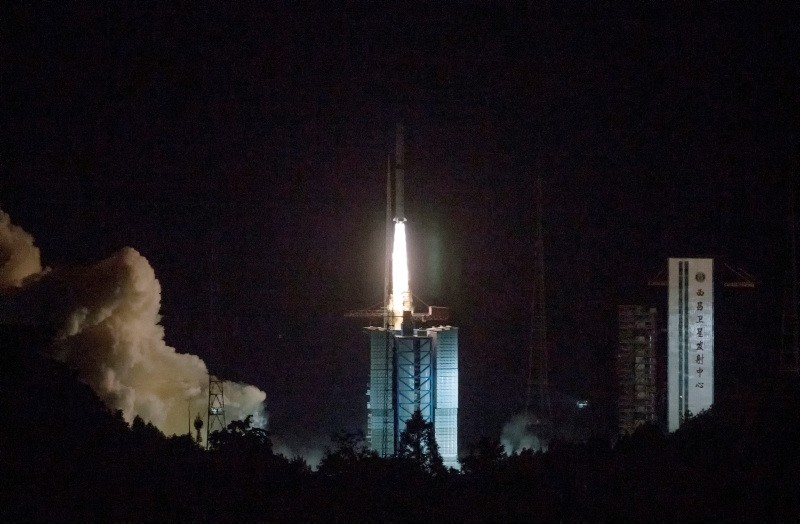
In this photo provided by China's official Xinhua News Agency, a Long March-4C rocket carrying a relay satellite, named Queqiao (Magpie Bridge), is launched from southwest China's Xichang Satellite Launch Center, Monday, May 21, 2018 (AP Photo)
by Associated Press May 21, 2018 12:00 am

China launched a relay satellite on Monday as part of a groundbreaking program to be the first to land a spacecraft on the far side of the moon later this year.

The satellite, lofted into space aboard a Long March-4C rocket, will facilitate communication between controllers on Earth and the Chang'e 4 mission, the China National Space Administration said on its website.

China hopes to become the first country to soft-land a probe on the moon's far side, also known as the dark side because it faces away from Earth and is comparatively unknown.

The satellite, named Queqiao, or "Magpie Bridge," after an ancient Chinese folk tale, was launched from the Xichang Satellite Launch Center in the southwestern province of Sichuan, the Space Administration said.

The launch is a "key step," but the satellite's mission must still overcome challenges including making multiple adjustments to its orbit, "braking" near the moon and using lunar gravity to its advantage, project manager Zhang Lihua was quoted as saying by the official Xinhua News Agency.

According to the administration and website space.com, Queqiao was expected to arrive shortly at the Earth-moon Lagrange point 2, a gravitationally stable spot located 64,000 kilometers (40,000 miles) beyond the far side of the moon.

Without such a communications relay link, spacecraft on the far side would have to "send their signals through the moon's rocky bulk," space.com said.

China previously landed its Jade Rabbit rover on the moon and plans to land its Chang'e 5 probe there next year and have it return to Earth with samples — the first time that has been done since 1976.

China conducted its first crewed space mission in 2003, making it only the third country after Russia and the U.S. to do so and has put a pair of space stations into orbit.

Upcoming missions include the launch of the 20-ton core module for the still orbiting Tiangong 2 station, along with specialized components for a 60-ton station that is due to come online in 2022 and a Mars rover planned for the mid 2020s.

However, the failure of China's Long March 5 rocket last year was seen as dealing a rare setback to the highly successful space program, delaying some missions and offering rival India a chance to move ahead in the space rankings.


  • shortlink copied
  • Last Update: May 21, 2018 11:54 am
    KEYWORDS
    life
    The Daily Sabah Newsletter
    Keep up to date with what’s happening in Turkey, it’s region and the world.
    You can unsubscribe at any time. By signing up you are agreeing to our Terms of Use and Privacy Policy. This site is protected by reCAPTCHA and the Google Privacy Policy and Terms of Service apply.
    No Image
    New front in Ethiopian war displaces thousands
    PHOTOGALLERY
    • POLITICS
    • Diplomacy
    • Legislation
    • War On Terror
    • EU Affairs
    • News Analysis
    • TÜRKİYE
    • Istanbul
    • Education
    • Investigations
    • Minorities
    • Diaspora
    • World
    • Mid-East
    • Europe
    • Americas
    • Asia Pacific
    • Africa
    • Syrian Crisis
    • İslamophobia
    • Business
    • Automotive
    • Economy
    • Energy
    • Finance
    • Tourism
    • Tech
    • Defense
    • Transportation
    • News Analysis
    • Lifestyle
    • Health
    • Environment
    • Travel
    • Food
    • Fashion
    • Science
    • Religion
    • History
    • Feature
    • Expat Corner
    • Arts
    • Cinema
    • Music
    • Events
    • Portrait
    • Performing Arts
    • Reviews
    • Sports
    • Football
    • Basketball
    • Motorsports
    • Tennis
    • Opinion
    • Columns
    • Op-Ed
    • Reader's Corner
    • Editorial
    • Photo gallery
    • DS TV
    • Jobs
    • privacy
    • about us
    • contact us
    • RSS
    © Turkuvaz Haberleşme ve Yayıncılık 2021