Daily Sabah logo

Politics
Diplomacy Legislation War On Terror EU Affairs Elections News Analysis
TÜRKİYE
Istanbul Education Investigations Minorities Expat Corner Diaspora
World
Mid-East Europe Americas Asia Pacific Africa Syrian Crisis Islamophobia
Business
Automotive Economy Energy Finance Tourism Tech Defense Transportation News Analysis
Lifestyle
Health Environment Travel Food Fashion Science Religion History Feature Expat Corner
Arts
Cinema Music Events Portrait Reviews Performing Arts
Sports
Football Basketball Motorsports Tennis
Opinion
Columns Op-Ed Reader's Corner Editorial
PHOTO GALLERY
JOBS ABOUT US RSS PRIVACY CONTACT US
© Turkuvaz Haberleşme ve Yayıncılık 2025

Daily Sabah - Latest & Breaking News from Turkey | Istanbul

  • Politics
    • Diplomacy
    • Legislation
    • War On Terror
    • EU Affairs
    • Elections
    • News Analysis
  • TÜRKİYE
    • Istanbul
    • Education
    • Investigations
    • Minorities
    • Expat Corner
    • Diaspora
  • World
    • Mid-East
    • Europe
    • Americas
    • Asia Pacific
    • Africa
    • Syrian Crisis
    • Islamophobia
  • Business
    • Automotive
    • Economy
    • Energy
    • Finance
    • Tourism
    • Tech
    • Defense
    • Transportation
    • News Analysis
  • Lifestyle
    • Health
    • Environment
    • Travel
    • Food
    • Fashion
    • Science
    • Religion
    • History
    • Feature
    • Expat Corner
  • Arts
    • Cinema
    • Music
    • Events
    • Portrait
    • Reviews
    • Performing Arts
  • Sports
    • Football
    • Basketball
    • Motorsports
    • Tennis
  • Gallery
  • Opinion
    • Columns
    • Op-Ed
    • Reader's Corner
    • Editorial
  • TV

Possibility of life: Scientists map Saturn's moon Titan

by

WASHINGTON Nov 19, 2019 - 12:59 pm GMT+3
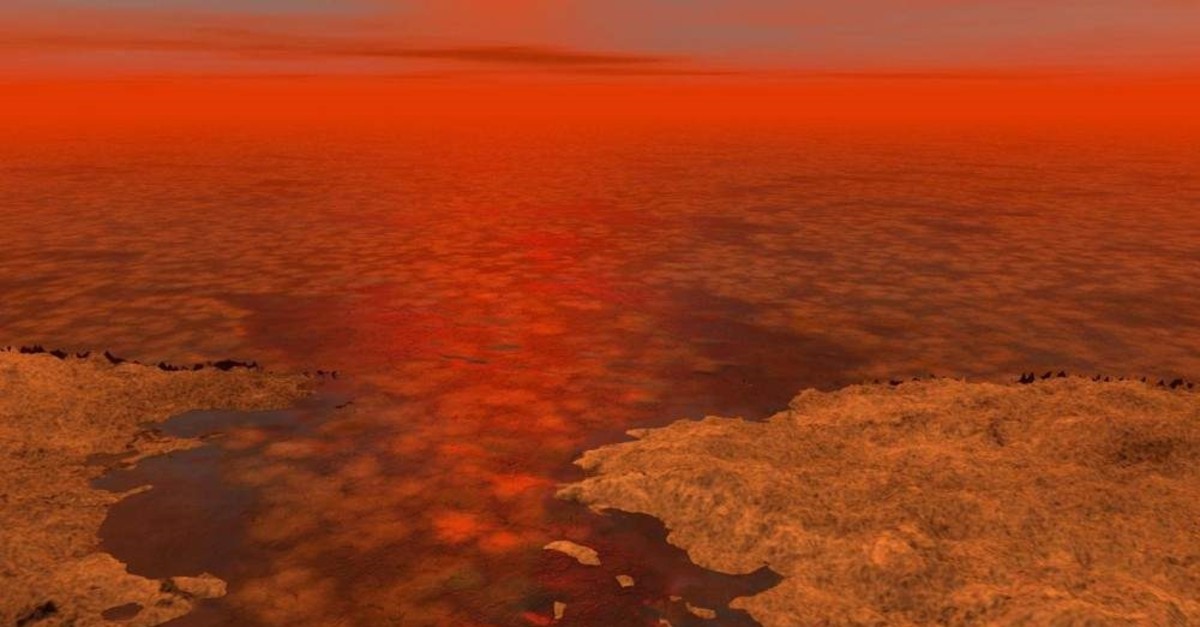
An artist's concept envisions what hydrocarbon ice forming on a liquid hydrocarbon sea on Saturn's moon Titan might look like. (REUTERS Photo)
by Nov 19, 2019 12:59 pm
Scientists on Monday unveiled the first global geological map of Saturn's moon Titan, including vast plains, dunes of frozen organic material and lakes of liquid methane, illuminating an exotic world considered a strong candidate in the search for life beyond Earth.
The map was based on radar, infrared and other data collected by NASA's Cassini spacecraft, which studied Saturn and its moons between 2004 and 2017. Titan, with a diameter of 5,150 kilometers, is the solar system's second-largest moon behind Jupiter's Ganymede. It is larger than the planet Mercury.
Organic material – carbon-based compounds critical for fostering living organisms – play a leading role on Titan.

"Organics are very important for the possibility of life on Titan, which many of us think likely would have evolved in the liquid water ocean under Titan's icy crust," said planetary geologist Rosaly Lopes of NASA's Jet Propulsion Laboratory in California. "Organic materials can, we think, penetrate down to the liquid water ocean, and this can provide nutrients necessary for life if it evolved there," added Lopes, who led the research published in the journal Nature Astronomy.
On Earth, water rains down from clouds and fills rivers, lakes and oceans. On Titan, clouds spew hydrocarbons like methane and ethane – gases also found on Earth – in liquid form due to the moon's frigid climate. Rainfall occurs everywhere on Titan, but the equatorial regions are drier than the poles, said study co-author Anezina Solomonidou, a European Space Agency research fellow. Plains covering 65% of the surface and dunes covering 17% of the surface made up of frozen bits of methane and other hydrocarbons dominate Titan's midlatitudes and equatorial regions, respectively.
Titan is the only other place in the solar system other than Earth boasting stable liquids on its surface, with lakes and seas full of methane major features in its polar regions. Hilly and mountainous areas, thought to represent exposed portions of Titan's crust of water ice, make up 14% of the surface.
About the author
Research Associate at Center for Islam and Global Affairs (CIGA) at Istanbul Sabahattin Zaim University
  • shortlink copied
  • Last Update: Dec 20, 2019 1:47 am
    KEYWORDS
    life
    The Daily Sabah Newsletter
    Keep up to date with what’s happening in Turkey, it’s region and the world.
    You can unsubscribe at any time. By signing up you are agreeing to our Terms of Use and Privacy Policy. This site is protected by reCAPTCHA and the Google Privacy Policy and Terms of Service apply.

    No Image
    World's 10 most expensive cities for expats in 2021
    PHOTOGALLERY
    • POLITICS
    • Diplomacy
    • Legislation
    • War On Terror
    • EU Affairs
    • News Analysis
    • TÜRKİYE
    • Istanbul
    • Education
    • Investigations
    • Minorities
    • Diaspora
    • World
    • Mid-East
    • Europe
    • Americas
    • Asia Pacific
    • Africa
    • Syrian Crisis
    • İslamophobia
    • Business
    • Automotive
    • Economy
    • Energy
    • Finance
    • Tourism
    • Tech
    • Defense
    • Transportation
    • News Analysis
    • Lifestyle
    • Health
    • Environment
    • Travel
    • Food
    • Fashion
    • Science
    • Religion
    • History
    • Feature
    • Expat Corner
    • Arts
    • Cinema
    • Music
    • Events
    • Portrait
    • Performing Arts
    • Reviews
    • Sports
    • Football
    • Basketball
    • Motorsports
    • Tennis
    • Opinion
    • Columns
    • Op-Ed
    • Reader's Corner
    • Editorial
    • Photo gallery
    • DS TV
    • Jobs
    • privacy
    • about us
    • contact us
    • RSS
    © Turkuvaz Haberleşme ve Yayıncılık 2021