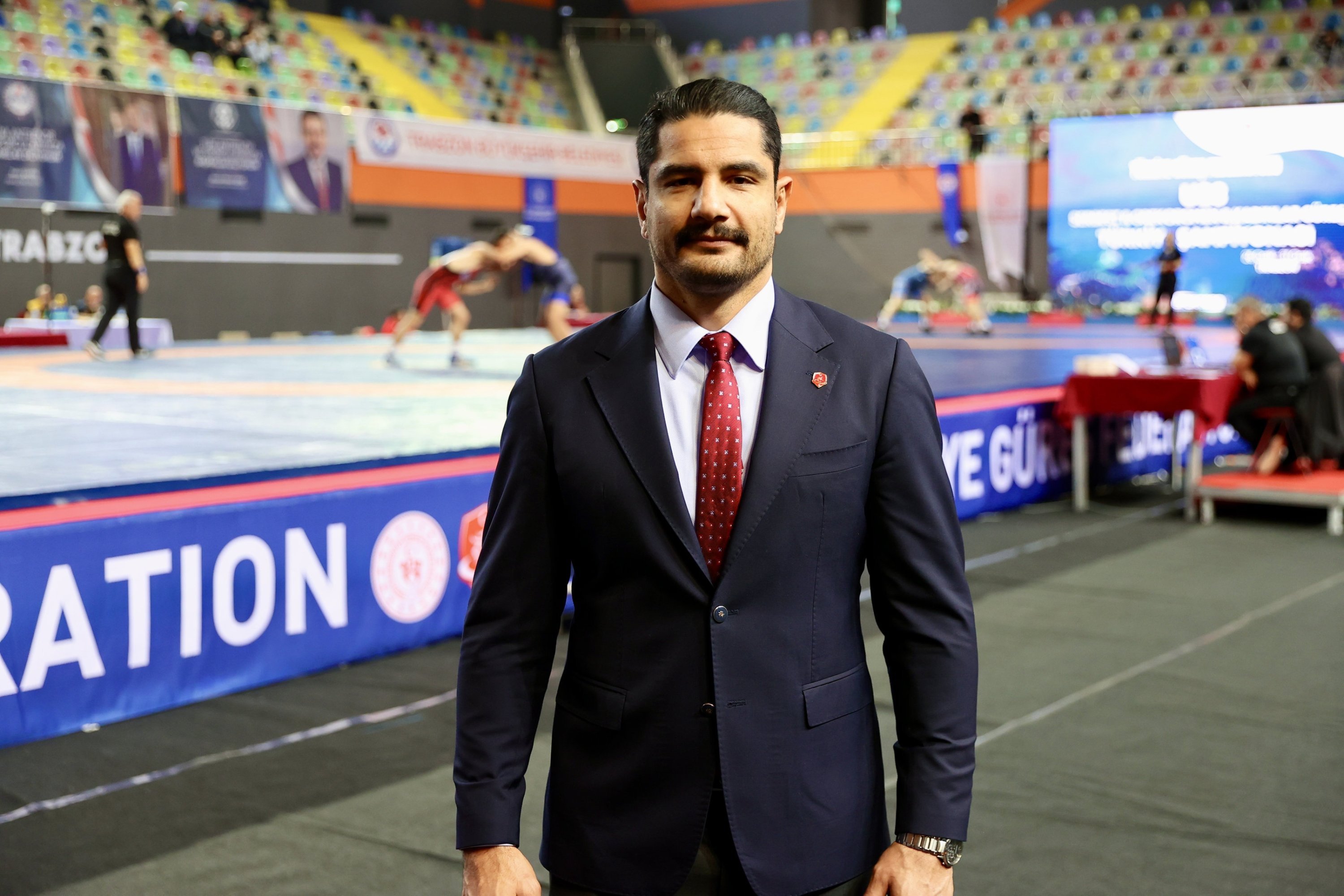
Turkish Wrestling Federation President Taha Akgül says Turkish wrestling is entering a new era built on youth development, long-term planning and a reimagined national championship he hopes will feel more like a festival than a tournament.
Speaking to Anadolu Agency (AA) during the Under-23 Turkish Wrestling Championships in Trabzon, Akgül outlined sweeping changes since taking office, from lowering the licensing age to reshaping how the sport identifies and nurtures talent.
One of his first moves was reducing the minimum licensing age from 12 to 8, a shift aimed at introducing children to competitive wrestling earlier. Last year marked a milestone, with 10-year-olds competing for the first time, followed by national championships for ages 11 through 14.
“We ran competitions on 10 mats and welcomed 6,300 children,” Akgül said. “That was a historic step for us.”
Talented young wrestlers identified during those events were invited to development camps at the federation’s Ankara facilities, which were reserved exclusively for them for two months.
Akgül said the number of camps will increase next year as part of a broader push to expand the base of the sport.
That vision extends to the senior national stage. The Turkish Championships, which Akgül calls the backbone of domestic wrestling, are set to grow significantly.
The June edition is expected to attract around 10,000 athletes and will be branded as the “2nd Grand Wrestling Festival.”
“For us, this isn’t just a championship,” he said. “It’s a wrestling-loving festival. We want to make it bigger, more inclusive and more inspiring.”
Akgül revealed that the federation committed 50% of its government-allocated budget to grassroots development last year, a figure he described as exceptional by international standards.
“About 190 to 200 million lira went directly to infrastructure and youth programs,” he said. “30% went to senior athletes and 20% to facilities and camps. Normally, if you spend 15-20% on grassroots, it’s considered enough. We went far beyond that, and we plan to increase it.”
He stressed that the investment reflects a deliberate long-term strategy rather than short-term results.
“Our ultimate target is the Olympics,” Akgül said. “We trust our current athletes for 2028, but the master plan is 2032 and beyond. We’re not trying to save the day, we’re drawing the big picture.”
That picture, he added, is one where Turkish wrestling consistently contends for three or four Olympic gold medals, a goal he believes requires years of preparation.
“You don’t just decide to win Olympic gold two or three years out. This work has to start today,” he said.
Akgül also emphasized the importance of educating coaches alongside athletes. The federation plans to send trainers to international tournaments and educational programs, while also bringing top-level coaches to Türkiye.
At the same time, a centralized training program will be developed and distributed nationwide, ensuring consistency in athlete development and allowing the federation to closely monitor progress.
“This has to be done with a common mind,” Akgül said. “We’ll provide the program, and we’ll follow it.”
Despite wrestling’s historic success, accounting for 30 of Türkiye’s 41 Olympic gold medals and 70 of its 100 total Olympic medals, Akgül said sponsorship support remains limited.
“Unfortunately, we don’t receive the backing we deserve from the private sector,” he said, calling in particular for greater involvement from banks, especially state-owned institutions.
“They support clubs and other sports like volleyball, which is great, but they shouldn’t forget wrestling,” Akgül said. “This is our ancestral sport, a culture, a tradition, an art.”
Rather than seeking funding for the federation itself, Akgül made a direct appeal for support at the grassroots level.
“Our call is simple,” he said. “Support our children. Even individual sponsorships for young athletes and clubs would make a huge difference.”