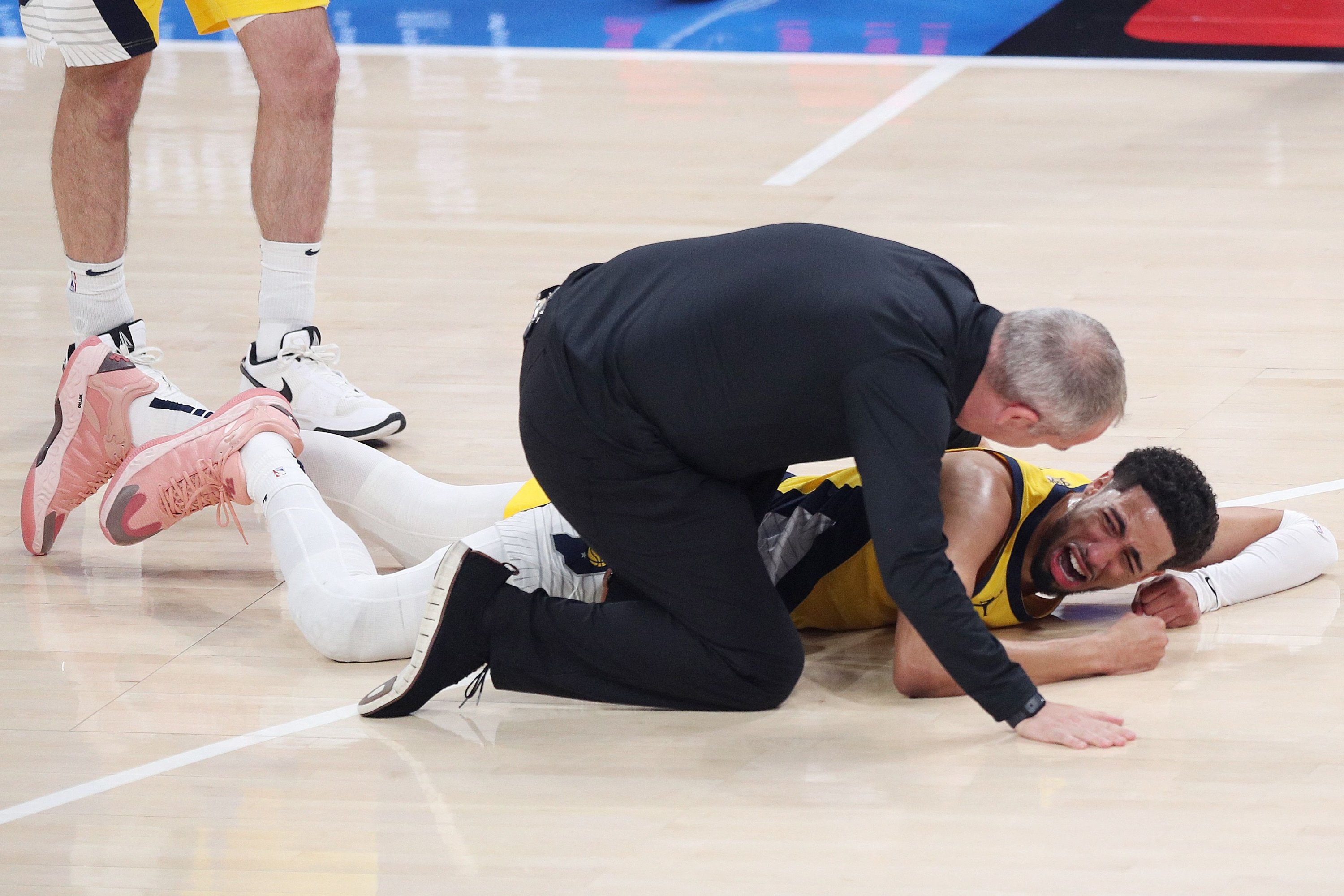
The Indiana Pacers won’t rush Tyrese Haliburton back to the court next season as the All-Star guard recovers from a torn right Achilles tendon suffered in Game 7 of the NBA Finals.
Pacers president of basketball operations Kevin Pritchard made it clear Monday that Haliburton will miss the entire 2025-26 season, saying at a news conference, “He will be back better than ever ... but we’re not going to jeopardize that now. Don’t get your hopes up that he’ll play.”
Haliburton underwent surgery June 23 at New York’s Hospital for Special Surgery, the team confirmed.
His postseason heroics – highlighted by buzzer-beaters, jaw-dropping plays and historic stat lines – captivated fans, though the Pacers ultimately fell 103-91 to the Oklahoma City Thunder in the Finals.
Haliburton recently wrote on social media: “And honestly, right now, torn Achilles and all, I don’t regret it. I’d do it again, and again after that, to fight for this city and my brothers. For the chance to do something special.”
Pritchard told reporters Monday that Haliburton’s mentality “just shows you what kind of kid he is.”
“If you’re asking me, would I have him do it over and over? I would not. I would not,” Pritchard said. “If I knew that he was going to get hurt, I would sacrifice that game because I care for the kid so much and want him to have an incredible career.”
Pritchard also told reporters it was a surprise to lose Myles Turner in free agency to Milwaukee. Turner agreed to a four-year deal to join the Bucks, who waived All-Star Damian Lillard to make the acquisition happen.
Turner spent his first 10 seasons with the Pacers.
“I know this, that Herb Simon and Steven Rales and the Simon family were fully prepared to go deep into the tax to keep him,” Pritchard said. “We really wanted to do that, and we were negotiating in good faith. But what happens in this league is sometimes you’re negotiating, but because a guy is unrestricted, he has the right to say, ‘That’s the offer I want. I’m going to take it and that’s best for my family.’”
“Again, we were in good-faith negotiations. It was a little surprising how Milwaukee created that. We always say in our conference room, there are cap teams that have cap space, and there are shadow teams that have cap space. ... It becomes very challenging by buying out or making trades – and hat tip to Milwaukee for doing that.”