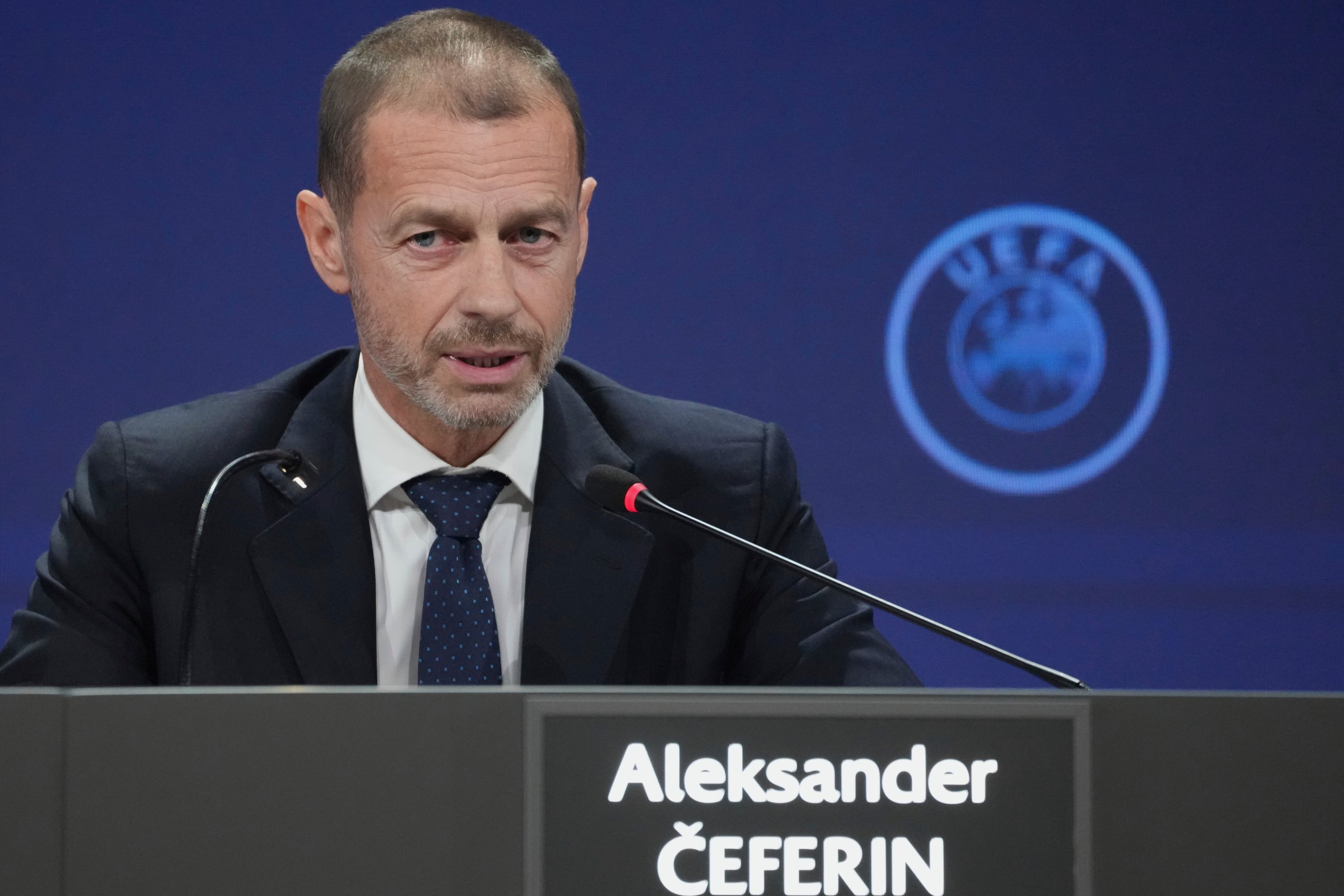
UEFA President Aleksander Ceferin is facing growing resistance after criticizing the expanded 48-team FIFA World Cup, describing parts of the tournament as lacking appeal and questioning the competitive value of some matches.
His remarks, made amid the ongoing 2026 edition in North America, have triggered a rare coordinated response from 13 national football federations.
The 2026 World Cup, jointly hosted by the United States, Mexico and Canada, is the first to feature 48 teams, up from 32, a shift approved by FIFA in 2017 to broaden global representation and create more pathways for emerging football nations.
The expanded format includes 12 groups of four, a Round of 32, and a total of 104 matches, significantly extending the tournament and increasing participation across continents long underrepresented at the elite level.
Ceferin’s reported comments, delivered during a conference in Slovenia, suggested the enlarged format had produced a high volume of “uninteresting” games.
While he acknowledged the value of global participation, his framing was widely interpreted as dismissive of newer and lower-ranked nations competing on football’s biggest stage. UEFA has not formally expanded on the remarks, but the reaction from outside Europe was swift.
A joint statement issued on June 14 brought together the football associations of Cabo Verde, Curaçao, Uzbekistan, DRC, Haiti, Algeria, Tunisia, Morocco, Egypt, Ghana, Senegal, Ivory Coast and South Africa.
The federations said they were deeply disappointed and stressed that every qualified nation earns its place through merit, regardless of ranking or history.
The statement underscored that World Cup qualification represents years of effort and, for several nations, historic breakthroughs.
Cabo Verde, Curaçao and Uzbekistan were highlighted as first-time qualifiers, with Curaçao among the smallest countries ever to reach the tournament and Uzbekistan marking a milestone for Central Asian football. DR Congo and Haiti also represent long-awaited returns to the global stage.
It also emphasized a broader point about the tournament’s identity, arguing that the World Cup’s strength lies in its diversity, bringing together different football cultures, histories and pathways.
The federations insisted that no match involving qualified teams should be dismissed as irrelevant, particularly at a competition built on global inclusion.
The dispute highlights a widening divide in football’s leadership over the direction of the World Cup.
UEFA has traditionally favored a more compact elite competition, while FIFA continues to push expansion as a means of widening access and accelerating development beyond traditional power centers.